
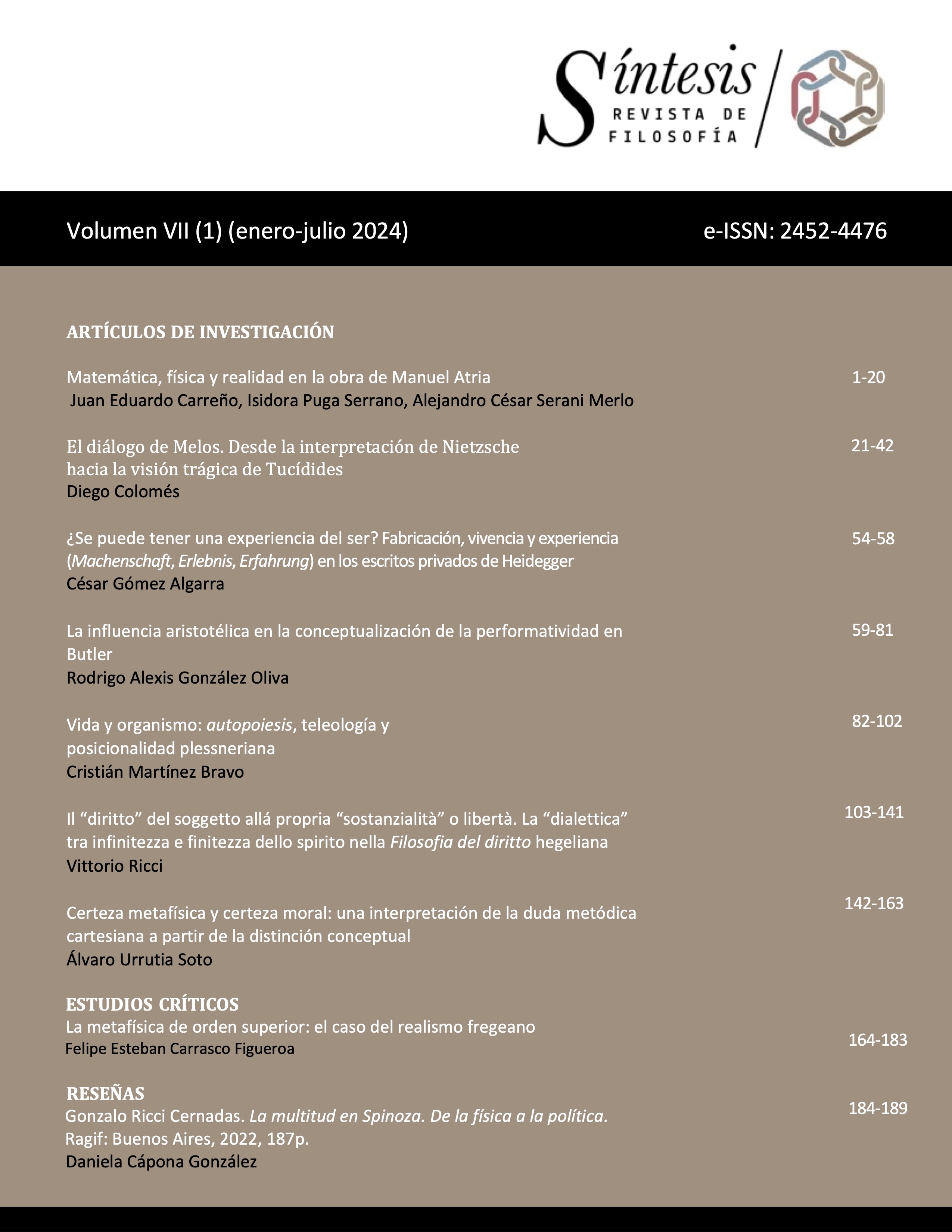
Subject's Right to its own 'Substantiality' or Freedom. The 'Dialectic' between the Infinity and Finiteness of the Spirit in Hegel's Philosophy of Right
DOI:
https://doi.org/10.15691/0718-5448Vol7Iss1a447Keywords:
Hegel, Fichte, Will, Freedom, IdeaAbstract
Even if the present work has a purely critical-reconstructive approach to Hegelian thought in the various phases of his philosophical activity, it intends to show in detail the very close and intrinsic connection between the system and the concept of right both from a phenomenological and epistemic point of view. Since the beginning of Hegel's reflection, a close and repeatedly in-depth dealing with the juridical theme and in particular that of Person has been documented precisely because it represents the foundation of a 'substantialization' of the subject in its objectivity which finds in the will the constitutive moment of its same freedom. Alternatively, the subject would be inexorably relegated to the more or less natural indeterminacy of its own formal subjectivity without true content. At the level of secondary literature, based on what it has been possible to consult, it appears that the analysis has bene focused rather on the separate content of Recht's Hegelian concept and its articulations while the connection with the system has not been made at least sufficiently explicit and seems mantained rather in the background. As just hinted at, Hegel’s philosophy of right is a pivotal element inside his system and his theoretical evolution since his early thinking activity. Its concept is essentially what can be called ‘substance’, namely objectivity concerning the subjective finite subject and determining its real infinity, wherein its will by aspiring to it its will finds its authentic (initial) freedom. The concept of right is necessarily treated both phenomenologically so that the finite spirit experiences this juridical will in the Wirklichkeit of its apparent form, and epistemologically so as to present its true philosophical concept or idea inside the science of the objective spirit.
References
FONTI
Fichte, J. G., Grundlage des Naturrechts nach Principien der Wissenschaftslehre, GA I,3: 301-470.
Fichte, J. G., Versuch einer neuen Darstellung der Wissenschaftslehre, GA I, 4: 177-292.
Hegel, G.W.F., Es sollte eine schwere Aufgabe … (Text : 24), GW 1: 141-153.
Hegel, G.W.F., Differenz des Fichte’schen und Schelling’schen Systems der Philosophie, GW 4: 1-92.
Hegel, G.W.F., Glauben und Wissen, GW 4: 316-413.
Hegel, G.W.F., Jenaer Systementwürfe III. Naturphilosophie und Philosophie des Geistes, GW 8.
Hegel, G.W.F., Phänomenologie des Geistes, GW 9.
Hegel, G.W.F., Geisteslehre - Logik 1808/09, GW 10: 5-60.
Hegel, G.W.F., Philosophische Enyzklopädie (1808-09), GW 10: 61-84.
Hegel, G.W.F., System der besondern Wissenschaften 1810/11, GW 10: 311-365.
Hegel, G.W.F., Schlülerhefte, GW 10: 523-810.
Hegel, G.W.F., Wissenschaft der Logik. Zweiter Band. Die Subjective Logik (1812), GW 12.
Hegel, G.W.F., Grundlinien der Philosophie des Rechts, GW 14,1.
Hegel, G.W.F., Grundlinien der Philosophie des Rechts, W 7.
Hegel, G.W.F., Grundlinien der Philosophie des Rechts (Beilagen), 14,2.
Hegel, G.W.F., Enzyklopädie der Philosophischen Wissenschaften im Grundrisse (1817), GW 13.
Hegel, G.W.F., Enzyklopädie der Philosophischen Wissenschaften im Grundrisse (1827), GW 19.
Hegel, G.W.F., Enzyklopädie der Philosophischen Wissenschaften im Grundrisse (1830), GW 20.
Hegel, G.W.F., ›Zusätze‹ aus Sekundäre Überlieferung. Enzyklopädie der Philosophischen Wissenschaften im Grundrisse. Ditter Teil, GW 25,2: 919-1119.
Hegel, G.W.F., Vorlesungen über die Philospohie des Rechts (1817/18, 1818/19 e 1819/20), GW 26,1.
Hegel, G.W.F., Vorlesungen über die Philospohie des Rechts (1821/22 e 1822/23), GW 26,2.
Hegel, G.W.F., Vorlesungen über die Philospohie des Rechts (1824/25 e 1831), GW 26,3.
Letteratura secondaria
Ahlers, R. 2006, “Der späte Fichte und Hegel über das Absolute und Systematizität”, Fichte Studien 30, pp. 187-200.
Amengual, G. 1989, “La filosofía del derecho de Hegel como filosofía de la libertad”, in G. Amengual (ed.), Estudios sobre la Filosofía del Derecho de He-gel, Madrid, CEC, pp. 11-67. (Apareció originariamente en TAULA, nº 10, UIB, 1988)
Arienzo, A.- Pisano, F.-Testa, S. (a cura di) 2018, La Fenomenologia dello spirito di Hegel. Problemi e interpretazioni, Napoli, FedOA ¬Press.
Asmuth, Ch., 2007 “Negativität. Hegels Lösung der Systemfrage in der Vorrede der Phänomenologie des Geistes”, Synthesis Philosophica 1, pp. 19-32.
Asmuth, Ch., “ ›Das Wesen als Reflexion in ihm selbst‹ – Fichte in Hegels We-senslogik, in M. Wunsch (Hg.): Von Hegel zur philosophischen Anthropologie. Gedenkband für Christa Hackenesch, Würzburg, Königshausen & Neumann, pp. 73-85.
Bourgeois, B. 2006, “Über die Sich-selbst-Gleichheit der Fichteschen Rechts- und Staatslehre”, in Fichte-Studien, pp. 31-47.
Brandt, R. 2009, “Die Freiheit der Reflexion und die Furie des Deduzierens”, in W. Beierwaltes-E. Fuchs (Hg.), Symposion Johann Gottlieb Fichte. Her-kunft und Ausstrahlung seines Denkens, München, C. H. Beck, pp. 7-21.
Garelli, G. 2018, “Cultura e negazione nella Fenomenologia dello spirito di Hegel”, in Arienzo, A.- Pisano, F.-Testa, S. (a cura di) 2018, La Fenomenologia dello spirito di Hegel. Problemi e interpretazioni, Napoli, FedOA -Press, pp. 218-231.
Goddard, J.-C. 2009, “1804-1805. La désubjectivation du transcendantal”, in Ar-chives de Philosophie 3, pp. 423-441.
James, D. 2014, “How “Natural” Is Fichte’s Theory of Natural Right?”, in The Palgrave Handbook of German Idealism, Altman M. C. (ed.), London, Palgrave Macmillan, pp. 344-363.
Kahlo, M. – Wolff, Ernst A. – Zaczyk, R. (Hg.) 1992, Fichtes Lehre vom Rechts-verhältnis
Die Deduktion der §§ 1–4 der „Grundlage des Naturrechts" und ihre Stellung in der Rechtsphilosophie. Frankfurt/M: V. Klostermann.
Kervégan, J.-F. 2020, “Recht und Rechte in Hegels Rechtsphilosophie”, Hegel-Studien, pp. 13-35.
Lewin, M. 2018, “Ist die theoretische Vernunft selbst eine Idee? Fichtes Umgang mit Kantischen Ideen um 1810”, Fichte-Studien 46, pp. 288-307.
Mohr, G. 2001, “Der Begriff der Person bei Kant, Fichte und Hegel”, in D. Sturma (Hg.), Person. Philosophiegeschichte – Theoretische Philosophie – Praktische Philosophie, Paderborn, mentis, pp. 103-141.
Noller, J. 2016, Die Bestimmung des Willens. Zum Problem individueller Freiheit im Ausgang von Kant, Freiburg/München, Herder GmbH (2ª Aufl.)
Radrizzani, I. 2006, “Recht und Natur. Das Naturrecht bei Fichte”, Fichte-Studien 27, pp. 135–55.
Quante, M.-Sandkaulen, B. (Hrsg.) 2020, “Hegels Rechtsphilosophie und das Recht”, Hegel-Studien 53-54.
Sell, A. 1997, “Aspekte des Lebens. Fichtes Wissenschaftslehre von 1804 und Hegels Phänomenologie des Geistes von 1807”, in C. Asmuth (hrsg.), Sein - Reflexion - Freiheit : Aspekte der Philosophie Johann Gottlieb Fichtes, Amsterdam-Philadelphia, Grüner, pp. 79-95.
Siep, L. 2013, “Natur und Freiheit”, in Hindrichs, G.- Honneth, A. (éd.), Freiheit. Stuttgarter Hegel-Kongress 2011, Frankfurt/M., Klostermann (Geist und Geschichte), pp. 55-86.
Vieweg, K. 2012, Das Denken der Freiheit. Hegels Grundlinien der Philosophie des Rechts, Munich, W. Fink.
Downloads
Published
Issue
Section
License
Authors who publish with this journal agree to the following terms:- Authors retain copyright and grant the journal right of first publication with the work simultaneously licensed under a Creative Commons Attribution License that allows the use, transformation, and distribution for any purpose, as long as the author is recognized, and in the event of changes or developements are made from it, the derivate work be shared under the same license.
- Authors are able to enter into separate, additional contractual arrangements for the non-exclusive distribution of the journal's published version of the work (e.g., post it to an institutional repository or publish it in a book).
- Authors are permitted and encouraged to post their work online (e.g., in institutional repositories or on their website) prior to and during the submission process, as it can lead to productive exchanges, as well as earlier and greater citation of published work (See The Effect of Open Access).