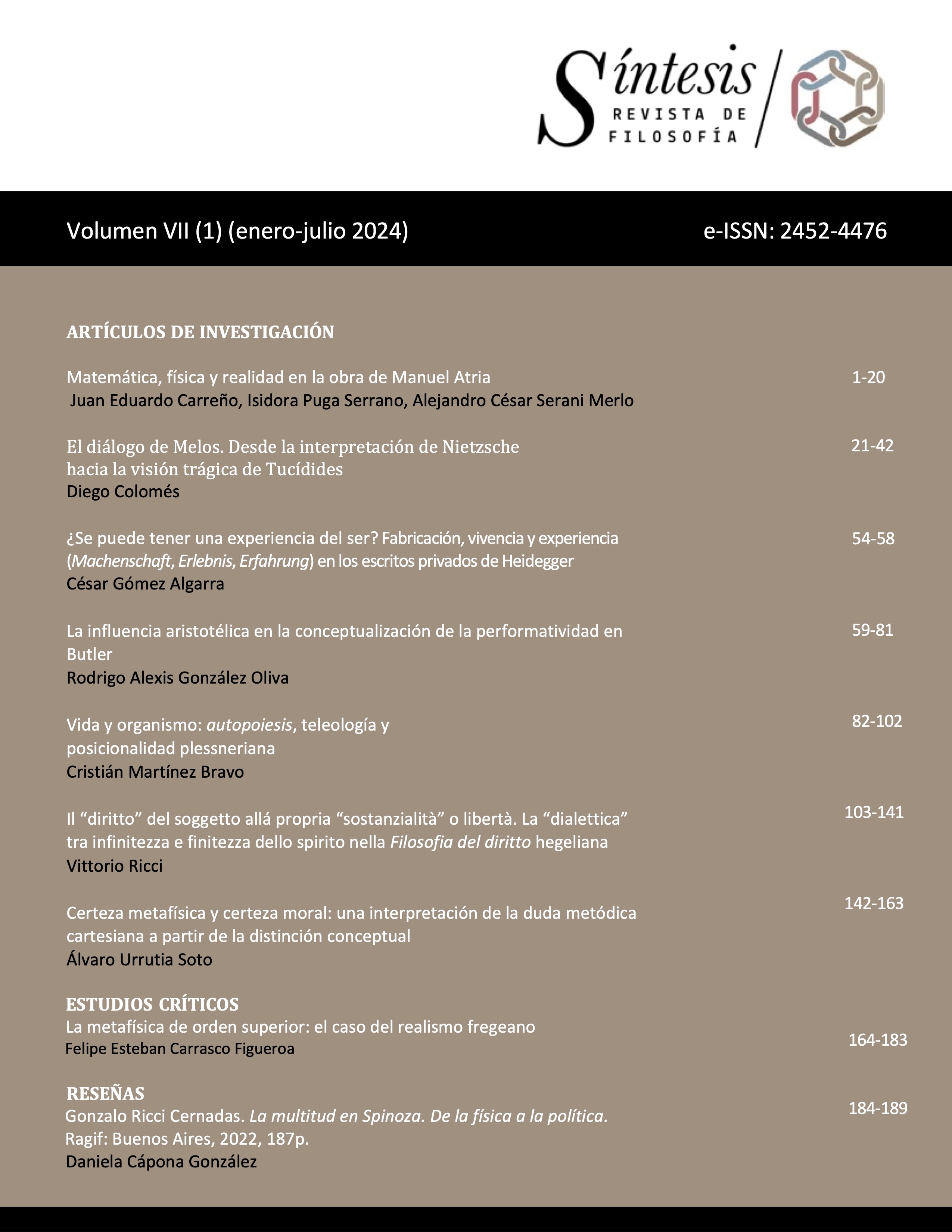
The Melian Dialogue. From Nietzsche's Interpretation to Thucydides' Tragic Vision
DOI:
https://doi.org/10.15691/0718-5448Vol7Iss1a443Keywords:
Thucydides, Nietzsche, Melian dialogue, Pelo-ponnesian War, TragedyAbstract
This work analyses the famous and “terrible” dialogue that Thucydides presents in his History of the Peloponnesian War between the Athenians and the Melians and seeks to highlight elements that would show a tragic vision of history and human affairs on the part of its author. For this purpose, Nietzsche's interpretation of this dialogue, specifically in paragraphs 92 and 93 of Human, all too Human I, is used as a heuristic element. According to the interpretation of the text, it is suggested that Nietzsche's interpretation is, at least, incomplete and in order to affirm this a scheme of analysis has been used with two planes: that of the particular-visible and that of the general-invisible. The dialectic between these planes, which expands in the dialogue itself between what it concretely says and what it leaves silent, would reveal to what extent Nietzsche's analysis focuses only on one of them, while the other, as a complement to the first, would reveal the broader vision of the author of the dialogue himself as a tragic vision.
References
Alsina, José. (1981). Tucídides. Historia, ética y política. Ediciones Rialp, Madrid.
Bailly, Anatole. (2000). Dictionnaire Grec-Français: Le Grand Bailly. Hachette, Vanves Cedex.
Canfora, Luciano (ed.). (1991). Il dialogo dei melii e degli ateniesi. Marsilio Edi-tori, Venezia. Texto bilingüe griego-italiano.
Calonge Ruiz, Julio. (1990). “Introducción”. En Tucídides, Historia de la guerra del Peloponeso. Libros I-II. Gredos, Madrid, pp. 7-106.
Gerhardt, Volker. (1996). Vom Willen zur Macht: Anthropologie und Metaphysik der Macht am exemplarischen Fall Friedrich Nietzsches. Walter de Gruyter, Berlin-New York.
Gómez-Lobo, Alfonso. (1991). “El diálogo de Melos y la visión histórica de Tu-cídides”. Revista Estudios Públicos, n. 44, pp. 247-273.
Jaeger, Werner. (2006). Paideia: los ideales de la cultura griega. FCE, México.
Nietzsche, F. (2007). Humano, demasiado humano I. Akal, Madrid.
__________. (2010). Crepúsculo de los ídolos. Alianza, Madrid.
Spinoza. (2013). Tratado político. Alianza, Madrid.
Steiner, George. (2012). La muerte de la tragedia. Siruela-FCE, España-México.
Torretti, Roberto (ed.). (2017). Por la razón o la fuerza (5.84-116). Ediciones Tácticas, Santiago de Chile. Bilingüe griego-español.
Tucídides. (1990). Historia de la guerra del Peloponeso. Libros I-II. Gredos, Madrid. Traducción de Juan José Torres Esbarranch. Introducción general de Julio Calonge Ruiz.
Tucídides. (2015). Historia de la guerra del Peloponeso. Libros V-VI. Gredos, Madrid. Traducción de Juan José Torres Esbarranch.
Downloads
Published
Issue
Section
License
Authors who publish with this journal agree to the following terms:- Authors retain copyright and grant the journal right of first publication with the work simultaneously licensed under a Creative Commons Attribution License that allows the use, transformation, and distribution for any purpose, as long as the author is recognized, and in the event of changes or developements are made from it, the derivate work be shared under the same license.
- Authors are able to enter into separate, additional contractual arrangements for the non-exclusive distribution of the journal's published version of the work (e.g., post it to an institutional repository or publish it in a book).
- Authors are permitted and encouraged to post their work online (e.g., in institutional repositories or on their website) prior to and during the submission process, as it can lead to productive exchanges, as well as earlier and greater citation of published work (See The Effect of Open Access).