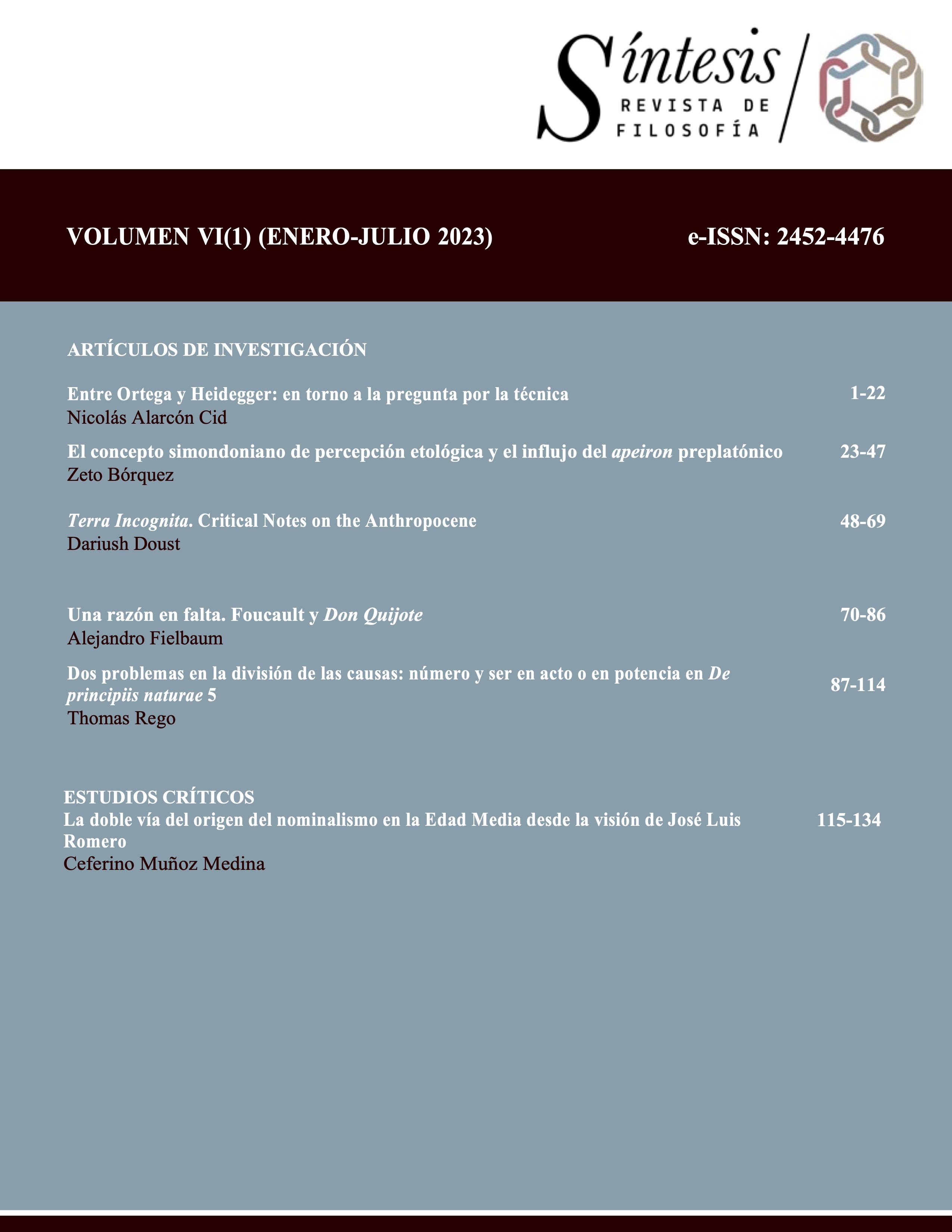
Tow Problems in the Division of Causes: Number and Being in Act or Potency in "De principiis naturae" 5
DOI:
https://doi.org/10.15691/0718-5448Vol6Iss1a417Keywords:
Thomas Aquinas, Division of causes, De principiis naturae, Act and potency, Avicenna.Abstract
The division of causes in Aquinas’ De principiis naturae 5 establishes how the four classical Aristotelian causes may be divided. The text presents several difficulties, the most important of which are the number of divisions and the not-necessary contemporaneity of the being in potency of a cause and its effect. We aim to resolve these difficulties through a detailed analysis of the Latin text, resulting in a complete commentary on the chapter, which is a secondary contribution. Through this analysis, we resolve the main difficulties. First, by discovering a tacit distinction between the divisions of causes as considered in themselves and as known and verbalized by human beings, the number of the divisions is finally seven (four belonging to the being of causes and three to their knowledge). This distinction has a linguistic sign in the expressions ‘item’ and ‘sciendum est quod’. Secondly, the fact that it is not necessary for a cause and its caused to be simultaneously in potency, can be justified in the case of the singular predication if we consider that an architect, once the house is built, is still in potency of rebuilding that same house, if ever it lost the internal causes of its integrity.
References
Fuentes
Avicena. 1961. Sufficientia. En Avicenna opera, canonicos regulares diui Augustini, Venetiis? 1508, unveränderter Nachdruck. Frankfurt am Main: Minerva.
______. 2009. The Physics of the Healing. Ed. J. McGinnis. Provo, Utah: Brigham Young University Press.
Aristóteles. 1960. Aristotelis Opera, ex rec. I. Bekkeri, editio altera cura O. Gigon. Berolini: W. de Gruyter et socios.
Sanctus Thomas Aquinatis. 1976. De principiis naturae, De mixtione elementorum, De ente et essentia. En Opera Omnia, iussu Leonis XIII P.M. edita. Roma: Editori di San Tommaso, tom. 43.
______. 1978. Summa Theologiae, cura Fratrum eiusdem Ordinis. Matriti: B.A.C.
______. 1965. In octo libros Physicorum Aristotelis expositio, cura et studio P. M. Maggiòlo O. P. Taurini-Romae: Marietti.
______. 1996. In quattuor libros sententiarum. En Opera omnia, in indice thomistico cura R. Busa, ed. secunda. Milano-Stuttgart: Friedrich Frommann Verlag - Günther Holzboog KG, vol. 1.
Estudios Complementarios
Bobik, Joseph. 1998. Aquinas on Matter and Form and the Elements: a Translation and Interpretation of the De principiis naturae and the De Mixtione Elementorum of St. Thomas Aquinas. Notre Dame, Ind.: University of Notre Dame Press.
Floucat, Yves. 2003. “De l’image au concept selon saint Thomas d’Aquin.” En Indubitanter ad veritatem. Studies offered to Leo J. Elders SVD in honor of the Golden Jubilee of his Ordination to the Priesthood, 159–171. Budel: Uitgeverij Damon.
Glare, P. D. (ed.) 2016. Oxford Latin Dictionary. Oxford University Press: Oxford.
Houser, Rollen E. 2012. “Avicenna and Aquinas’s De principiis naturae, cc. 1-3.” The Thomist 76: 577-610.
Heinzmann, Richard. 1999. De principiis naturae = Die Prinzipien der Wirk-lichkeit. Übersetzt und kommentiert von R. Heinzmann. Stuttgart: Kohlhammer.
Montagnes, Bernard. 1963. La doctrine de l'analogie de l'être d'après saint Thomas d'Aquin. Louvain: Publications universitaires.
Pauson, John J. 1950. Saint Thomas Aquinas. De principiis naturae, Introd. and critical text by J. J. Pauson. Fribourg (Switzerland)-Louvain: Société Philosophique - Éditions E. Nauwelaerts.
Rego, Thomas. 2006. “Aristóteles, fuente principal del De principiis naturae.” Sapientia 61: 81-110.
______. 2007. “Causas, principios y elementos en el De principiis naturae 3 de santo Tomás de Aquino.” Intus Legere Filosofía 1/1: 11-31.
______. 2008. “Materia, forma y privación en el opúsculo De principiis natu-rae de santo Tomás de Aquino” Sapientia 64: 111-135.
______. 2009. “La preeminencia de la causa final. Estudio sobre el De principiis naturae 4.” Intus Legere Filosofía 3/2: 47-68.
Ruello, Francis. 1974. “La signification du mot ‘nature’ dans le ‘De principiis naturae’ de saint Thomas d’Aquin.” Rivista di Filosofía Neo-Scolastica 66 2/4: 613-625.
Tomás y Ballús, Antonino. 1947. “Aclaración y resumen.” En Santo Tomás de Aquino, Opúsculos filosóficos genuinos, Introd., notas y trad. de A. Tomás y Ballús. Buenos Aires: Poblet.
Torrell, Jean-Pierre. 1993. Initiation à saint Thomas d’Aquin. Sa personne et son œuvre. Paris-Fribourg (Suisse): Éditions du Cerf - Éditions Universitaires Fribourg Suisse.
Turiel, Bienvenido. 2005. “Introducción.” En Tomás de Aquino. Comentario al libro de Aristóteles sobre la generación y la corrupción, Los principios de la naturaleza y otros opúsculos cosmológicos, Introd. y trad. de I. Aguinalde Sáenz y B. Turiel. Pamplona: EUNSA.
Wallace, William A. 1996. The Modeling of Nature: Philosophy of Science and Philosophy of Nature in Synthesis. Washington, D. C.: The Catholic University of America Press.
Weisheipl, James A., 1983. Friar Thomas D’Aquino: His Life, Thought, and Works, with corrigenda and addenda. Washington, D.C.: The Catholic University of America Press.
Downloads
Published
Issue
Section
License
Authors who publish with this journal agree to the following terms:- Authors retain copyright and grant the journal right of first publication with the work simultaneously licensed under a Creative Commons Attribution License that allows the use, transformation, and distribution for any purpose, as long as the author is recognized, and in the event of changes or developements are made from it, the derivate work be shared under the same license.
- Authors are able to enter into separate, additional contractual arrangements for the non-exclusive distribution of the journal's published version of the work (e.g., post it to an institutional repository or publish it in a book).
- Authors are permitted and encouraged to post their work online (e.g., in institutional repositories or on their website) prior to and during the submission process, as it can lead to productive exchanges, as well as earlier and greater citation of published work (See The Effect of Open Access).