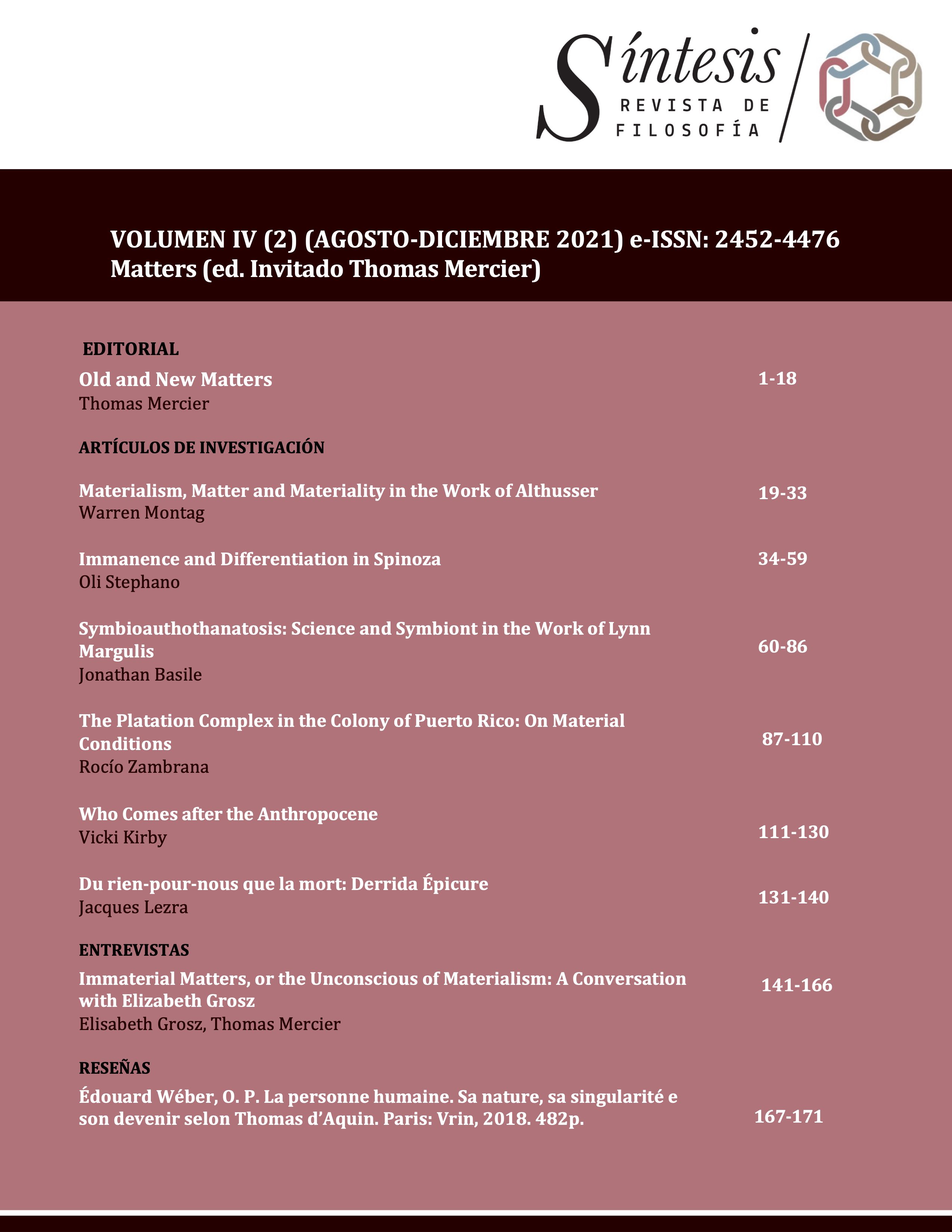
Immanence and Differentiation in Spinoza
DOI:
https://doi.org/10.15691/0718-5448Vol4Iss2a358Keywords:
Substance Monism, Immanent Ontology, Relational Ethics, Ontology of Becoming, DeleuzeAbstract
This paper argues that ontological immanence involves but is not reducible to substance monism. Attending to immanence in Spinoza’s ontology, I provide a creative exegesis of the defining features of Spinoza’s immanent ontology, arguing that it recasts the concept of substance itself, from a term of transcendence and totalization to one of immanence and differentiation. In critical conversation with Deleuze’s influential reading, I identify five interconnected features which, taken together, elaborate Spinoza’s ontology of immanence: substance monism, univocity of attributes, immanent causality, the identification between G-d and Nature, and the status of finite modes as explications of substance rather than its extrinsic effects. I argue that, taken together, these features refashion the concept of substance, such that substance becomes not a term of totalization but rather one of ongoing production of diversity. Attending to the role of finite modes in this ontology, I emphasize the ways in which immanence can lend force to vital reconfigurations of ethical and political life: by defining beings and systems in terms of their capacities, which are augmented, diminished, or maintained depending on how they converge in relation.
References
Aristotle. 2002. Metaphysics. Translated by Joe Sacks. Santa Fe, NM: Green Lion.
Barad, Karen. 2007. Meeting the Universe Halfway: Quantum Physics and the Entanglement of Matter and Meaning. Durham and London: Duke University Press.
Borges, Jorge Luis. 1981. Borges: A Reader. Edited by Emir Rodríguez Monegal and Alastair Read. New York: Dutton.
Coole, Diana, and Samantha Frost, eds. 2010. New Materialisms: Ontology, Agency, and Politics. Durham, NC: Duke University Press.
Deleuze, Gilles. 1988. Spinoza: Practical Philosophy. Translated by Robert Hurley. San Francisco: City Lights.
Deleuze, Gilles. 1992. Expressionism in Philosophy: Spinoza. Translated by Martin Joughin. New York: Zone Books.
Deleuze, Gilles. 1994. Difference and Repetition. Translated by Paul Patton. New York: Columbia University Press.
Deleuze, Gilles and Félix Guattari. 1994. What is Philosophy? Translated by Graham Burchell and Hugh Tomlinson. London: Verso.
Descartes, René. 1985. Philosophical Writings of Descartes, Vol. 1. Translated by John Cottingham, Dugald Murdoch, and Robert Stroothoff. Cambridge, UK: Cambridge University Press.
Dolphijn, Rick and Iris van der Tuin, eds. 2012. New Materialism: Interviews & Cartographies. Ann Arbor, MI: Open Humanities Press.
Friedman, Joel. 1986. “How the Finite Follows from the Infinite in Spinoza’s Metaphysical System.” Synthese 69 (3): 371–407.
Frim, Landon and Harrison Fluss. 2018. “Substance Abuse: Spinoza Contra Deleuze.” Epoché 23 (1): 191–217.
Goff, Philip, ed. 2012. Spinoza on Monism. New York: Palgrave Macmillan.
Grosz, Elizabeth. 2017. The Incorporeal: Ontology, Ethics, and the Limits of Materialism. New York: Columbia University Press.
Hampshire, Stuart. 2005. Spinoza and Spinozism. New York: Oxford University Press.
Lloyd, Genevieve. 1996. Routledge Philosophy Guidebook to Spinoza and the Ethics. New York, Routledge.
Melamed, Yitzhak. 2012. “Why Spinoza is Not an Eleatic Monist (Or Why Diversity Exists).” In Spinoza on Monism, edited by Philip Goff, 206–22. New York: Palgrave Macmillan.
Melamed, Yitzhak. 2013a. Spinoza’s Metaphysics. New York: Oxford University Press.
Melamed, Yitzhak. 2013b. “The Building Blocks of Spinoza’s Metaphysics: Substance, Attributes, and Modes.” Online publication, DOI: 10.1093/oxfordhb/9780195335828.013.006
Montag, Warren, and Ted Stolze, eds. 1997. The New Spinoza. Minneapolis, MN: University of Minnesota Press.
Negri, Antonio. 1991. The Savage Anomaly: The Power of Spinoza’s Metaphysics and Politics. Translated by Michael Hardt. Minneapolis, MN: University of Minneapolis Press.
Ramey, Joshua. 2012. The Hermetic Deleuze. Durham, NC: Duke University Press.
Smith, Daniel. 2012. Essays on Deleuze. Edinburgh: Edinburgh University Press.
Spinoza, Baruch. 2002. Spinoza: Complete Works. New York: Hackett.
Spinoza, Baruch. 1996. Ethics. Translated by Edwin Curley. New York: Penguin.
Stephano, Oli. 2017. “Spinoza, Ecology, and Immanent Ethics: Beside Moral Considerability.” Environmental Philosophy 14 (2): 317–338.
Stephano, Oli. 2019. “Human Power and Ecological Flourishing: Refiguring Right and Advantage with Spinoza.” SubStance 48 (2): 81-101.
Viljanen, Valtteri. 2009. “Spinoza’s Ontology.” In The Cambridge Companion to Spinoza’s Ethics, edited by Olli Koistinen, 56–78. New York: Cambridge University Press.
Downloads
Published
Issue
Section
License
Authors who publish with this journal agree to the following terms:- Authors retain copyright and grant the journal right of first publication with the work simultaneously licensed under a Creative Commons Attribution License that allows the use, transformation, and distribution for any purpose, as long as the author is recognized, and in the event of changes or developements are made from it, the derivate work be shared under the same license.
- Authors are able to enter into separate, additional contractual arrangements for the non-exclusive distribution of the journal's published version of the work (e.g., post it to an institutional repository or publish it in a book).
- Authors are permitted and encouraged to post their work online (e.g., in institutional repositories or on their website) prior to and during the submission process, as it can lead to productive exchanges, as well as earlier and greater citation of published work (See The Effect of Open Access).