
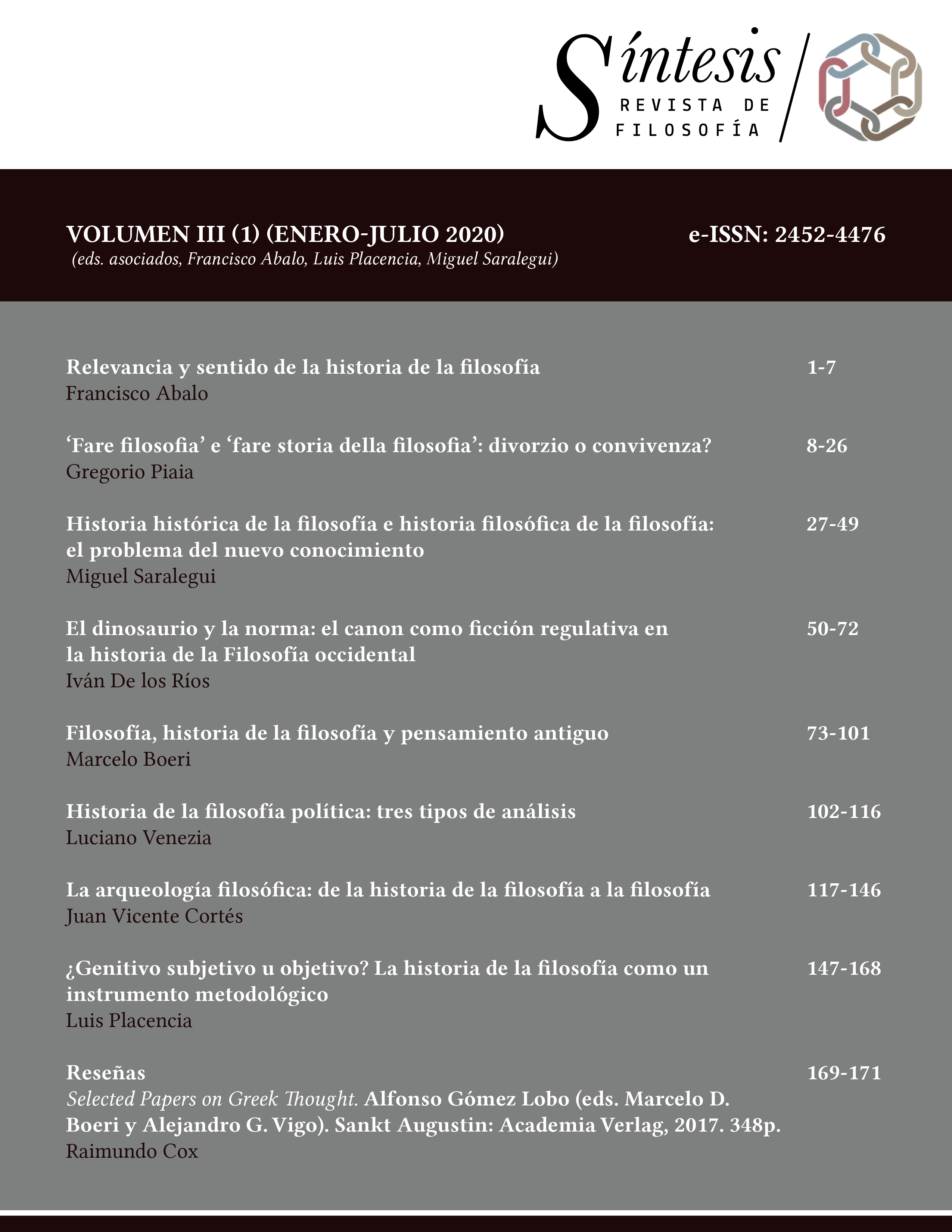
The Dinosaur and the Norm: The Canon as a Regulatory Fiction in the History
DOI:
https://doi.org/10.15691/0718-5448Vol3Iss1a311Keywords:
canon, history of philosophy, philosophy teachingAbstract
A common assumption in the study of philosophy is the existence of a list of thinkers, texts and classic topics which would contains the fundamental highlights in the history of philosophical thinking. This list has been called “canon” and is very often characterized by its model character. In connection with it, there is a number of interesting and deeply philosophical questions: i) Is there really a philosophical canon? ii) If there is: what is its function? How is it configured? Is it stable? iii) What are the requirements that a text or an author must satisfy in order to become a member of the canon and what are the criteria to select them? Are these criteria ideologically oriented or they rather respect the values of originality, sublimity, depth and intrinsic representativeness to philosophy? iv) Is it essential to the study of philosophy the reference to a canon?
References
Bloom, Harold. El canon de Occidente. Buenos Aires: Anagrama, 1995.
Borges, Jorge Luis. “Sobre los clásicos.” En Otras inquisiciones, Obras Completas de Jorge Luis Borges. Madrid: Círculo de Lectores, 1975. pp. 615-616.
Camus, Albert. El mito de Sísifo. Barcelona: Altaya, 1998.
Esteban, J. Emilio, “El espíritu libre, el topo y el psicólogo: figuras de la crítica y genealogía de la filosofía del porvenir” En ¿Nietzsche ha muerto? Memorias del Congreso Internacional, 2009, ed. De Gerardo Martínez y Julio Quesada: Universidad Veracruzana, Universidad Autónoma de Madrid y Fundación Hombre y Mundo, pp. 261-291.
González, María Cristina, y Nora Stigol. “La filosofía y su historia. Un debate abierto.” Revista de Filosofía vol. 37, Nº2 (2012): 151-170.
Gracia, Jorge. “Cánones filosóficos y tradiciones filosóficas: El caso de la filoso-fía latinoamericana.” Análisis filosófico vol. XXX, Nº1 (2010): 117-134.
—. Latin-American Philosophy in the Twentieth Century: Man, Values and the Search for Philosophical Identity. New Tork: Prometheus Books, 1986.
—. Philosophy and Its History: Issues in Philosophical Historiography. New York: State University of New York Press, 1992.
—. “Hispanics, Philosophy and the Curriculum.” Teaching Philosophy vol.22, Nº3 (1999): 241-248.
Jakobson, Jim. “Prolegomena to the Historiography of Philosophy.” En The Past’s Present. Essays on the Historicity of Philosophical Thinking, 2005, de Marcia Sá Cavalcante y Hans Ruin. Huddinge: Södertörn Philosophical Studies, pp. 55-93.
Manzo, Silvia. “Piezas de un modelo para armar, desarmar y rearmas. Autores, textos y temas en la construcción de cánones filosóficos.” En La moderni-dad ayer y hoy, de Susana Maidana y María Risco. Tucumán: Universidad Nacional de Tucumán, 2017. 117-146.
Monterroso, Augusto. 1959. “El dinosaurio.” En Obras completas (y otros cuentos), de Augusto Monterroso. México DF: UNAM, 1959. P. 57.
Moreno Pestaña, José Luis. La norma de la filosofía. La configuración del pa-trón filosófico español tras la Guerra Civil. Madrid: Biblioteca Nueva, 2013.
Nietzsche, Friedrich. Sämtliche Werke. Kritische Studienausgabe in 15 Bänden. Hrsg. von Giorgio Colli und Mazzino Montinari. Berlin-New York: Walter de Gruyter Verlag, 1967-77. Neueausgabe 1999.
Onfray, Michel. La comunidad filosófica. Manifiesto por una Universidad popu-lar. Barcelona: Gedisa, 2008.
—. Contra-historia de la filosofía. Barcelona: Anagrama, 2007.
—. Anti-manual de filosofía. Madrid: Alianza, 2005.
Rabossi, Eduardo. En el comienzo Dios creó el canon. Biblia berolinensis. Buenos Aires: Gedisa, 2008.
Schacht, Richard. 1993. “On philosophy's canon, and its Nutzen und Nachteil.” The Monist vol. 76, Nº4 (1993): 421-435.
Spinoza, Baruch. Tratado teológico-político, traducido por A. Domínguez. Madrid: Altaya, 1986.
Westphal, Merold. “The Canon as Flexible, Normative Fact.” The Monist vol. 76, Nº4 (1993): 436-449.
Downloads
Published
Issue
Section
License
Authors who publish with this journal agree to the following terms:- Authors retain copyright and grant the journal right of first publication with the work simultaneously licensed under a Creative Commons Attribution License that allows the use, transformation, and distribution for any purpose, as long as the author is recognized, and in the event of changes or developements are made from it, the derivate work be shared under the same license.
- Authors are able to enter into separate, additional contractual arrangements for the non-exclusive distribution of the journal's published version of the work (e.g., post it to an institutional repository or publish it in a book).
- Authors are permitted and encouraged to post their work online (e.g., in institutional repositories or on their website) prior to and during the submission process, as it can lead to productive exchanges, as well as earlier and greater citation of published work (See The Effect of Open Access).