SOUL AND BODY IN NUMENIUS OF APAMEA
DOI:
https://doi.org/10.15691/0718-5448Vol1Iss2a247Keywords:
Numenius, soul, matter, body, beingAbstract
In this paper I will study the relationship between soul and body in Numenius of Apamea, by analysing some of the fragments and testimonies preserved by various sources. I will show how these texts have as a common background the controversy against the Stoics. On the other hand, I will argue that the conception of the soul as a principle of stability, on the one hand, and as a principle of movement, on the other, is resolved in a differentiation between two types of movements: one that guarantees the stability, the order and the rationality of the real and the other that involves irrationality and disorder. Precisely, in the encounter and interaction between both psychic movements are the world and the humans, as beings that are corporeal and animated.
References
Bakhouche, B. 2011. Calcidius. Commentaire au Timée de Platon. Paris : Vrin.
Barnard, L. W. 1972. “The Father of Christian Anthropology.” Zeitschrift für die neotestamentliche Wissenschaft 63: 254-270.
Boeri, M. – Salles, R. 2014. Los filósofos estoicos. Ontología, lógica, física y ética. Sankt Augustin: Academia Verlag.
Des Places, É. 1973. Numénius. Fragments. Paris: Les Belles Lettres.
Des Places, É. 1987. Eusèbe de Césarée. La préparation évangélique. Livres XIV-XV. Paris: Éditions du Cerf.
Dodds, E. 1960. “Numenius and Ammonius.” En Les sources de Plotin [Entretiens sur l’antiquité classique, tome V], 1-61. Genève, Vandoeuvres: Fondation Hardt.
Dörrie, H. - Baltes, M. 1996. Der Platonismus in der Antike: Der philosophische Lehre des Platonismus [1]: Einige grunlegende Axiome / Platonische Physik (im antiken Verständnis) I, Band 4. Stuttgart-Bad Cannstatt: Frommann-Holzboog.
Dörrie, H. - Baltes, M. 2002. Der Platonismus in der Antike: Der philosophische Lehre des Platonismus [3]: Von der »Seele« als der Ursache aller sinnvollen Abläufe, Band 6, 1-2. Stuttgart-Bad Cannstatt: Frommann-Holzboog.
García Bazán, F. 1991. Oráculos Caldeos; Numenio de Apamea: Fragmentos y Testimonios. Madrid: Gredos.
Jourdan, F. 2014. “La matière à l'origine du mal chez Numénius (fr. 43 et 52 Des Places).” Philosophie antique 14: 185-235.
Leemans, E.-A. 1937. Studie over den Wijsgeer Numenius van Apamea met Uitgave der Fragmenten. Bruxelles: Palais des Académies.
Mié, F. 2018. “Refining the Material Substance: Aristotle’s Program in Metaphysics H1-5”. Síntesis. Revista de Filosofía I (2): 54-100.
Müller, G. 2015. “Qué es “lo que es viviente” (ὅ ἐστι ζῷον) según Numenio de Apamea.” Cuadernos de Filosofía 64: 9-22.
Petty, R.. 2012. Fragments of Numenius of Apamea. Westbury, Wiltshire: The Prometheus Trust.
Smith, A. 1993. Porphyrii Philosophi Fragmenta. Stuttgart-Leipzig: Teubner.
Van Winden, J. C. M. 1965. Calcidius on Matter. His Doctrine and sources. Leiden: Brill.
Vimercati, E. 2012. “La materia e il male in Numenio di Apamea.” Filosofia e Teologia XXVI/1: 77-92.
Von Arnim, H. 1903-24. Stoicorum Veterum Fragmenta (= SVF). 4 vols. Leipzig: Teubner.
Wachsmuth, C. – Hense, O. 1884-1912. Ioannis Stobaei Anthologium. 5 vols. Berlin: Weidmann.
Waszink, J. H. 1962. Timaeus, a Calcidio translatus commentarioque instructus, Londres- Leiden: Brill.
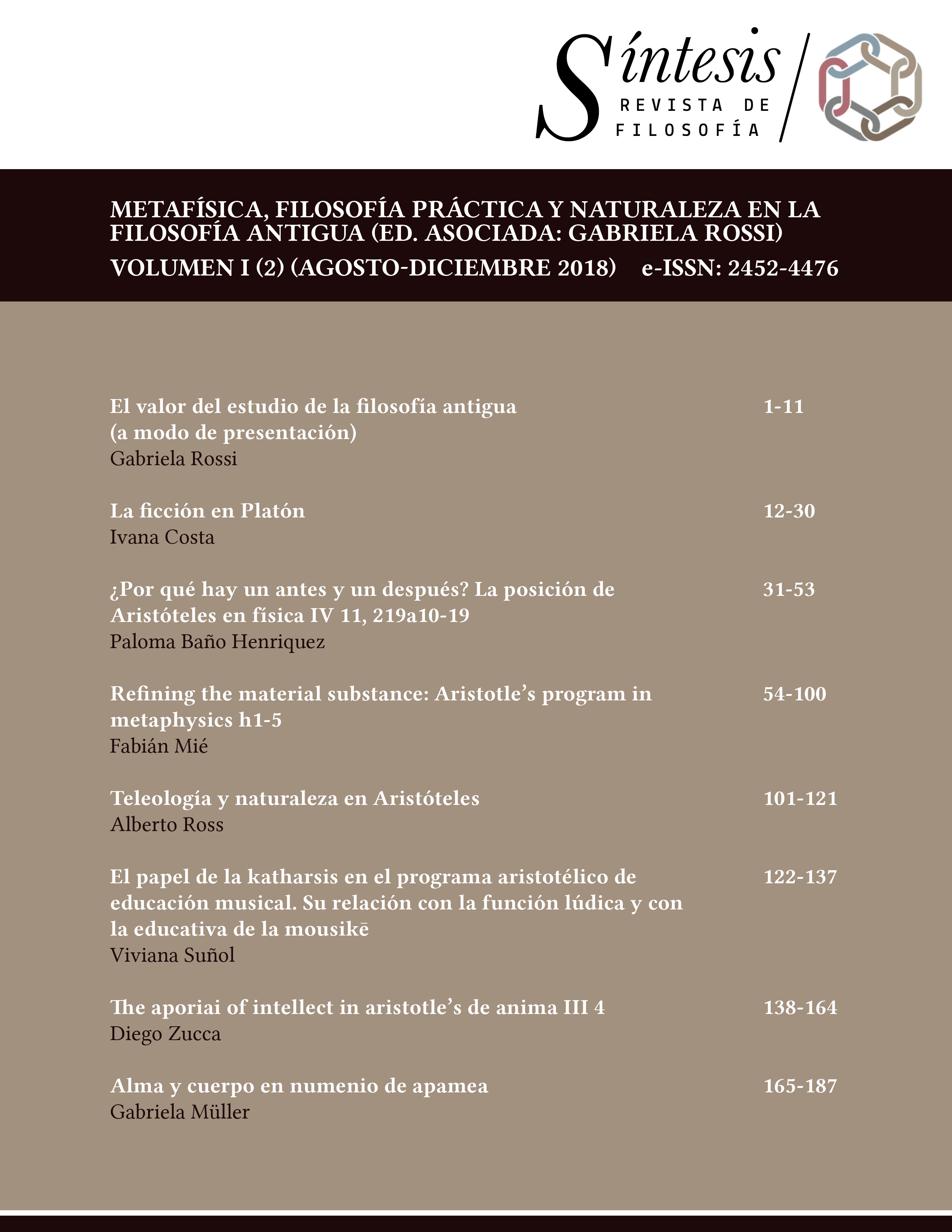
Downloads
Published
Issue
Section
License
Authors who publish with this journal agree to the following terms:- Authors retain copyright and grant the journal right of first publication with the work simultaneously licensed under a Creative Commons Attribution License that allows the use, transformation, and distribution for any purpose, as long as the author is recognized, and in the event of changes or developements are made from it, the derivate work be shared under the same license.
- Authors are able to enter into separate, additional contractual arrangements for the non-exclusive distribution of the journal's published version of the work (e.g., post it to an institutional repository or publish it in a book).
- Authors are permitted and encouraged to post their work online (e.g., in institutional repositories or on their website) prior to and during the submission process, as it can lead to productive exchanges, as well as earlier and greater citation of published work (See The Effect of Open Access).