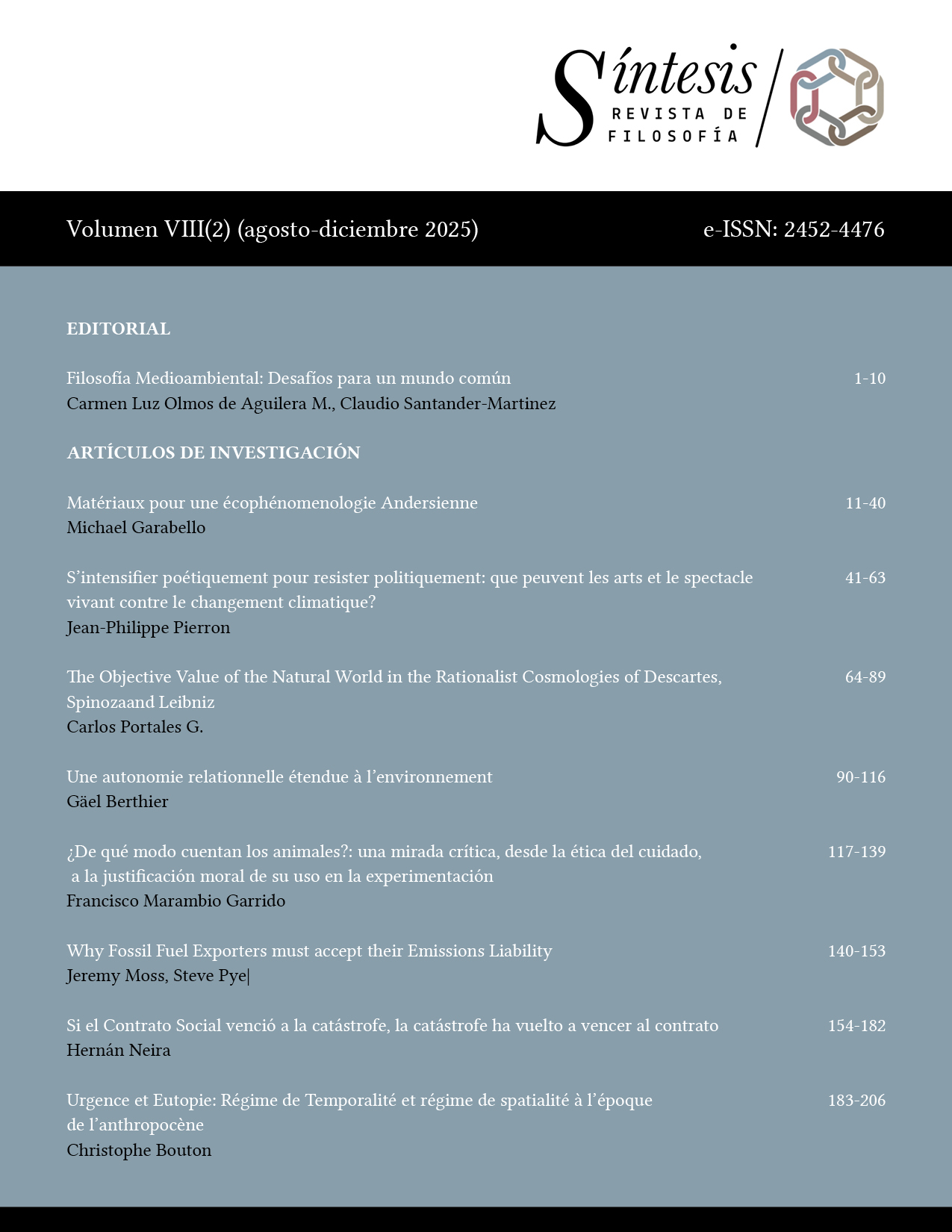
Filosofía Medioambiental: Desafíos para un mundo común
DOI:
https://doi.org/10.15691/0718-5448Vol8Iss2a495Keywords:
éticas medioambientales, ontologías, historicidadAbstract
EditorialReferences
Afeissa, H.S. (ed.). (2007). Éthique de l’environnement. Nature, valeur, respect, Paris: VRIN
Bourg, D., Swaton (2021), S. Primauté du vivant, Paris: PUF
Callicott, J. Baird (1989). In Defense of the Land Ethic: Essays in Environmental Philosophy. Albany: State University of New York Press.
______________(1994). Earth's Insights: A Multicultural Survey of Ecological Ethics from the Mediterranean Basin to Australian Outback. Berkeley: University of California Press.
Ferry, L. (1992). Le nouvel ordre écologique. L’arbre, l’animal et l’homme. Paris: Grasset
Fox, W. (1984), “Deep Ecology. A new philosophy of our time?”, The Ecol-ogist 14:194-200.
_______________ (1986) Approaching deep ecology: a response to Richard Sylvan’s Critique of Deep Ecology, Board of Environmental Studies, Uni-versity of Tasmania.
_______________ (1995) Toward a Transpersonal Ecology: Developing New Foundations for Environmentalism, New York: State University of New York Press
Goodpaster, K. E. (1978). “On Being Morally Considerable”. The Journal of Philosophy, 75(6), 308–325.
Hargrove, E. (1989). Foundations of Environmental Ethics, Texas: Environmen-tal Ethics Books.
Larrère, C. (1997). Les philosophies de l'environnement. Paris: PUF.
Larrère, C., Larrère, R., Penser et agir avec la nature. Une enquête philosophique, Paris: La découverte.
Leopold, A. (1949). A Sand County Almanac, Nueva York: Oxford University Press.
Muir, J. (1912). The Yosemite, Nueva York: The century company. Edición dis-ponible por The Sierra Club.
Pelluchon, C., (2021), Les Lumieres à l’âge du vivant, Paris: Seuil.
White, L. (1967). The Historical Roots of Our Ecologic Crisis. Science, 155(3767), 1203–1207.
Downloads
Published
Issue
Section
License
Authors who publish with this journal agree to the following terms:- Authors retain copyright and grant the journal right of first publication with the work simultaneously licensed under a Creative Commons Attribution License that allows the use, transformation, and distribution for any purpose, as long as the author is recognized, and in the event of changes or developements are made from it, the derivate work be shared under the same license.
- Authors are able to enter into separate, additional contractual arrangements for the non-exclusive distribution of the journal's published version of the work (e.g., post it to an institutional repository or publish it in a book).
- Authors are permitted and encouraged to post their work online (e.g., in institutional repositories or on their website) prior to and during the submission process, as it can lead to productive exchanges, as well as earlier and greater citation of published work (See The Effect of Open Access).