The Heideggerian Destruction of Coexistence and its Drifts in Nancy and Sloterdijk
DOI:
https://doi.org/10.15691/0718-5448Vol8Iss1a475Keywords:
Destruktion, Coexistence, Colligation, Spheres, Singular-plural.Abstract
The Heideggerian proposal of a destruction (Destruktion) of Western ontology is fundamental for contemporary thought, which has mainly studied its general characteristics and its deconstructive drift. However, its application to coexistence is often marginalized, despite being developed even by relevant thinkers such as Jean-Luc Nancy and Peter Sloterdijk. The following analysis, therefore, will deal with the destruction of the coexistenctial dimension of Being and Time –mainly its fourth chapter- and the drifts of it in Nancy and Sloterdijk. From both exercises we will identify why the Heideggerian destruction of coexistence, in spite of having a definite theoretical direction, presents conditions for bifurcating into two interpretative drifts. We will argue that this possibility is conditioned by an implicit ambivalence in the Heideggerian coexistential formulation that is projected in the receptions of Nancy and Sloterdijk.
References
Agamben, Giorgio. 1996. La comunidad que viene. Traducido por José Luis Vi-llacañas y Claudio La Rocca. Valencia: Pre-Textos.
_____. 2010. Signatura Rerum. Sobre el método. Traducido por Flavia Costa y Mercedes Ruvituso. Barcelona: Editorial Anagrama.
Caputo, John D. 1987. Radical Hermeneutics. Repetition, Deconstruction, and the Hermeneutic Project. Bloomington and Indianapolis: Indiana University Press.
Castro Soto, René. 2023. “El carácter ambivalente de la coexistencia en Heidegger y su recepción espacial en Nancy y Sloterdijk”. Tesis de Magíster, Univer-sidad Diego Portales.
Contreras Guala, Carlos. 2010. Jacques Derrida. Márgenes ético-políticos de la desconstrucción. Santiago: Editorial Universitaria.
Esposito, Roberto. 2003. Communitas. Origen y destino de la comunidad. Tra-ducido por Carlo Molinari. Buenos Aires: Amorrortu Editores.
Ferraris, Maurizio. 2006. Introducción a Derrida. Traducido por Luciano Padilla López. Buenos Aires: Amorrortu Editores.
Gadamer, Hans-Georg. 1988. “Destruktion y Deconstrucción”. En Verdad y Mé-todo II. Traducido por Manuel Olasagasti, 349-359. Salamanca: Ediciones Sígueme.
_____. 1998. “Deconstrucción y Hermenéutica”. En El giro hermenéutico. Tra-ducido por Arturo Parada, 73-84. Madrid: Cátedra.
_____. 2014. “Conférence du 5 février 1988”. En Derrida, Jacques; Gadamer, Hans-Georg y Lacoue-Labarthe, Phillipe. La Conférence de Heidelberg. Heidegger: portée philosophique et politique de sa pensée. Recontre-débat de Heidelberg, 5 et 6 février 1988, 37-53. Fécamp: Nouvelles Éditions Lignes.
González Páez, Néstor. 2022. “‘Ser-en-común’ (Heidegger, Kant y Kafka). Ensa-yo sobre la violencia ontológico fundamental de la comunidad [Gemeins-chaft], el ser-con [Mitsein] y la comunicación [Mitteilung]”. Revista Casta-lia 39: 137-162. Santiago: Universidad Academia de Humanismo Cristiano.
Han, Byung-Chul. 2021. El corazón de Heidegger. El concepto de “estado de ánimo” de Martin Heidegger. Traducido por Alberto Ciria. Barcelona: Herder Editorial.
Heidegger, Martin. 1968. El ser y el tiempo. Traducido por José Gaos. México: Fondo de Cultura Económica.
_____. 1977. Gestamtausgabe. I. Abteilung: Veröffentlichte Schriften 1914-19710, Band 2, Sein un Zeit. Frankfurt am Main: Vittorio Klostermann.
_____. 2002. Interpretaciones fenomenológicas sobre Aristóteles (Indicación de la situación hermenéutica) [Informe Natorp]. Traducido por Jesús Adrián Escudero. Madrid: Editorial Trotta.
_____. 2005. La idea de la filosofía y el problema de la concepción del mundo. Traducido por Jesús Adrián Escudero. Barcelona: Editorial Herder.
_____. 2009. Tiempo e Historia. Traducido por Jesús Adrián Escudero. Madrid: Editorial Trotta.
_____. 1997. Ser y Tiempo. Traducido por Jorge Eduardo Rivera. Santiago de Chile: Editorial Universitaria.
Levine, Steven (Ed.). 2008. On Heidegger. Being and Time. New York: Routledge.
Nancy, Jean-Luc. 2001. La comunidad desobrada. Traducido por Pablo Pereira, Isidro Herrera y Alejandro del Río. Madrid: Arena Libros.
_____. 2006. Ser singular plural. Traducido por Antonio Tudela. Madrid: Arena Libros.
_____. 2016. ¿Qué significa partir? Traducido por Gabriel Entin. Buenos Aires: Capital Intelectual.
Sartre, Jean-Paul. 1993. El ser y la nada. Ensayo de ontología fenomenológica. Traducido por Juan Valmar. Buenos Aires: Editorial Losada.
Schürmann, Reiner. 2017. El principio de anarquía. Heidegger y la cuestión del actuar. Traducido por Miguel Lancho, 108-132. Madrid: Arena Libros.
Sloterdijk, Peter. 2001. Sin salvación. Tras las huellas de Heidegger. Traducido por Joaquín Chamorro Mielke. Madrid: Ediciones Akal.
_____. 2003. Esferas I. Burbujas, Microesferología. Traducido por Isidoro Re-guera. Madrid: Ediciones Siruela.
_____. 2012. Has de cambiar tu vida. Sobre antropotécnica. Traducido por Pe-dro Madrigal. Valencia: Editorial Pre-Textos.
Steinbock, Anthony J. 2022. Mundo familiar y Mundo ajeno. Fenomenología generativa. Traducido por Rocío Garcés Ferrer y Andrés Alfonso Martos. Salamanca: Ediciones Sígueme.
Vega, Francisco. 2012. “La tarea de la Destruktion y el concepto de tiempo. Con-sideraciones en torno a la destrucción de la historia de la ontología anuncia-da por Heidegger en Ser y Tiempo”. En Límite. Revista de Filosofía y Psi-cología V. 7 N°26: 41-62. Iquique: Universidad de Tarapacá.
Virno, Paolo. 2003. Gramática de la multitud. Para un análisis de las formas de vida contemporáneas. Madrid: Traficantes de Sueños.
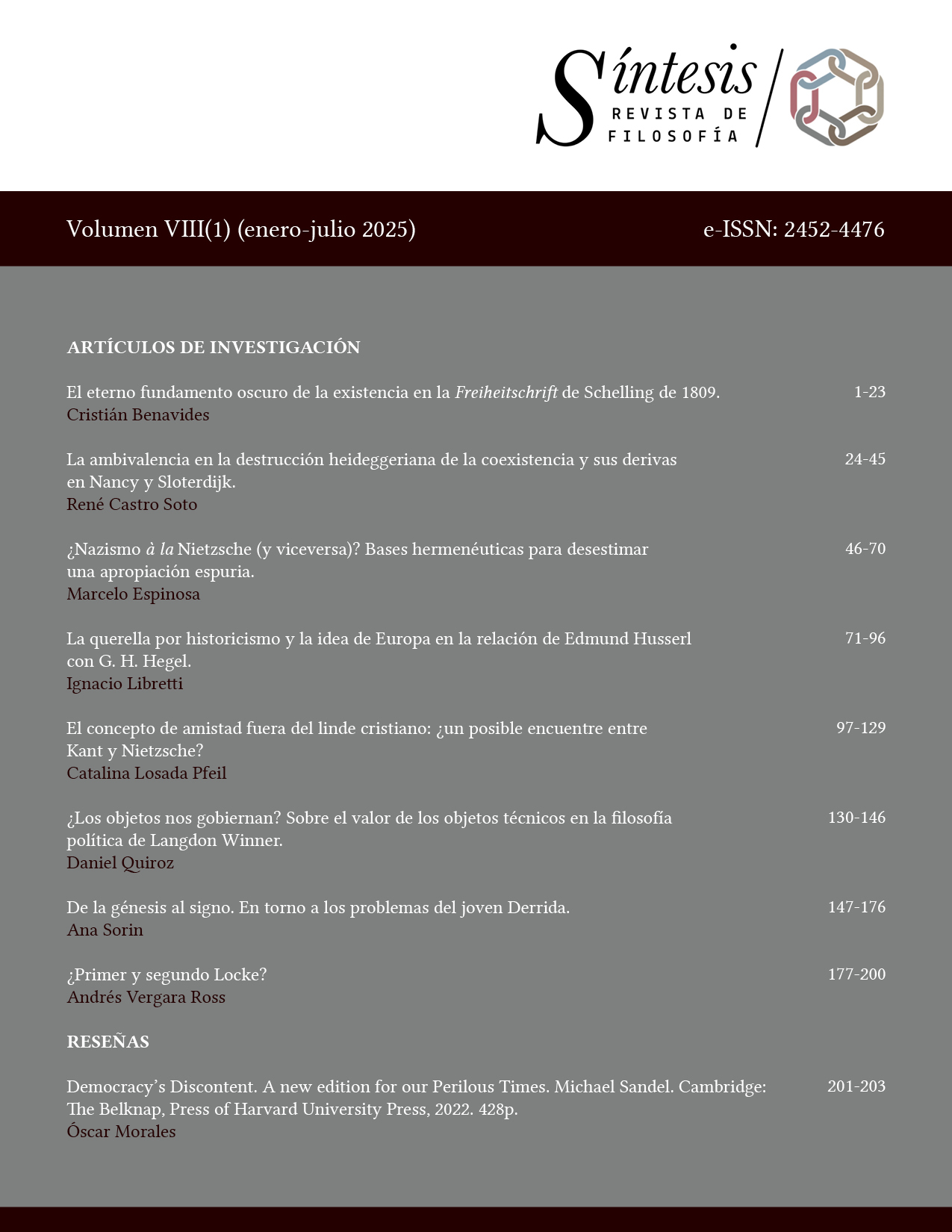
Downloads
Published
Issue
Section
License
Authors who publish with this journal agree to the following terms:- Authors retain copyright and grant the journal right of first publication with the work simultaneously licensed under a Creative Commons Attribution License that allows the use, transformation, and distribution for any purpose, as long as the author is recognized, and in the event of changes or developements are made from it, the derivate work be shared under the same license.
- Authors are able to enter into separate, additional contractual arrangements for the non-exclusive distribution of the journal's published version of the work (e.g., post it to an institutional repository or publish it in a book).
- Authors are permitted and encouraged to post their work online (e.g., in institutional repositories or on their website) prior to and during the submission process, as it can lead to productive exchanges, as well as earlier and greater citation of published work (See The Effect of Open Access).