
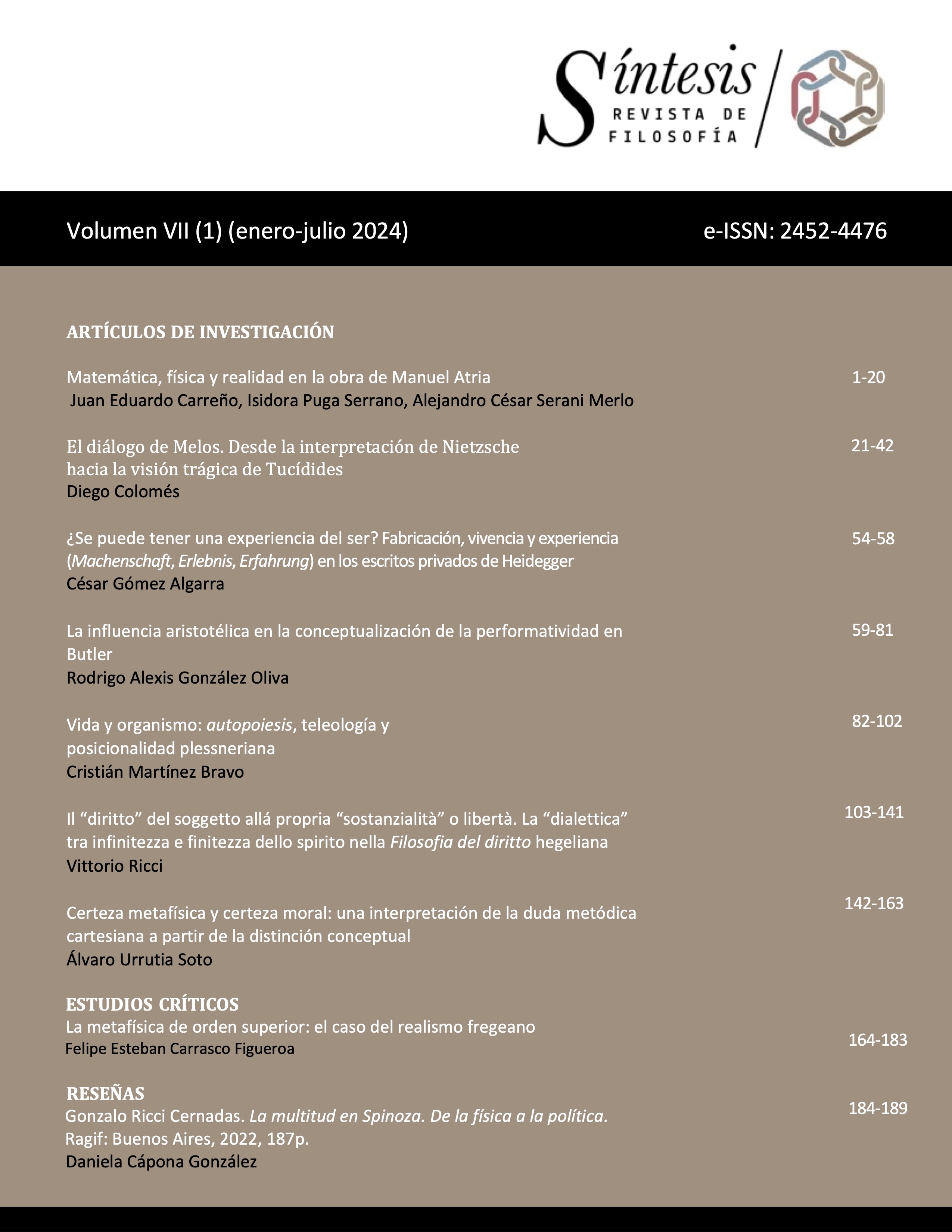
Higher-Order Metaphysics: The Case of Freeman Realism
DOI:
https://doi.org/10.15691/0718-5448Vol7Iss1a449Keywords:
Higher-order metaphysics, Properties, Proposi-tions, Fregean realism, QuantificationAbstract
Higher-order metaphysics is an emerging research program that aims to account for metaphysical problems using the tools of higher-order logic. This critical study shows some of the relevant antecedents that led to this paradigm shift that is occurring in analytical metaphysics. Within this context, the case of Fregean realism is analysed. This is a recent movement that uses the resources of higher-order logic to articulate a theory of properties and propositions. The central idea of this conception is that properties are not objects, but rather the conditions of satisfaction of predicates. This exclusive distinction between properties and objects applies to different metaphysical problems. For Fregean realism, these puzzles are presented as pseudo problems that arise from talking about properties as if they were objects.
References
Bacon, Andrew. A Philosophical Introduction to Higher-Order Logics. New York and London: Routledge, 2023.
Boolos, George. "Nominalistic Platonism." Philosophical Review 94, no. 3 (1985): 327-344.
Boolos, George. "To Be Is to Be a Value of a Variable (or to Be Some Values of Some Variables)." Journal of Philosophy 81 (1984): 430-439.
Button, Tim, y Robert Trueman. "A Fictionalist Theory of Universals." In Higher-Order Metaphysics, edited by Peter Fritz and Nicholas K. Jones. Oxford University Press, forthcoming.
Eklund, Matti. "On How Logic Became First-Order." Nordic Journal of Philo-sophical Logic 1 (1996): 147–67.
Ewald, William. "The Emergence of First-Order Logic." The Stanford Encyclo-pedia of Philosophy, Spring 2019 Edition. Edward N. Zalta (ed.). URL: https://plato.stanford.edu/archives/spr2019/entries/logic-firstorder-emergence/.
Fritz, Peter, y Nicholas K. Jones. Higher-Order Metaphysics. Oxford: Oxford University Press, forthcoming.
Gödel, Kurt. "On Formally Undecidable Propositions of Principia Mathematica and Related Systems I." In Gödel 1986, pp. 145–195. Originally published as "Uber formal unentscheidbare Satze der Principia mathematica und ver-wandter Systeme I", Monatshefte fur Mathematik und Physik 38 (1931): 173–198.
Gödel, Kurt. Collected Works, vol. I. Oxford University Press, 1986.
Hilbert, David, and Ackermann, Wilhelm. Grundzüge der Theoretischen Logik. Berlin: J. Springer, 1928, 2nd edn.
Jones, Nicholas K. "A Higher-Order Solution to the Problem of the Concept Horse." Ergo: An Open Access Journal of Philosophy 3 (2016): 132-166.
Jones, Nicholas K. "Nominalist Realism." Nous (2017): 1-28.
King, Jeffrey, Scott Soames, and Jeff Speaks (eds.). New Thinking About Propo-sitions. Oxford: Oxford University Press, 2014.
Lederman, Harvey. "Higher-Order Metaphysics and Propositional Attitudes." In Higher-Order Metaphysics, edited by Peter Fritz and Nicholas K. Jones. Oxford University Press, forthcoming.
Löwenheim, Leopold. "On Possibilities in the Calculus of Relatives." In From Frege to Gödel, edited by Jean van Heijenoort, pp. 228–251. Originally published as "Uber Moglichkeiten im Relativkalkul", Mathematische Annalen 76 (1915): 447–470.
Moore, Gregory H. "Beyond First-Order Logic: The Historical Interplay Between Mathematical Logic and Axiomatic Set Theory." History and Philosophy of Logic I (1980): 95–137.
Moore, Gregory H. "The Emergence of First-Order Logic." In History and Philosophy of Modern Mathematics, edited by William Aspray and Philip Kitcher, pp. 95–135. Minneapolis: University of Minnesota Press, 1988.
Prior, Arthur N. Objects of Thought. Oxford: Clarendon Press, 1971.
Quine, Willard Van Orman. From a Logical Point of View, 2nd edn. New York: Harper & Row, 1961.
Quine, Willard Van Orman. Philosophy of Logic. Englewood Cliffs: Prentice Hall, 1970.
Rayo, Agustin, and Stephen Yablo. "Nominalism through De-nominalization." Nous 35, no. 1 (2001): 74–92.
Shapiro, Stewart. Foundations Without Foundationalism. Oxford: Clarendon Press, 1991.
Sider, Ted. "Crash Course on Higher-Order Logic." Teaching document, 2022.
Sider, Ted. "Higher-Order Metametaphysics." En curso de publicación.
Skiba, Lukas. "Higher-Order Metaphysics." Philosophy Compass 16, no. 10 (2021).
Skolem, Thoralf. "Some Remarks on Axiomatized Set Theory." In From Frege to Gödel, edited by Jean van Heijenoort, pp. 290–301. Originally published as "Einige Bemerkungen zur axiomatischen Begrundung der Mengenlehre", Matematikerkongressen i Helsingfors den 4–7 Juli 1922, Den femte skan-dinaviska matematikerkongressen, Redogorelse, Akademiska Bokhandeln, Helsinki, 1922, pp. 217–232.
Soames, Scott. "Cognitive Propositions." In New Thinking About Propositions, edited by J. King, S. Soames, and J. Speaks, pp. 91-124. Oxford University Press, 2014.
Trueman, Robert. Properties and Propositions: The Metaphysics of Higher-Order Logic. Cambridge: Cambridge University Press, 2021.
van Heijenoort, Jean. From Frege to Gödel: A Source Book in Mathematical Logic, 1879–1931. Cambridge, MA: Harvard University Press, 1967.
Williamson, Timothy. "Everything." Philosophical Perspectives 17 (2013): 415–65.
Williamson, Timothy. Modal Logic as Metaphysics. Oxford: Oxford University Press, 2013.
Downloads
Published
Issue
Section
License
Authors who publish with this journal agree to the following terms:- Authors retain copyright and grant the journal right of first publication with the work simultaneously licensed under a Creative Commons Attribution License that allows the use, transformation, and distribution for any purpose, as long as the author is recognized, and in the event of changes or developements are made from it, the derivate work be shared under the same license.
- Authors are able to enter into separate, additional contractual arrangements for the non-exclusive distribution of the journal's published version of the work (e.g., post it to an institutional repository or publish it in a book).
- Authors are permitted and encouraged to post their work online (e.g., in institutional repositories or on their website) prior to and during the submission process, as it can lead to productive exchanges, as well as earlier and greater citation of published work (See The Effect of Open Access).