
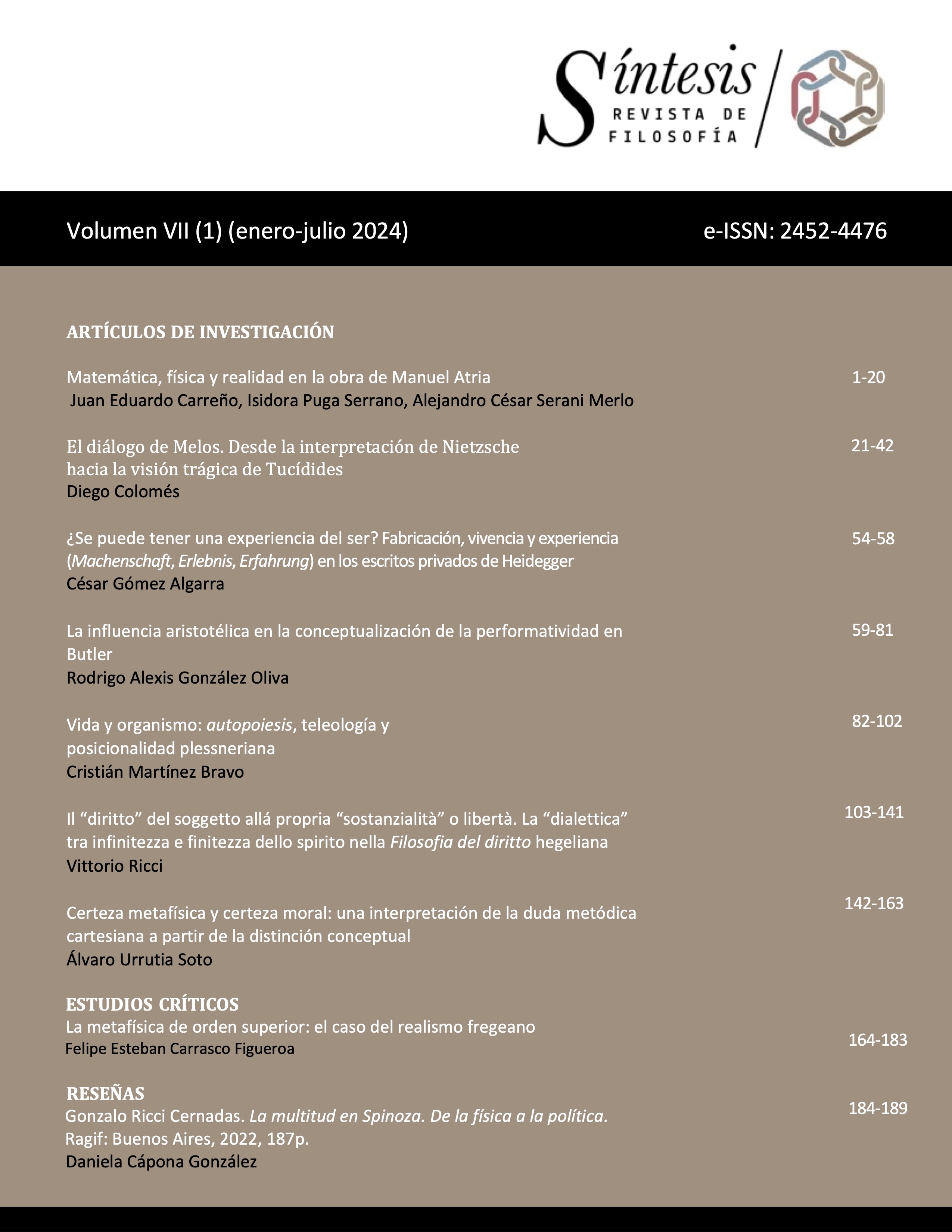
The Aristotelian Influence on Butler's Conceptualization of Performativity
DOI:
https://doi.org/10.15691/0718-5448Vol7Iss1a445Keywords:
Performativity, Discourse, Power, Form, MaterialityAbstract
This paper proposes to critically review Judith Butler's conceptualization of performativity from 1990-2015. In these years Butler proposes to extend the scope of J. L Austin’s concept towards gender theory, replacing Austin's speech act analytic with a post-structural analytic of power. Butler critically uses the reference to poststructuralism and French feminism to reinterpret the Aristotelian conception of the intelligibility of power as the materialization of a discursive form, subordinating to it the scope of performativity. Noting that this influence is absent in Austin's theoretical and analytical grounding of the concept, we will finally contrast the scope and limitations of Butler facing Austin.
References
Arendt, Hanna. 2023. La condición humana. Buenos Aires: Paidós.
Aristóteles. 1985. Ética a Nicómaco. Madrid: Gredos.
___________. 1987. Acerca de la generación y de la corrupción. Madrid: Gredos.
___________. 1990a. Retórica. Madrid: Gredos.
___________. 1990b. Acerca del alma. Madrid: Gredos.
___________. 1994. Metafísica. Madrid: Gredos.
___________. 1995. Física. Madrid: Gredos.
___________. 2005. Tὰ μετὰ τὰ φυσικά. Atenas: Παπαδήμας.
___________. 2006. θικὰ Νικομάχεια. Atenas: Ζήτρος.
___________. 2010. Φυσικά. Atenas: Ζήτρος.
Austin Henry, Robert; Sálem, Joana; Canibilio, Viviana (comp.). 2020. La vía chilena al socialismo 50 años después. Tomo I. Historia. Buenos Aires: CLACSO.
Austin, John Langshaw. 1975. Ensayos filosóficos. Madrid: Alianza.
___________. 1990. Cómo hacer cosas con las palabras. Barcelona: Paidós.
___________. 1981. Sentido y percepción. Madrid: Tecnos.
Barad, Karen. 2003. “Posthumanist performativity: Toward an understanding of how matter comes to matter”. Signs: Journal of Women in Culture and So-ciety, v. 28, n. 3, 801-831.
___________. 2008. “Queer Causation and the Ethics of Mattering”. En Giffney, Noreen y Hird J., Myra (eds). Queering the Non/Human. Burlington: Ashgate Publishing, 311–38.
Butler, Judith. 1998. “Actos performativos y constitución del género: un ensayo sobre fenomenología y teoría feminista”. Debate Feminista, n.18, 296-314.
___________. 2001. Mecanismos psíquicos del poder. Valencia: Cátedra.
___________. 2002. Cuerpos que importan. Sobre los límites materiales y dis-cursivos del "sexo". Buenos Aires: Paidós.
___________. 2004. Lenguaje, poder, identidad [Excitable Speech. A politics of the performative]. Madrid: Síntesis.
___________. 2007. El género en disputa. El feminismo y la subversión de la identidad. México: Paidós.
___________. 2006. Deshacer el género. Barcelona: Paidós.
___________. 2009. “Performatividad, precariedad y políticas sexuales”. Antro-pología Iberoamericana (AIBR), v. 4, n. 3, 321-336.
___________. 2012. Sujetos del deseo. Buenos Aires: Amorrortu.
___________. 2014. “’Nosotros, el pueblo’. Apuntes sobre la libertad de reunión”. En Badiou, Alain et al. ¿Qué es un pueblo?, 41-61. Santiago: LOM.
___________. 2017. Cuerpos aliados y lucha política. Hacia una teoría perfor-mativa de la asamblea. Buenos Aires: Paidós.
___________. 2021. La fuerza de la no violencia. Buenos Aires: Paidós.
Butler, Judith; Athanasiou, Athena. 2017. Desposesión: Lo performativo en lo político. Buenos Aires: Eterna Cadencia.
Butler, Judith; Bell, Vikky. 1999. On Speech, race and melancholia. Theory, Culture & Society, v. 16, n. 2, 163-174.
Butler, Judith; Laclau, Ernesto; Žižek, Slavoj. 2000. Contingencia, hegemonía, universalidad. Buenos Aires: FCE.
Butler, Judith; Spivak, Gayatri. 2009. ¿Quién le canta al estado nación?. Buenos Aires: Paidós.
Deleuze, Gilles. 2013. El saber. Curso sobre Foucault. Buenos Aires: Cactus.
Derrida, Jacques. 1984. “Kafka: Ante la ley”. La filosofía como institución. Barcelona: Granica, 95-144.
___________. 1994. “Firma, acontecimiento, contexto”. Márgenes de la filosofía. Madrid: Cátedra, 347-372.
Farías, Víctor. 2000. La Izquierda Chilena (1969-1973): Documentos para el Estudio de su Línea Estratégica. V.1. Santiago: Centro de Estudios Públicos (CEP).
Felman, Shoshana. 2012. El escándalo del cuerpo hablante. Don Juan con J. L. Austin (y J. Lacan) o la seducción entre lenguas. México: Ortega-Ortiz.
Foucault, Michel. 2002. La arqueología del saber. México: Siglo XXI.
Fundación Jaime Guzmán. 2012. Manual de formación-Principios fundamentales. Disponible en: https://bit.ly/3vJnnXk
Gaudichaud, Frank. 2004. Poder popular y cordones industriales. Santiago: Siglo XXI.
González, Rodrigo. 2023. “Conceptos y lineamientos filosóficos de Cómo hacer cosas con palabras de J. L. Austin”. Eikasia, n. 118, 109-126.
Kaufman-Osborn, Timothy. 1997. “Fashionable Subjects: On Judith Butler and the Causal Idioms of Postmodern Feminist Theory”. Political Research Quarterly, v. 3, n. 50, 649–674.
Kirby, Vicki. 2006. Judith Butler: Pensamiento en acción. Barcelona: Bellaterra.
Kríes, Rafael. 2001. El ABC del poder popular. Santiago: Escaparate.
Lacan, Jacques. 2008. Seminario 17: El reverso del psicoanálisis. Buenos Aires: Paidós.
Lazzaratto, Maurizio. 2006. Por una política menor. Buenos Aires: Traficantes de sueños.
Lenin, V. I. 2013. “El doble poder”. En Obras selectas., vol. 2. 1917-1923. Buenos Aires, IPSA, 36-39.
Loxley, James. 2007. Performativity. Londres-Nueva York: Routledge.
Lukács, Georg. 1970. Historia y consciencia de clase. La Habana: Editorial de Ciencias Sociales.
Pérez Navarro, Pablo. 2008. Del texto al sexo: Judith Butler y la performatividad. Barcelona: Egales.
Rousseau, Jean Jacques. 1983. El contrato social. Madrid: Sarpe.
Rowe, M. W. 2023. J. L. Austin: Philosopher and D-Day Intelligence Officer. Oxford: Oxford University Press.
Senatore, Mauro. 2019. “Teleotheology: Derrida and the Aristotelian foundations of structuralism”. Philosophy today, n. 63, 175-194.
Stanton, Donna 1992. Discourses of sexuality. From Aristotle to AIDS. Michigan: Michigan press.
Žižek, Slavoj. 2003. El sublime objeto de la ideología. Buenos Aires: Siglo XXI.
Downloads
Published
Issue
Section
License
Authors who publish with this journal agree to the following terms:- Authors retain copyright and grant the journal right of first publication with the work simultaneously licensed under a Creative Commons Attribution License that allows the use, transformation, and distribution for any purpose, as long as the author is recognized, and in the event of changes or developements are made from it, the derivate work be shared under the same license.
- Authors are able to enter into separate, additional contractual arrangements for the non-exclusive distribution of the journal's published version of the work (e.g., post it to an institutional repository or publish it in a book).
- Authors are permitted and encouraged to post their work online (e.g., in institutional repositories or on their website) prior to and during the submission process, as it can lead to productive exchanges, as well as earlier and greater citation of published work (See The Effect of Open Access).