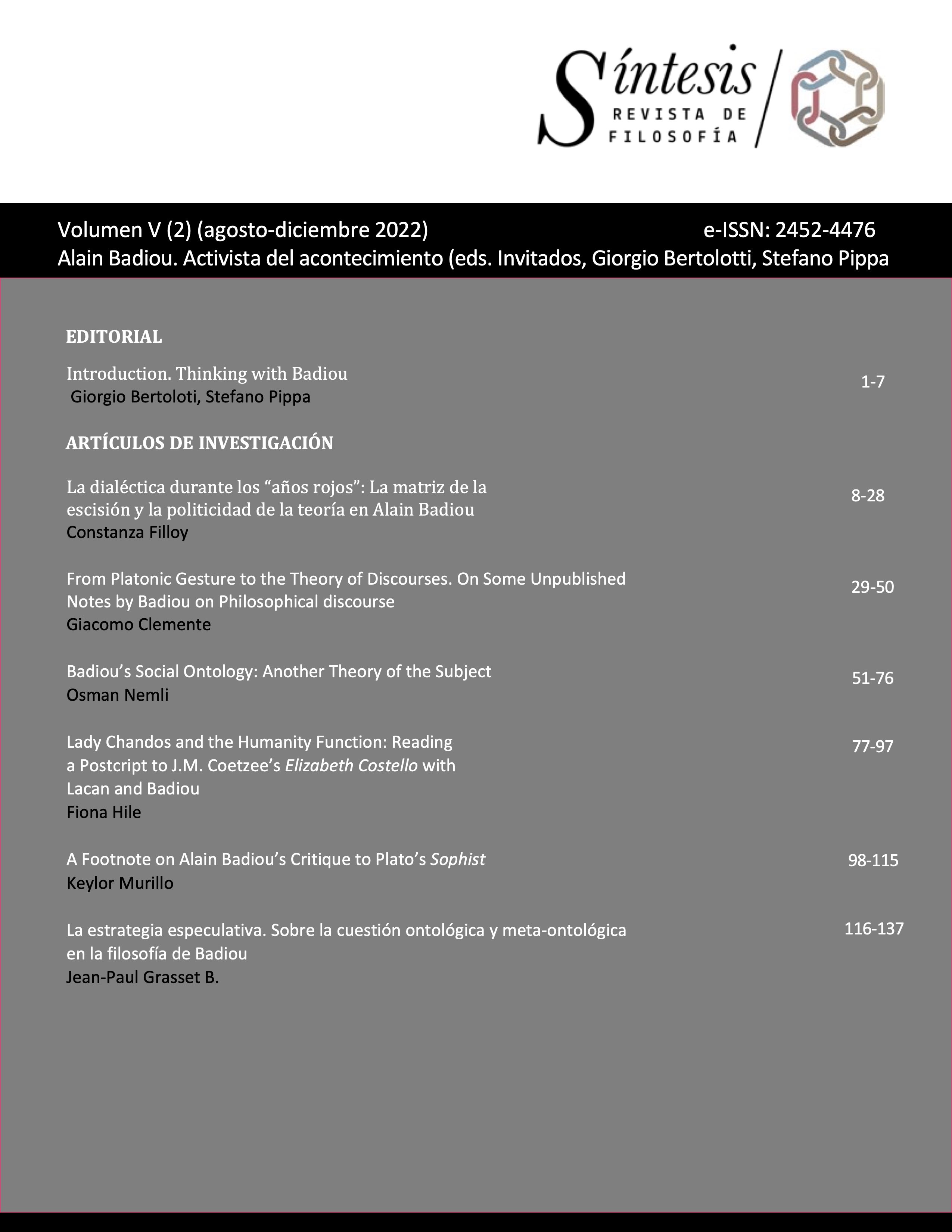
From Platonic Gesture to the theory of Discourses. On Some Unpublished Notes by Badiou on Philosophical Discourse.
DOI:
https://doi.org/10.15691/0718-5448Vol5Iss2a387Keywords:
Epistemological Break, Philosophical Discourse, Ideology, Plato, Dialectical/Historical materialismAbstract
This article will examine some theses that Badiou developed in the first period of his philosophy, when he was close to the theoretical horizon of Althusserianism. The article traces a route back from the Manifesto for Philosophy to some yet unpublished notes, dating from the late Sixties, on an aborted collective project on materialist philosophy. While, according to the later Badiou – who is also the most well-known – contemporary philosophical discourse should recover the Platonic gesture after Heidegger, it will be shown that the early Badiou, by debating the nature of the Platonic gesture with Macherey, seems to conceptualise philosophical discourse and its function under the inseparable link of dialectical materialism and historical materialism. The article ends with some open questions for a possible theory of discourse that would build on Badiou’s theoretical insights.
References
Althusser, Louis. 1967. Conception du monde et philosophie; Philosophie et con-ception du monde. Althusser collection (IMEC). [ALT2. A10-03.06].
Althusser, Louis. 1990. Philosophy and the Spontaneous Philosophy of the Sci-entists and Other Essays. Edited by G. Elliott, translated by B. Brewster, J. H. Kavanagh, T. E. Lewis, G. Locke and W. Montag. London: Verso.
Althusser, Louis. 2017. Philosophy for Non-Philosophers. Translated by G. M. Goshgarian, with an introduction by W. Montag. London-New York: Bloomsbury Academic.
Badiou, Alain. 1967a. À propos du concept d’application créatrice. Althusser collection (IMEC). [ALT2. A10-03.08].
Badiou, Alain. 1967b. Sur le texte de Macherey et la note d’Althusser du 15 novembre. Althusser collection (IMEC). [ALT2. A10-04.04].
Badiou, Alain. 1967c. Pratique, philosophie. Althusser collection (IMEC). [ALT2. A10-04.07].
Badiou, Alain. 1967d. Diderot: la visibilité du généalogique. Althusser collection (IMEC). [ALT2. A52-02.06].
Badiou, Alain. 1999. Manifesto for Philosophy Followed by Two Essays. Trans-lated, edited, and with and introduction by N. Madarasz. Albany: State University of New York Press.
Badiou, Alain. 2008. Manifesto per la filosofia. Translated by F. Elefante. Napoli: Edizioni Cronopio.
Badiou, Alain. 2012. “The (Re)commencement of Dialectical Materialism.” In The adventure of French Philosophy, 133-170. Introduction and translation by B. Boostels. London-New York: Verso.
Badiou, Alain. 2013. “The Autonomy of the Aesthetic Process.” Introduction and translation by B. Boostels. Radical Philosophy 178, Mar/Apr: 30-39.
Badiou, Alain. 2013. Theory of the Subject. Translated by B. Boostels. London-New York: Bloomsbury Academic.
Plato. 2007. Republic. Translated by D. Lee, with an introduction by M. Lane. London-New York: Penguin Books.
Macherey, Pierre. 1967. Sur la nature de la philosophie. Althusser collection (IMEC). [ALT2. A10-03.14].
Regnault, François. 1968. Qu’est-ce qu’une coupure épistémologique?. Althus-ser collection (IMEC). [ALT2. A12-03.05].
Tort, Michel. 1967. L’idéologisation philosophique. Althusser collection (IMEC). [ALT2. A10-03.07].
Downloads
Published
Issue
Section
License
Authors who publish with this journal agree to the following terms:- Authors retain copyright and grant the journal right of first publication with the work simultaneously licensed under a Creative Commons Attribution License that allows the use, transformation, and distribution for any purpose, as long as the author is recognized, and in the event of changes or developements are made from it, the derivate work be shared under the same license.
- Authors are able to enter into separate, additional contractual arrangements for the non-exclusive distribution of the journal's published version of the work (e.g., post it to an institutional repository or publish it in a book).
- Authors are permitted and encouraged to post their work online (e.g., in institutional repositories or on their website) prior to and during the submission process, as it can lead to productive exchanges, as well as earlier and greater citation of published work (See The Effect of Open Access).