
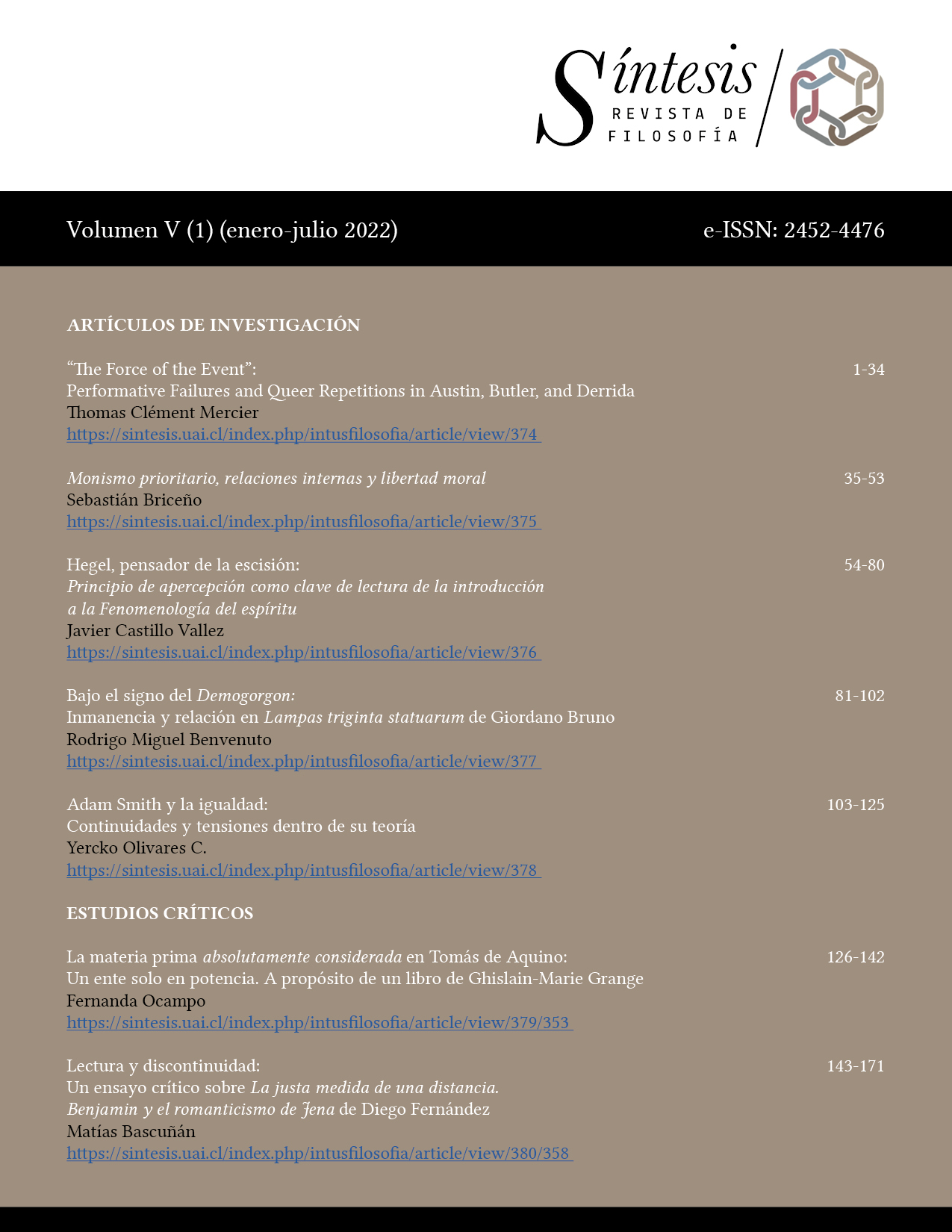
Hegel as a Thinker of Excision: "Principle of Apperception" as a Key to Reading the Introduction of the "Phenomenology of Spirit"
DOI:
https://doi.org/10.15691/0718-5448Vol5Iss1a376Keywords:
Knowing, Truth, Unity, Manifold, ManifestationAbstract
The present article proposes a reading key to understand the structural role of knowing and truth, exposed by Hegel in the introduction of the Phenomenology of Spirit, starting from the Kantian principle of apperception and the notion of the manifold without any further. It will be seen that this leads to an original excision that Hegel first rejects in the writing on Difference, but which he must then assume in the introduction to the Phenomenology in order for this project to take on consistency.
References
Aristóteles. 1998. Metafísica (Met), Madrid: Gredos.
Borges, J. L. [1944] 2017. “Funes el memorioso”. En Borges esencial, Barcelona: Alfaguara.
Caimi, Mario. 2018. “La revolución copernicana del modo de pensar. Algunos problemas”, en LEYVA, G.; PELÁEZ, A.; STEPANENKO, P. (eds.): Los Rostros de la razón: Immanuel Kant desde Hispanoamérica, Barcelona: Anthropos Editorial, 17–36.
Düsing, Klaus. 2002. La subjetividad en la filosofía clásica alemana de Kant a Hegel. Una panorámica a modo de programa, en Azafea. Rev. filos. 4, 2002, Salamanca: Ediciones Universidad de Salamanca: pp. 97-121.
Fichte. J.G. 1794/95. Grundlage der gesamten Wissenschaftslehre. Foundations of the Entire Science of Knowledge, trans. Peter Heath. In Fichte: Science of Knowledge (Wissenschaftslehre), ed. Peter Heath and John Lachs, New York: Appleton-Century-Crofts, 1970; 2nd ed., Cambridge: Cambridge University Press, 1982.
Hegel, G. W. F. 1988. Phänomenologie des Geistes (PhG), Band 9. En Gesammelte Werke. Hrsg. von Nordrhein-Westfäliche Akademie der Wissenschaften und der Künste, Hamburg: Felix Meiner (1968 y ss.) Trad. cas-tellano. Gómez Ramos. 2010. Madrid: Abada. Trad. Inglés. Pinkard. T. 2018. Cambridge: Cambridge University Press.
––– 1977. The Difference Between Fichte's and Schelling's System of Philosophy. (Trad. H. Harris y W. Cerf. Albany), N.Y.: SUNY Press.
Henrich, Dieter. 1994. La estructura de la prueba en la deducción trascendental de Kant, en Dulce María Granja (coord.), Kant: de la Critica a la filosofía de la religión, Barcelona: Anthropos, pp. 23-44.
Jacobi. F. H. 1787. David Hume über den Glauben, oder Idealismus und Realismus. Ein Gespräch, Breslau: Gottlieb Löwe. 1983 facsimile reproduction that includes the Vorrede of 1815, New York and London: Garland.
Kant, I. 2003. KrV: Kritik der reinen Vernunft (KrV). Herausgegeben von J. Timmermann. Hamburg: Felix Meiner. Caimi. M. Traduc. 2009. Mexico D.F.: FCE
Maybee, Julie E. 2019. "Hegel’s Dialectics", The Stanford Encyclopedia of Philosophy (Winter 2019 Edition), Edward N. Zalta (ed.), URL = <https://plato.stanford.edu/archives/win2019/entries/hegel-dialectics/>
Pereboom, D. 2019. "Kant’s Transcendental Arguments", The Stanford Encyclopedia of Philosophy (Spring 2019 Edition), Edward N. Zalta (ed.), URL =<https://plato.stanford.edu/archives/spr2019/entries/kant-transcendental/>
Pippin, R. B. 1989. Hegel's idealism: The satisfactions of self-consciousness. Cambridge: Cambridge University Press.
Pinkard, T. 1990. “How Kantian Was Hegel?”. The Review of Metaphysics, Jun., Vol. 43, No. 4 (Jun., 1990), 831-838.
Pizarro. 2012. “Una sincronía insoportable: Funes el memorioso”. Thémata. Revista de Filosofía. Número 45. 2012. 343- 357.
Placencia, Luis. 2017. Descartes y Kant sobre la conciencia. Observaciones sobre un olvidado punto de contacto sistemático entre Kant y Descartes en CONTEXTOS KANTIANOS. International Journal of Philosophy N.o 5, Junio 2017. 278-295.
Prauss, G. 1974. Kant und das Problem der Dinge an Sich, Bonn: Grundman.
Siep, L. 2015. El camino de la fenomenología del espíritu: un comentario introductorio al “Escrito sobre la diferencia" y la" Fenomenología del espíritu" de Hegel. Barcelona: Anthropos.
Rohlf, Michael. 2020. "Immanuel Kant", The Stanford Encyclopedia of Philosophy, Edward N. Zalta (ed.), URL = <https://plato.stanford.edu/archives/spr2020/entries/kant/>.
Zuluaga, Mauricio. 2005. “El problema de Agripa”. Ideas y Valores, 54(128), 61-88.
Downloads
Published
Issue
Section
License
Authors who publish with this journal agree to the following terms:- Authors retain copyright and grant the journal right of first publication with the work simultaneously licensed under a Creative Commons Attribution License that allows the use, transformation, and distribution for any purpose, as long as the author is recognized, and in the event of changes or developements are made from it, the derivate work be shared under the same license.
- Authors are able to enter into separate, additional contractual arrangements for the non-exclusive distribution of the journal's published version of the work (e.g., post it to an institutional repository or publish it in a book).
- Authors are permitted and encouraged to post their work online (e.g., in institutional repositories or on their website) prior to and during the submission process, as it can lead to productive exchanges, as well as earlier and greater citation of published work (See The Effect of Open Access).