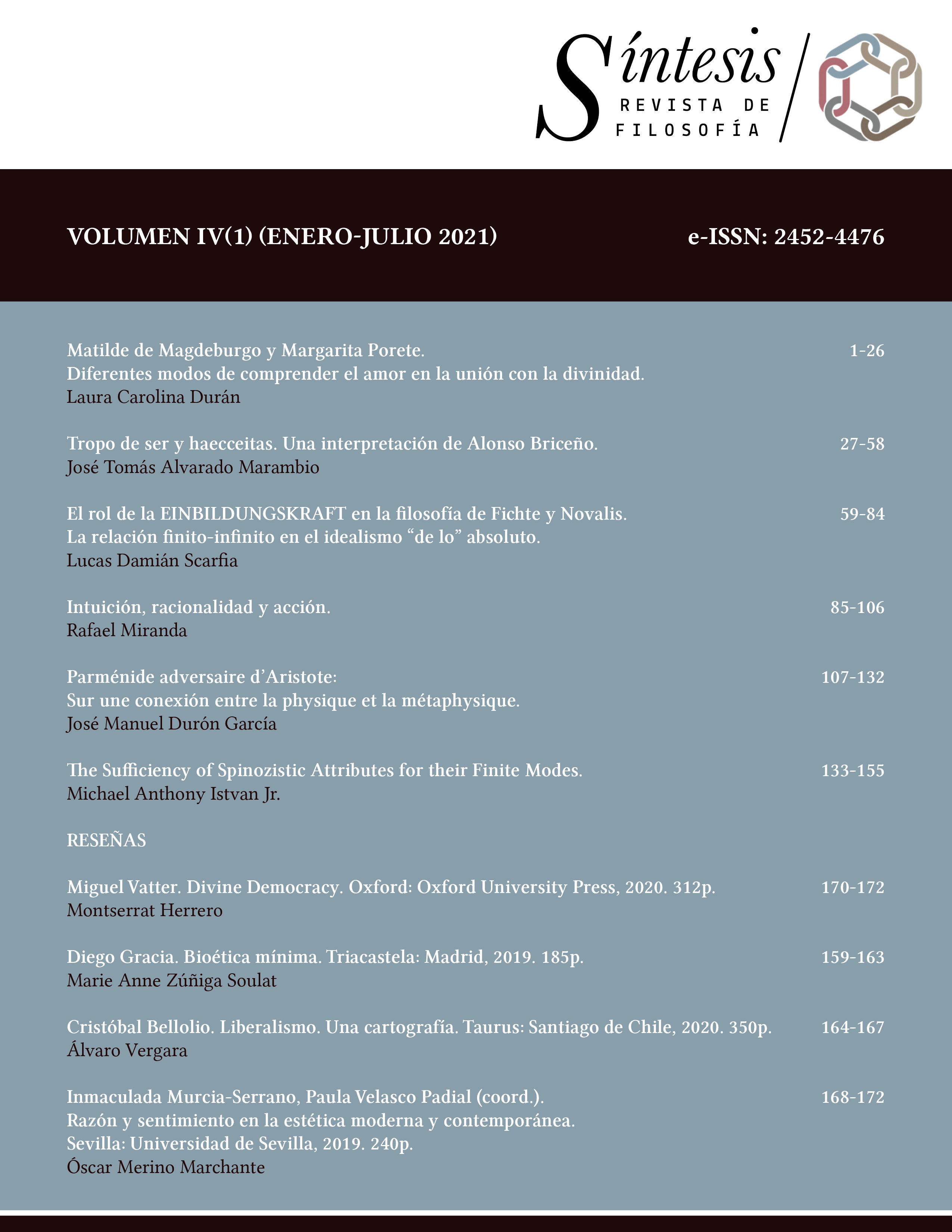
Mechthild of Magdeburg and Marguerite Porete. Different Ways of Understanding Love in Union with Divinity
DOI:
https://doi.org/10.15691/0718-5448Vol4Iss1a345Keywords:
Mystics, Love, Liberty, Mechthild Of Magdeburg, Marguerite PoreteAbstract
This article analyzes the work of two beguines from the 13th century belonging to the so-called vernacular theology. It is proposed to characterize the works of Mechthild of Magdeburg, The Flowing Light of the Goodhead, and Marguerite Porete, The Mirror of Simple Souls, in order to determine the most distinctive traits of the authors. In both works love is central, at the same time it is intimately linked to knowledge. Even so, the reading of the texts and their careful examination allow us to propose that Mechthild’s work is mainly linked to the literature of courtly love, while Marguerite’s, to the time it includes these elements, it is more rooted in the mystique of nothingness, which will later become widely known in tradition through the work of Meister Eckhart. For this reason, the place given to the senses and corporeality acquires greater relevance in Mechthild’s work, while in Marguerite the unitive loving experience is purely spiritual. These nuances in the characterizations of the union with the divinity must be read in their historical context, since during the 13th century and the following a controversy developed on the affective or intellectual character of the mystical union. These different ways of understanding love that we find in the works of these medieval authors represent another way of approaching the idea and function of eros, which from Plato onwards has been one of the central themes of philosophical reflection.
References
Avenati de Palumbo, Cecilia. 2009. “El imaginario de la luz en la mística cortés de Matilde de Magdeburgo. Continuidad y transformación de la herencia hildegariana en el siglo XIII”. Revista de Teología, XLVI, 100: 523-536.
Bradley, Ritamary. 1954. “Backgrounds of the Title Speculum in Medieval Literature”. Speculum, 29, 1, 108: 100-115.
Cirlot, Victoria; Garí, Blanca. 2008. La mirada interior. Escritoras místicas y visionarias en la Edad Media. Madrid: Siruela.
Davies, Oliver. 1991. “Hildegard of Bingen, Mechthild of Magdeburg and the young Meister Eckhart”. Mediaevistik, 4: 37-51.
De Gier, Imke. 2014. “Text as Authority: Marguerite Porete’s Mirouer des simples ames”. En Mulieres religiosae. Shaping Female Spiritual Authority in the Medieval and Early Modern Periods, editado por Veerle Fraeters, Imke De Gier, 127-150. Turnhout: Brepols.
De Libera, Alain. 2020. La invención del sujeto moderno. Buenos Aires: Manantial.
Dickens, Andrea. 2009. The Female Mystic. Great Women Thinkers of the Middle Ages. London/ New York: Tauris.
Dubois, Danielle. 2017. “Natural and Supernatural Virtues in the Thirteenth Century: the case of Marguerite Porete’s Mirror of Simple Souls”. Journal of Medieval History, 43, 2: 174-192.
Elledge, Allison. 2008. Women Mysticism in the Late Middle Ages: The Influence of Affective Love and the Courtly Love Tradition. Master’s The-sis: University of Tennessee.
Field, Sean. 1999. “Annihilation and Perfection in Two Sermon by Gilbert of Tournai for the translation of St. Francis”. Franciscana, 1: 237:274.
Field, Sean. 2012. The Beguine, the Angel and the Inquisitor: The Trials of Marguerite Porete and Guiard of Cressonessart. Notre Dame: University of Notre Dame Press.
Fozzer, Giovanna; Guarnieri, Romana; Vanini, Marco. 1994. Marglierita Porete. Lo specchio delle anime semplici. Testo mediofrancese a fronte. Versiones trecentesca italiana in appendice. Milano: Edizioni San Paolo.
García Acosta, Pablo. 2009. “Poética de la visibilidad del Mirouer des simples âmes de Marguerite Porete”. Tesis Doctoral UPF. Universitat Pompeu Favra.
Garí, Blanca. 1995. “El camino al ‘Pais de la libertad’ en el ‘Espejo de las almas simples’”. Duoda. Revista d’Estudis Feministes, 9: 49-68.
Garí, Blanca. 2005. Margarita Porete. El espejo de las Almas Simples. Cofás: Siruela.
Guarnieri, Romana. 1986. Marguerite Porete. Le Mirouer des Simples Ames. Turnhout: Brepols.
Henricum Oudin Fratres. 1877. Sanctae Mechtildis virginis ordinis Sancti Benedicti Liber specialis gratiae et Liber Lux Divinitatis. Parisiis: Pictavii.
Hollywood, Amy. 1995. The Soul as a Virgin Wife: Mechthild of Magdeburg, Marguerite Porete and Meister Eckhart. Notre Dame/ London: University of Notre Dame Press.
Keul, Hildegund. 2016. Matilde de Magdeburgo. Poeta, beguina, mística. Barcelona: Herder.
Lerner, Robert. 1976. “An Angel of Philadelphia in the Reign of Philip the Fair: The Case of Guiard of Cressonessart”. En Order and Innovation in the Middle Ages: Essays in Honor of Joseph R. Strayer, editado por William Jordan, Bruce Mcnab y Teofilo Ruiz, 343-364. Princeton: Princeton University Press.
Matter, Ann. 1990. The Voice of my Beloved: The Song of Songs in Western Medieval Christianity. Philadelphia: University of Pennsylvania Press.
McGuinn, Bernard. 1998. The Flowering of Mysticism. Men and Women in the New Mysticism. Vol. III. The Presence of God: A History of Western Christian Mysticism. New York: Crossroad Publishing Company.
McGuinn, Bernard. 2001. Meister Eckhart and the Beguine Mystiks. Hadewijch of Bravant, Mechthild of Magdeburg and Marguerite Porete. New York: Continuum.
Mommaers, Paul. 1962. “La transformation d’amour selon Marguerite Porete”. Ons Geestelijk Erf, 65: 88-107.
Morino, Angelo. 1995. “Introduzione”. En Lo specchio delle anime semplice by Margarite Porete, traduzione di Donata Ferold, 9-25. Palermo: Sellerio.
Muraro, Luisa. 1995. Lingua materna scienza divina. Scritti sulla filosofia mistica di Margherita Porete. Napoli: M. D’Auria Editore.
Newman, Barbara. 1995. From Virile Woman to WomanChrist. Studies in Medieval Religion and Literature. Philadelphia: University of Pennsylvania Press.
Otero Villena, Almuneda. 2016. Matilde de Magdeburgo. La luz que fluye de la divinidad. Barcelona: Herder.
Pereira, Micaela. 1998. “Margherita Porete nello specchio degli studi recenti”. Mediaevistik, 11: 71-96.
Poor, Sara. 2014. “Transmission and Impact: Mechthild of Magdeburg’s Das fließende Licht der Gottheit”. En A Companion to Mysticism and Devotion in Northern Germany in the Late Middle Ages, editado por Elizabeth Andersen; Henrike Lahnemann; Anne Simon, 73-102. Leiden: Brill.
Rudy, Gordon. 2002. Mystical Language of Sensation in the Later Middle Ages. New York: Routledge.
Ruh, Kurt. 1977. “Beginenmystik. Hadewijch, Mechthild von Magdeburg, Marguerite Porete”. Zeitschrift für deutsches Altertum und deutsche Literatur, 106, 3: 265-277.
Schmidt, Margot. 1985. “Elemente der Schau bei Mechthild von Mandeburg und Mechthild von Hackerborn: Zur Bedeutung der geist-lichen Sinne”. En Fraauenmystik im Mittelalter, editado por Peter Dinzelbacher y Dieter R. Bauer, 137-139. Stuttgart: Schwabenverlag.
Sells, Michael. 2001. “Tres seguidores de la religión del amor: Niẓām, Ibn ‘Arabī y Marguerite Porete”. En Mujeres de luz. La mística femenina, lo femenino en la mística, editado por Pablo Beneito; Lorenzo Piera; Juan José Barcenilla, 137-156. Madrid: Trotta.
Stabler Miller, Tanya. 2014. The Beguines of Medieval Paris: Gender, Pat-ronage, and Spiritual Authority. Philadelphia: University of Pennsylvania Press.
Tobin, Frank. 2001. “Mechthild of Magdeburg and Meister Eckhart. Points of Coincidence”. En Meister Eckhart and the Beguine Mystiks. Hadewijch of Bravant, Mechthild of Magdeburg and Marguerite Porete, editado por Bernard McGuinn, 44-64. New York: Continuum.
Verdeyen, Paul. 1986. “Le procès d’Inquisition contre Marguerite Porete et Guiard de Cressonessart (1309-1310)”. Revue d’historie ecclésiastique, 81: 48-94.
Von Balthasar, Hans U. 1955. “Mechthild kirchlicher Auftrag”. En Das fließende Licht der Gottheit, editado por Margot Schmidt, 19-45. Einsendeln: Benziger.
Voss Roberts, Michelle. 2008. “Flowing and Crossing: The Somatic Theologies of Mechthild and Lalleśwarī”. Journal of the American Academy of Religion, 76, 3: 638-663.
Walker Bynum, Caroline. 1992. Fragmentation and Redemption: Essays on Gender and the Human Body Part One. New York: Zone.
Downloads
Published
Issue
Section
License
Authors who publish with this journal agree to the following terms:- Authors retain copyright and grant the journal right of first publication with the work simultaneously licensed under a Creative Commons Attribution License that allows the use, transformation, and distribution for any purpose, as long as the author is recognized, and in the event of changes or developements are made from it, the derivate work be shared under the same license.
- Authors are able to enter into separate, additional contractual arrangements for the non-exclusive distribution of the journal's published version of the work (e.g., post it to an institutional repository or publish it in a book).
- Authors are permitted and encouraged to post their work online (e.g., in institutional repositories or on their website) prior to and during the submission process, as it can lead to productive exchanges, as well as earlier and greater citation of published work (See The Effect of Open Access).