
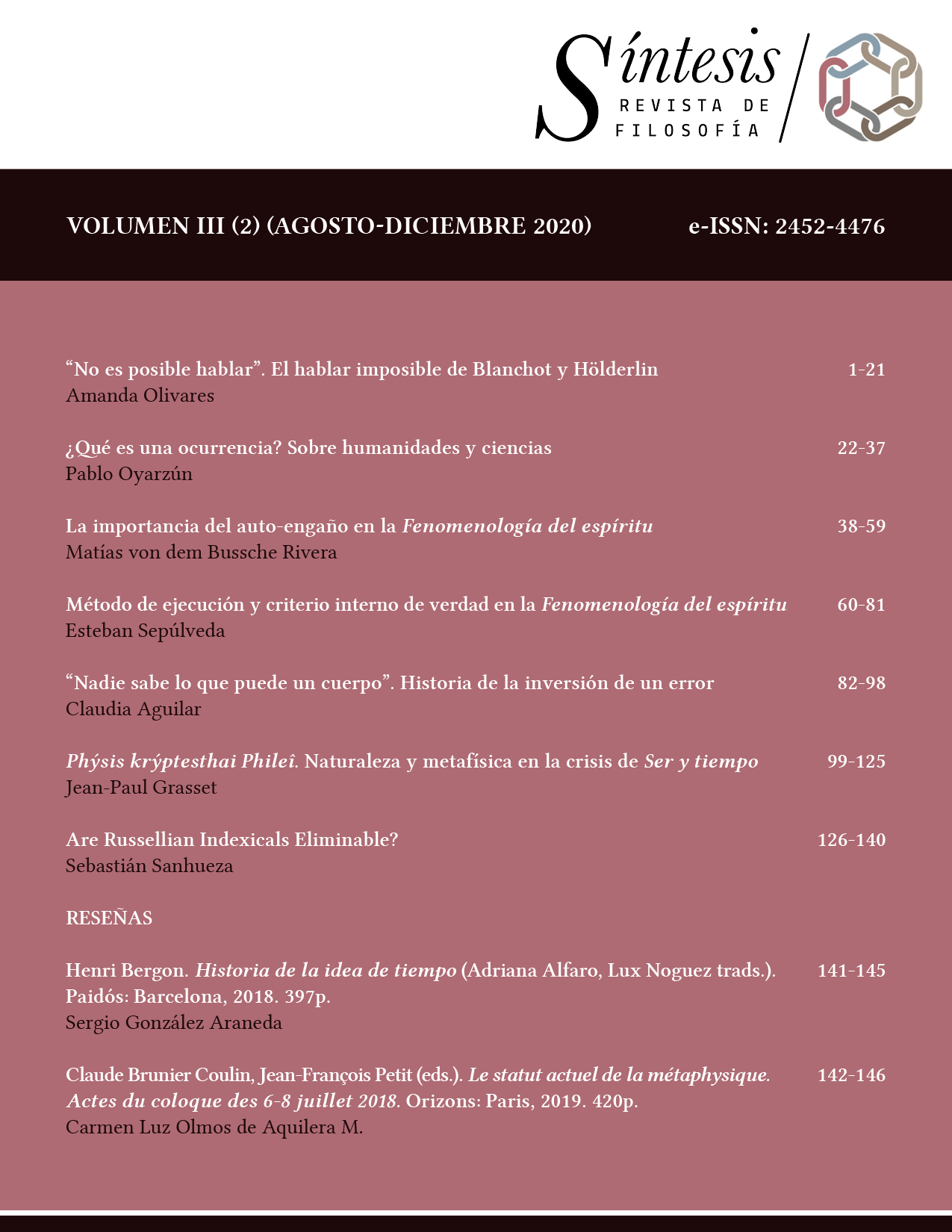
Phýsis krýptesthai phileî. Nature and Metaphysics in the Crisis of Being and Time
DOI:
https://doi.org/10.15691/0718-5448Vol3Iss2a332Keywords:
Nature, Concealment, Phýsis, Metaphysics, entityAbstract
In this paper, I will expound Heidegger’s concept of phýsis in the years 1927-30. This concept appears in the doctrine of Welteingang des Seienden, in the frame of a ‘radicalization of the ontology’, a metaphysical project that later will generate a crisis, leading Heidegger to reinterpret the question of the meaning of being as the question of the truth of Being. I will show that the question of phýsis contributes with some elements to that crisis and to a later change of approach in the philosophical-historical field and the phenomenological one. My hypothesis is that the recourse to the concept of phýsis in the context of Welteingang des Seienden doctrine’s is a speculative resource that aims to clarify the sense in which the natural being is, but without appearing within the world, in terms of a ‘transition’ from complete concealment (phýsis) to Unconcealment (alétheia). This will have consequences for the evaluation of the metaphysical tradition. The latter will be understood as a question about phýsis in the double meaning of being in totality, and the being of beings or essentiality.
References
Aubenque, Pierre. 1977=1962. Le problème de l’être chez Aristote, Paris: PUF.
Aubenque, Pierre et alii. 1985. Études aristotéliciennes. Métaphysique et théologie, Paris: Vrin.
Aristóteles 1990. Metafísica. Madrid: Gredos.
Beelman, Axel. 1994. Heideggers hermeneutischer Lebensbegriff. Würz-burg: Königshausen & Neumann.
Biemel, Walter. 1950. Le concept de monde chez Heidegger. Louvain: Nauvelaerts.
Calvo Martínez, Tomás. 2000. “La noción de Physis en los orígenes de la filosofía griega”, Daímon. Revista de Filosofía 21.
Cornford, Francis MacDonald. 1984. De la religión a la filosofía. Barcelona: Ariel.
_______. 1987. Principium sapientiae. Los orígenes del pensamiento filosófico griego. Madrid: Visor.
Courtine, Jean-François (ed.). 1996. Heidegger 1919-1929. De l’hermeneutique de la facticité a la métaphysique du ‘Dasein’. Paris: Vrin.
Crowell, Steven G. 2001. Husserl, Heidegger, and the Space of Meaning: Paths Toward Transcendental Phenomenology. Evanston, IL: Northwestern University Press.
Dastur, Françoise. 1995. “Pour une zoologie privative”. Alter. Revue de phénoménologie 3: 281-317.
Figal, Günter. 2008. “Heidegger y la fenomenología”. In Félix Duque (ed.), Heidegger, sendas que vienen. Madrid: UAM Ediciones.
Gabriel, Markus. 2017. Sentido y existencia. Una ontología realista (R. Gabás trad.). Barcelona: Herder.
Gadamer Hans-Georg. 1996. Mis años de aprendizaje. Barcelona: Herder.
_______. 1999. El inicio de la filosofía occidental. Barcelona: Paidós.
Greisch, Jean. 2010. La invención de la diferencia ontológica. Heidegger des-pués de Ser y Tiempo. Buenos Aires: Las Cuarenta.
Guthrie, William Keith Chambers. 1984. Historia de la filosofía griega I. Los primeros presocráticos y los pitagóricos. Madrid: Gredos.
_______. 1986. Historia de la filosofía griega II. La tradición presocrática desde Parménides a Demócrito. Madrid: Gredos.
Haar, Michel. 2002. Heidegger et l’essence de l’homme. Paris: J. Millon.
Heidegger, Martin. 1950. Holzwege, GA Bd. 5. Frankfurt a. M.: V. Kloster-mann.
_______. 1975. Grundprobleme der Phänomenologie, GA Bd. 24. Frankfurt a.M.: V. Klostermann.
_______. 1976. Wegmarken, GA Bd. 9. Frankfurt a.M.: V. Klostermann.
_______. 1978. Metaphysische Anfangsgründe der Logik im ausgang von Leib-niz, GA Bd. 26. Frankfurt a.M.: V. Klostermann.
_______. 1979. Heraklit, GA Bd. 55. Frankfurt a.M.: V. Klostermann.
_______. 1983a. Die Grundbegriffe der Metaphysik. Welt-Endlichkeit-Einsamkeit, GA Bd. 29/30. Frankfurt a.M.: V. Klostermann.
_______. 1983b. Einführung in die Metaphysik, GA Bd. 40. Frankfurt a.M.: V. Klostermann.
_______. 1996. Einleitung in die Philosophie, GA Bd. 27. Frankfurt a.M.: V. Klosterman.
_______. 1997. Der deutsche Idealismus (Fichte, Schelling, Hegel) und die philosophische Problemlage der Gegenwart, GA, Bd. 28. Frankfurt a.M.: V. Klostermann.
_______. 2006a. Sein und Zeit. Tübingen: M. Niemeyer
_______. 2006b. Geschichte der Philosophie von Thomas von Aquin bis Kant, GA Bd. 23. Frankfurt a.M.: Vittorio Klostermann.
_______. (2013-2014) Das Argument gegen den Brauch (für das Ansichsein des Seienden-«der Natur»), Jahresgabe der Martin-Heidegger-Gesellschaft.
Jaeger, Werner. 1993. La teología de los primeros filósofos griegos. Ma-drid: FCE.
Jaran, François. 2018 “El tránsito hacia un nuevo comienzo: la metafísica del Dasein (1927-1930”. In Rodríguez, R. (ed.), Guía Comares de Heidegger. Barcelona: Comares: 75-98.
_______. 2010a. La métaphysique du Dasein. Heidegger et la possibilité de la metaphysique (1927–1930). Bucharest: Zeta Books.
_______. 2010b. “Toward a Metaphysical Freedom: Heidegger’s Project of a Metaphysics of Dasein”. International Journal of Philosophical Studies 18-2: 205-227.
_______. 2008. “Una metafísica como remedio a la ‘desolación total de la si-tuación filosófica’ de los años 1920 (Martin Heidegger, Max Sche-ler)”. Pensamiento 64-241: 389-407.
_______. 2006. “La pensée metaphysique de Heidegger. La transcendance du Dasein comme source d’une metaphysica naturalis”. Les études philosophiques 76-1: 47-61.
Llorente, Jaime. 2013. “Transitividad y fundamento. Reinterpretación del concepto de phýsis desde la perspectiva de una ontología negativa”. Eikasía. Revista de Filosofía 49: 119-145.
Misch, Georg. 1967. Phänomenologie und Lebensphilosophie. Eine Auseinandersetzung der Diltheyschen Richtung mit Heidegger und Husserl. Darmstadt: WissenschaftlicheBuchgesellschaft.
Muñoz, Enrique. 2008. Der Mensch im Zentrum, aber nicht als Mensch. Zur Konzeption des Menschen in der ontologischen Perspektive Martin Heidegger. Würzburg: Ergon.
Onians, Richard Broxton. 1951. The Origins of European Thought about the Body, the Mind, the Soul, the World, Time and Fate. New York: Cambridge University Press.
Ramos dos Reis, Róbson. 2010 “Natureza e normatividade na hermenêutica ontológica de Martin Heidegger”. Natureza Humana 12-1: 1-46.
Reale, Giovanni. 1993. Aristotele, La Metafisica, vol. I-III, Milano.
_______. 1994. Il concetto di “Filosofia Prima” et l’unità della Metafisica di Aristotele, Milano: Vita e pensiero.
Riedel, Manfred. 1989. “Naturhermeneutik und Ethik im Denken Heideggers”. Heidegger Studies 5: 153-172.
_______. 1991. “Das Natürliche in der Natur.” In H.-H. Gander (ed.) Von Heidegger her. Martin Heidegger Gesellschaft – Schriftenreihe. Band 1. Frankfurt am Main: V. Klostermann: 51-72.
Ross, William David. 1924. Aristotle’s Metaphysics, vol. I-II, Oxford: Oxford University Press.
_______. 1936. Aristotle’s Physics, Oxford: Oxford University Press.
Rubio, Roberto. 2004. “El concepto heideggeriano de ‘formación de mundo’ y su contexto”. Escritos de Filosofía 44: 227-246.
_______. 2008. “¿Continuidad de la cuestión de Dios en el pensar de Heideg-ger?La especificidad del planteo heideggeriano tras la crisis de Ser y Tiempo”. Teología y Vida XLIX: 289-303.
_______. 2010 “Naturaleza y mundo en la transición del pensar de Heideg-ger tras Ser y Tiempo”. In Actas del II Congreso Internacional de Fenomenología y Hermenéutica, Universidad Nacional Andrés Bello. San-tiago: UNAB.
Tengelyi, László. 2014. Welt und Unendlichkeit. Zum Problem phänomenologischer Metaphysik. Freiburg; München: Karl Alber Verlag.
Thurnher, R. 1997. Wandlungen der Seinsfrage. Zur Krisis im Denken Heideggers nach “Sein und Zeit”. Tübingen: Attempto Verlag.
Van Buren, John. 1994. The Young Heidegger. The Rumor of a Hidden King. Indiana: Indiana University Press.
Vigo, Alejandro. 2007. Aristóteles. Una introducción. Santiago: IES.
_______. 2008. Arqueología y aleteiología y otros estudios heideggerianos. Buenos Aires: Biblos.
_______. 2011. Estudios aristotélicos. Pamplona: Eunsa.
Volpi, Franco. 2012. Heidegger y Aristóteles. Buenos Aires: FCE.
Von Herrmann, Friedrich-Wilhelm. 1997. La ‘segunda mitad’ de Ser y Tiempo. Sobre Los problemas fundamentales de la Fenomenología de Heidegger. Madrid: Trotta.
Wieland, Wolfgang. 1962. Die aristotelische Physik. Untersuchungen über die Grundlegung der Naturwissenchaft un die sprachlichen Bedingungen der Prinzipienforschung bei Aristoteles. Göttingen: Vandenhoeck & Ruprecht.
Xolocotzi, Ángel. 2004 Fenomenología de la vida fáctica. Heidegger y su camino a Ser y Tiempo. México: Plaza y Valdés.
_______. 2005. “Fundamento, esencia y Ereignis. En torno a la unidad del camino del pensar de Martin Heidegger”. Endoxa: Series Filosóficas 20: 733-744.
_______. 2009. Facetas heideggerianas. Puebla: Los Libros de Homero.
Downloads
Published
Issue
Section
License
Authors who publish with this journal agree to the following terms:- Authors retain copyright and grant the journal right of first publication with the work simultaneously licensed under a Creative Commons Attribution License that allows the use, transformation, and distribution for any purpose, as long as the author is recognized, and in the event of changes or developements are made from it, the derivate work be shared under the same license.
- Authors are able to enter into separate, additional contractual arrangements for the non-exclusive distribution of the journal's published version of the work (e.g., post it to an institutional repository or publish it in a book).
- Authors are permitted and encouraged to post their work online (e.g., in institutional repositories or on their website) prior to and during the submission process, as it can lead to productive exchanges, as well as earlier and greater citation of published work (See The Effect of Open Access).