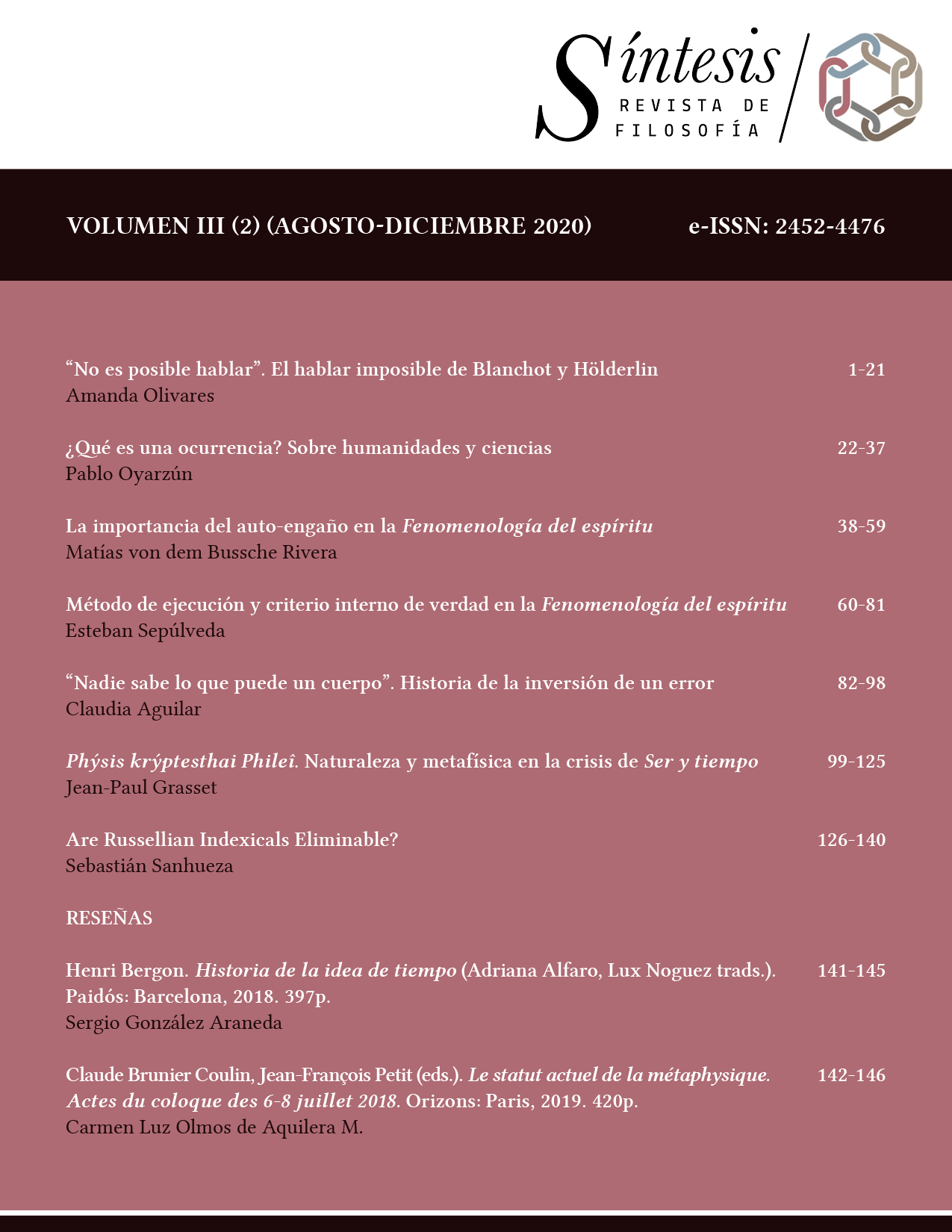
What is an Occurrence? On the Humanities and Sciences
DOI:
https://doi.org/10.15691/0718-5448Vol3Iss2a328Keywords:
Lichtenberg, economía del conocimiento, pa-perAbstract
First, I discuss the asymmetric relationship between the humanities and sciences in contemporary institutions of knowledge by suggesting the trouble of emphasizing the difference between them, given that both epistemic orders today are subordinate to the same structural conditionings. I shall analyse the effects that these conditionings have on the humanities by focusing on two critical issues. Second, I discuss the epistemic signification of occurrence as a principle shared by the sciences and humanities, by resorting to the exemplary case of the work of Georg Christoph Lichtenberg. In this work, experimentalism and essay, singularities, fiction and variation account for the same epistemic outbreak in the humanities (and literature) and sciences.
References
Blair, Ann. 1992. “Humanist methods in Natural Philosophy: The Commonplace Book”. Journal of the History of Ideas 53-4: 541-551.
Blair, Ann. 2004. “Note Taking as an Art of Transmission”. Critical Inquiry 31-1: 85-107.
Campe, Rüdiger. 2011. “‘Unsere kleinen blinden Fertigkeiten’. Zur Entstehung des Wissens un zum Verfahren des Schreibens in Lichtenbergs Sudelbüchern”. In Ulrich Joost, Alexander Neumann (coor.), Lichtenberg-Jahrbuch, Heidelberg: Universitäts Verlag Winter: 7-32.
Daston, Lorraine. 2004. “Taking Note(s)”. Isis 95-3: 443-448.
Lichtenberg, Georg Christoph. 1980. Sudelbücher I.
Herausgegeben von Wolfgang Promies. München: Deutscher Taschenbuch Verlag.
______. 1991. Sudelbücher II. Materialhefte, Tagebücher. Herausgegeben von Wolfgang Promies. München: Deutscher Taschenbuch Verlag.
______. 1972. Schriften und Briefe III. Herausgegeben von Wolfgang Promies. München: Deutscher Taschenbuch Verlag.
Oyarzun, R., Pablo. 2008. “Sobre el concepto de calidad académica”. In Olga Grau y Patricia Bonzi (eds.), Grafías filosóficas. Problemas actuales de la filosofía y su enseñanza. Santiago: Cátedra UNESCO de Filosofía: 47-58.
Pfannkuchen, Antje. 2016. “A Matter of Visibility. G. Chr. Lichtenberg’s Art and Science of Observation”. Configurations 24-3: 375-400.
Poe, Edgar Allan. 1978. The Collected Works of Edgar Allan Poe. II Tales and Sketches (1831-1842). (Thomas Olive Mabbott ed.). Cambridge, MA: The Belknap Press of Harvard University Press. En línea:https://www.eapoe.org/works/mabbott/tom3t011.htm#nnmotto
Schöne, Albrecht. 1993. Aufklärung aus dem Geist der Experimentalphysik. Lichtenbergsche Konjunktive. München: C. H. Beck.
Snow, Charles Percy. 2012. The Two Cultures. With Introduction by Stefan Collini. Cambridge: Cambridge University Press.
Spinoza, Baruj. 2020. Œuvres IV. Ethica. Éthique. Texte établie par Fokke Akkerman et Piet Steenbakkers. Traduction par Pierre-François Moreau. Introduction et notes par Pierre-François Moreau et Piet Steenbakkers. París: PUF.
Yehige, Yftach, and Stuart, Michael T. 2004. “On the Origin of the Philosophy of Thought Experiments: The Forerun”. Perspectives on Science 22-2, 179-220.
Downloads
Published
Issue
Section
License
Authors who publish with this journal agree to the following terms:- Authors retain copyright and grant the journal right of first publication with the work simultaneously licensed under a Creative Commons Attribution License that allows the use, transformation, and distribution for any purpose, as long as the author is recognized, and in the event of changes or developements are made from it, the derivate work be shared under the same license.
- Authors are able to enter into separate, additional contractual arrangements for the non-exclusive distribution of the journal's published version of the work (e.g., post it to an institutional repository or publish it in a book).
- Authors are permitted and encouraged to post their work online (e.g., in institutional repositories or on their website) prior to and during the submission process, as it can lead to productive exchanges, as well as earlier and greater citation of published work (See The Effect of Open Access).