
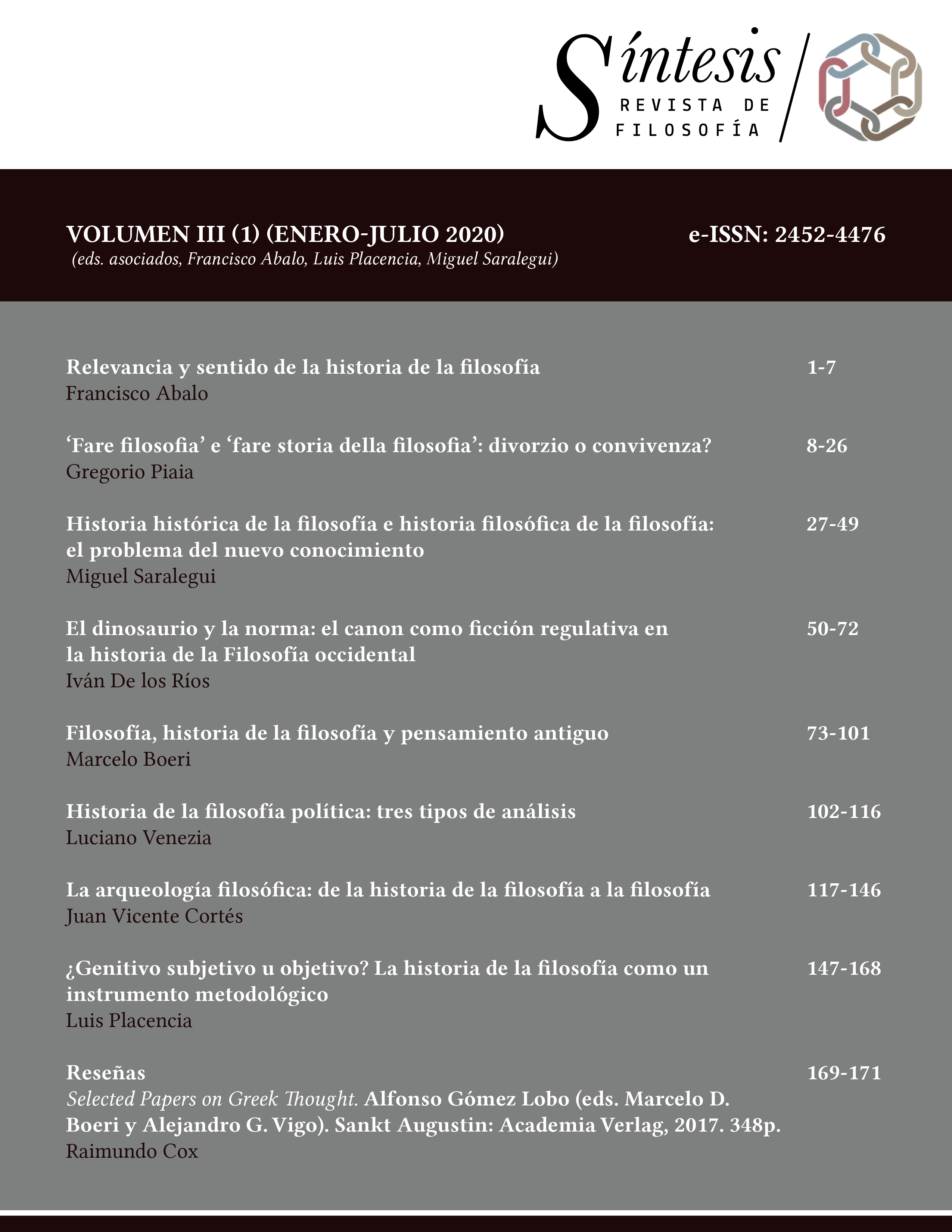
Subjective of Objective Genitive? The History of Philosophy as a Methodological Instrument
DOI:
https://doi.org/10.15691/0718-5448Vol3Iss1a315Keywords:
history of philosophy, method, philosophical dialogue, understandingAbstract
The expression “history of philosophy” con-sists of multiple components. Some of them (“history”, “philosophy”) have been the object of philosophical attention for several centuries. Therefore, much has been said on the sense by which the history of philosophy is “philosophy” or “history”. In this article, I aim to account for the way we can address this question from a different perspective, that is, engaging with the problem of the genitive implicit in the expression “history of philosophy”. To this end, I shall present different models of interpretation of the relation of philosophy to its own history, which hinge on the presupposition that a clear-cut distinction exists between them. I shall demonstrate that the models developed here are inadequate and unable to ac-count for the methodic function that the his-tory of philosophy has for philosophy.
References
Austin, John. 1979. “A plea for excuses”. En Philosophical papers, 175-204. Oxford: OUP.
Beck, Lewis White. 1969. Early german Philosophy. Bristol: Thoemmes press.
Bloch, Marc. 1949. Apologie pour L’histoire ou Métier d’Historien. Paris: Libraire Armand Colin.
Bodéüs, Richard. 2002. Aristote. Catégories. Texte établi et traduit par R. Bodéüs, Paris: PUF.
Brandt, Reinhardt. 1984. Die Interpretation philosophischer Werke. Ein Einführung in das Studium antiker und neuzeitlicher Philosohie. Stuttgart-Bad Cannstatt: Frommann-Holzboog.
Cramer, Konrad. 2013. „Das philosophische Interesse an der Geschichte der Philosophie“. En Subjektivität und Autonomie, editado por Stefan Lang & Lars-Thade Ulrichs, 33-50. Berlin-Boston: Walter de Gruyter.
Curley, Edwin. 1986. “Dialogues with the dead”, Synthese 67 1986: 33-49.
Donagan, Alan. 1994. “The history of philosophy as discipline”. En The philosophical papers of Alan Donagan, editado por Jeff Malpas, 1-13. Chicago: Chicago University Press.
Dumoulin, Bertrand. 1983. “L’ousia dans les catégories et dans la métaphysique”. En Zweifelhaftes im Corpus Aristotelicum. Studien zu einigen Dubia. Akten des 9. Symposium Aristotelicum, editado por Jürgen Wiesner, 57-72. Berlin-New York: Walter de Gruyter.
Dupreél, Eugène. 1909. “Aristote et le Traité des Categories”, Archiv für Geschichte der Philosophie 1909: 230-251.
Erdmann, Benno. 1878. Kants Prolegomena zu einer jeden künftigen Metaphysik, die als Wissenschaft wird auftreten können. Herausgegeben und historisch erklärt von B. Erdmann, Leipzig: Leopold Voss 1878.
Frede, Michael.1983. „Titel, Einheit und Echtheit der aristotelischen Kategorienschrift“. En Zweifelhaftes im Corpus Aristotelicum. Studien zu einigen Dubia. Akten des 9. Symposium Aristotelicum, editado por Jürgen Wiesner, 1-29. Berlin-New York: Walter de Gruyter.
Gadamer, Hans-Georg. 1986. „Vom Zirkel des Verstehens“. En Gesammelte Werke. Band 2, 57-65. Tübingen: Mohr & Siebeck.
Ginzburg, Carlo. 1991. Il giudice e lo Storico. Considerazioni in margine al proceso Sofri. Torino: Einaudi.
_______ 2010. El Hilo y las Huellas. Lo verdadero, lo falso, lo ficticio. Traducción de Luciano Padilla López. México DF: FCE.
_______ 2012. Threads and Traces. True, false, fictive. Translated by Anne C. Tedeschi and John Tedeschi. Berkeley-Los Angeles: University of California Press.
Gracia, Jorge. 1992. Philosophy and its History. Issues in philosophical Histori-ography. Albany: SUNY. 1992.
Gueroult, Martial. 1969: “The history of philosophy as a philosophical problem”, The monist 53: 563-587.
Hegel, Georg Friedrich Wilhelm. 1959 (= Enzyklopädie). Enzyklopädie der philosophischen Wissenschaften im Gründrisse. Neu herausgegeben von Friedhelm Nicolin und Otto Pöggeler. Hamburg: Felix Meiner.
_______ 1970 (= TA). Werke in 20 Bänden, Frankfurt am Main: Suhrkamp 1970.
Hinske, Norbert. 1970. Kants Weg zur Transzendental-philosophie. Der dreißigjährige Kant.
Suttgart: Kohlhammer.
Husik, Isaac. 1904: “On the categories of Aristotle”, The Philosophical Review 13: 514-528.
_______ (1939): “The authenticity of Aristotle’s Categories”, The Journal of Phi-losophy 36: 427-431.
Jaeger, Werner. 1948. Aristotle. Fundamentals of the history of his development, Oxford: OUP.
Kant, Immanuel. 1902-2009 (= AA) Kant’s gesammelte Schriften. Herausgege-ben von der Preussischen bzw. von der, Berlin: Reimer.
_______. 1956 (= KrV). Kritik der reinen Vernunft. Herausgegeben von Ray-mund Schmidt. Hamburg: Felix Meiner.
Kreimendahl, Lothar. 1990. Kant. Der Durchbruch von 1769. Köln: Dinter Verlag.
Kuehn, Manfred. 2000. Kant. A Biography. Cambridge: CUP.
Mansion, Suzanne. 1946. “La première doctrine de la substance: la substance selon Aristote”, Revue philosophique de Louvain 44: 349-369.
Nietzsche, Friedrich. 1972 (=NW). Nietzsche Werke. Herausgegeben von G. Col-li und M. Montinari, Berlin-New York: Walter de Gruyter.
Olimpiodoro. 1992. Olympiodori Prolegomena et in Categorias Commentarium. Edidit Adolfus Busse. Berlin: Georg Reimer.
Paulsen, Friedrich. 1875. Versuch einer Entwicklungsgeschichte der kantischen Erkenntnistheorie, Leipzig: Fues՚s.
_______ 1924. Immanuel Kant. Sein Leben uns seine Lehre, Stuttgart: Frommann.
Placencia, Luis. 2019. Handlung und praktisches Urteil bei Kant. Eine historische und systematische Untersuchung zu Kants Konzeption des absichtli-chen Handelns und ihren urteilstheoretischen Voraussetzungen. Freiburg-München.
Puntel, Lorenz. 1991. “The history of philosophy in contemporary philosophy. The view from Germany”, TOPOI 10: 147-153.
_______ 2001. „Über das komplexe Verhältnis der Philosophie zu ihrer Geschichte“. En Kant Verstehen – Understanding Kant, editado por Dieter Schönecker & Thomas Zwenger, 132-158. Darmstadt: WBG.
Reich, Klaus. 1958. I. Kant. Über die Form und die Prinzipien der Sinnen und Geisteswelt, Hamburg: Felix Meiner.
Ricoeur, Paul. 1986. “La fonction herméneutique de la distanciation”. En Du texte à l’action, 113-131. Paris: Éditions du Seuil.
Rijk, de Lambertus Marie. 1951. “The authenticity of Aristotle’s Categories”, Mnemosyne 4: 129-158.
Schmucker, Joseph. 1974. „Zur entwicklungsgeschichtlichen Bedeutung der Inauguraldissertation von 1770“, Kant-Studien 65: 263-282.
Simplicio: Simplicii in Aristotelis Categorias Commentarium. Edidit Carolus Kalbfleisch, Berlin 1907.
Sorell, Tom. 2005. “On saying No to History of Philosophyˮ. En Analytic Philosophy and History of Philosophy, editado por Tom Sorell & G. A. J. (John) Rogers, 43-59. Oxford: OUP.
Spinoza, Baruch. 2012 (= TTP). Oeuvres: Tome 3, Traité théologico-politique. Texte établi par Fokke Akkerman et traduit par Jacqueline Lagrée et Pierre-François Moreau. Paris: PUF.
Stekeler-Weithofer, Pirmin. 2006. Philosophiegeschichte, Berlin-New York: Walter de Gruyter.
Wieland, Wolfgang. 1992. Die aristotelische Physik, Göttingen: Vandehoeck & Ruprecht.
_______ 1995. „Über den Grund des Interesses der Philosophie an ihrer Geschichte“. En Veritas filia temporis? Philosophiehistorie zwischen Wahrheit und Geschichte, editado por Rolf Puster, 9-30. Berlin-New York: Walter de Gruyter.
Vigo, Alejandro 2001. “Platón, en torno a las condiciones y función del diálogo cooperativo”, Tópicos (Santa Fé) 9: 5-41.
_______ 2013. Juicio, experiencia, verdad. De la lógica de la validez a la fenomenología. Pamplona: EUNSA.
Williams, Bernard. 2007. “Descartes and the historiography philosophy”. En The sense of the past. Essays in the history of philosophy Williams, editado por Myles Burnyeat, 257-264. New Jersey: Princeton University Press.
Wilson, Margaret. 1978. Descartes, London-Boston: Routledge & K. Paul.
Downloads
Published
Issue
Section
License
Authors who publish with this journal agree to the following terms:- Authors retain copyright and grant the journal right of first publication with the work simultaneously licensed under a Creative Commons Attribution License that allows the use, transformation, and distribution for any purpose, as long as the author is recognized, and in the event of changes or developements are made from it, the derivate work be shared under the same license.
- Authors are able to enter into separate, additional contractual arrangements for the non-exclusive distribution of the journal's published version of the work (e.g., post it to an institutional repository or publish it in a book).
- Authors are permitted and encouraged to post their work online (e.g., in institutional repositories or on their website) prior to and during the submission process, as it can lead to productive exchanges, as well as earlier and greater citation of published work (See The Effect of Open Access).