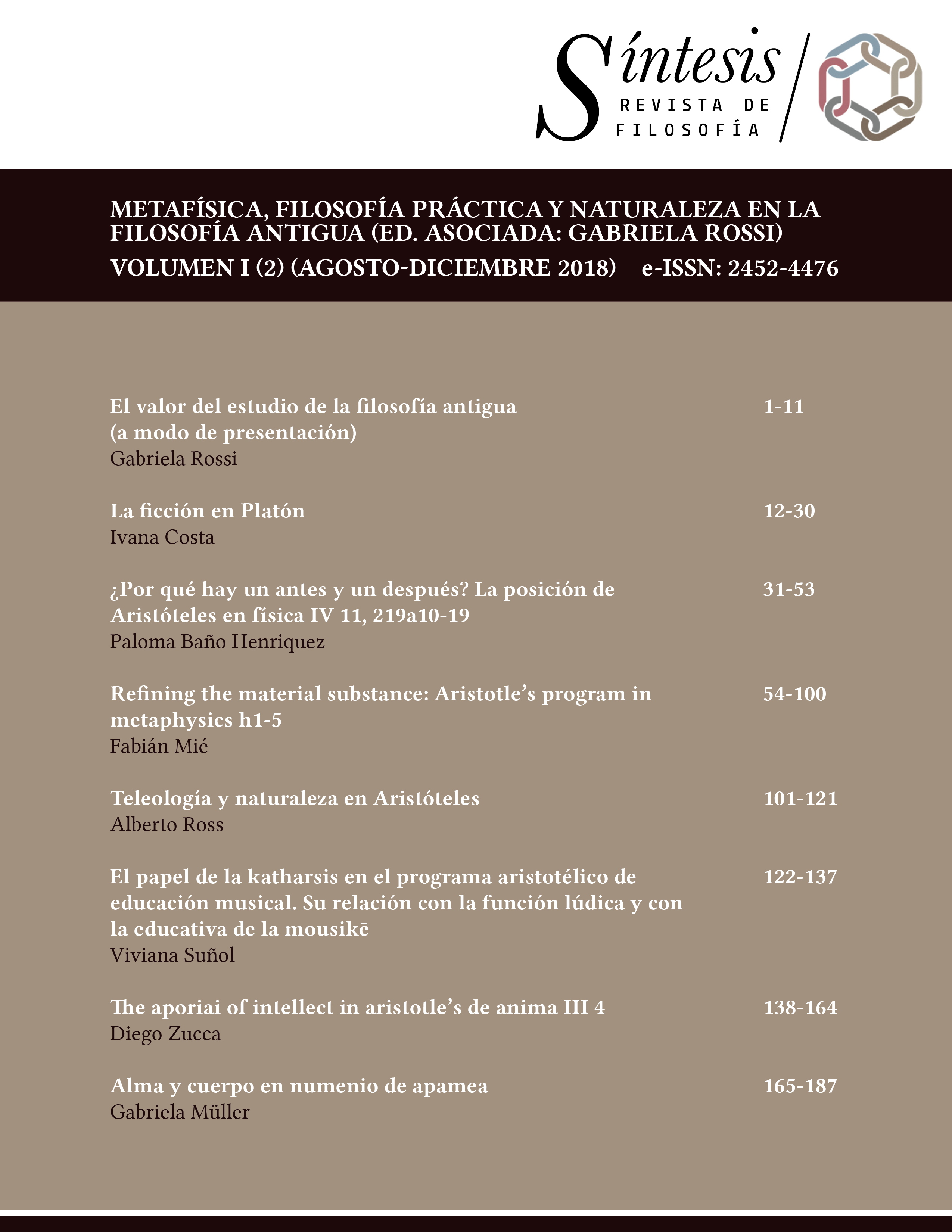
FICTION IN PLATO
DOI:
https://doi.org/10.15691/0718-5448Vol1Iss2a241Keywords:
Plato, fiction, truth, falsityAbstract
In philosophy, fictions are employed in different manners: metaphors, hypothesis, mental experiments and postulates, whose theoretical falsity is admitted, but which are nonetheless used because of their practical value, or because they can contribute to shape rationality. This procedure is not alien to Plato, who employs fictions profusely in his dialogues. This paper has two parts: the first one makes a quick review of the history of the meanings of “fiction” (focusing the lexical family of plassō/plasma) in order to underline the philosophical relevance of its connotations. In the second one, I argue in favor of reading “fiction” to refer to one of the two senses of falsity –a sense we could call conscious falsity– that Plato distinguishes in Republic II-III.
References
Instrumentos léxicos
H.G. Lidell y R. Scott. 1968. A Greek-English Lexicon. With a new edition by H.S. Jones, Oxford, Clarendon Press.
Chantraine, P. 1968. Dictionnaire Étimologique de la Langue Grecque. Histoire des Mots (4 vol.), París, Éditions Klincksieck.
Edición y traducciones de los diálogos
Burnet, J. 1903-1995. Platonis Opera, I-VI, Oxford, Oxford Classical Texts.
Eggers Lan, C. 1986. República, en Platón, Diálogos IV, Madrid, Gredos.
Eggers Lan, C. 1999. Platón - Timeo (trad., introd. y notas de C. E. L.), Buenos Aires, Colihue.
Gómez Lobo, A. 2002. Platón - Menón (trad., análisis y notas de A. G. L.), Santiago de Chile, Editorial Universitaria.
Lisi, F. 1996. Timeo, en Platón, Diálogos VII, Madrid, Gredos.
Lisi, F. 1999. Leyes, en Platón, Diálogos VIII-IX, Madrid, Gredos.
Vigo, A. 2012. Platón - Fedón (trad., introd. y notas de A. V.), Buenos Aires, Colihue.
Edición y traducciones de Aristóteles
Ross, W. D. 1924. Aristotle’s Metaphysics, Oxford, Clarendon Press.
Candel, M. 1993. Aristóteles, Acerca del cielo (trad., introd. y notas de M.C.), Madrid, Gredos
Peck, A. L. 1943. Aristotle - Generation of Animals (transl. by A. L. P.), Cambridge, Harvard University Press.
Zucchi, H. 2004. Aristóteles - Metafísica (trad., introd. y notas de H. Z.), Buenos Aires, Sudamericana.
Bibliografía secundaria citada
Cléro, J.-P. 2014. Essai sur les fictions, Paris, Hermann.
Düring, I. 1987. Aristóteles. Exposición e interpretación de su pensamiento, México, FCE.
Ferrari, F. 2006. I miti di Platone, Milano, Rizzoli.
Gill, C. 1993. “Plato on Falsehood-not Fiction”, en C. Gill y T. Wiseman (eds.), Lies and Fiction in the Ancient World, University of Exeter Press, pp. 38-87.
Guthrie, W. K. C. 1994. Historia de la filosofía griega, vol. III: Siglo V - Ilustración, Madrid, Gredos.
Kenyon, F. G. 1951. Books and Readers in Ancient Greece and Rome, Oxford, Clarendon Press.
Kermode, F. 1983. El sentido de un final, Barcelona, Gedisa.
Ogden, C. K. 1959. Bentham's Theory of Fictions. Paterson, NJ: Littlefield, Adams.
Shotwell, J. 1961. The Story of Ancient History, Nueva York, Columbia University Press.
Signes Cordoñer, J. 2004. Escritura y literatura en la Grecia arcaica, Madrid, Akal.
Vaihinger, H. 1996. “La voluntad de ilusión en Nietzsche”, Apéndice a F. Nietzsche, Sobre verdad y mentira en sentido extramoral, Madrid, Tecnos.
Vigo, A. 2013. “La conciencia errónea: De Sócrates a Tomás de Aquino”, en Signos filosóficos 15.29, pp. 9-37.
Downloads
Published
Issue
Section
License
Authors who publish with this journal agree to the following terms:- Authors retain copyright and grant the journal right of first publication with the work simultaneously licensed under a Creative Commons Attribution License that allows the use, transformation, and distribution for any purpose, as long as the author is recognized, and in the event of changes or developements are made from it, the derivate work be shared under the same license.
- Authors are able to enter into separate, additional contractual arrangements for the non-exclusive distribution of the journal's published version of the work (e.g., post it to an institutional repository or publish it in a book).
- Authors are permitted and encouraged to post their work online (e.g., in institutional repositories or on their website) prior to and during the submission process, as it can lead to productive exchanges, as well as earlier and greater citation of published work (See The Effect of Open Access).