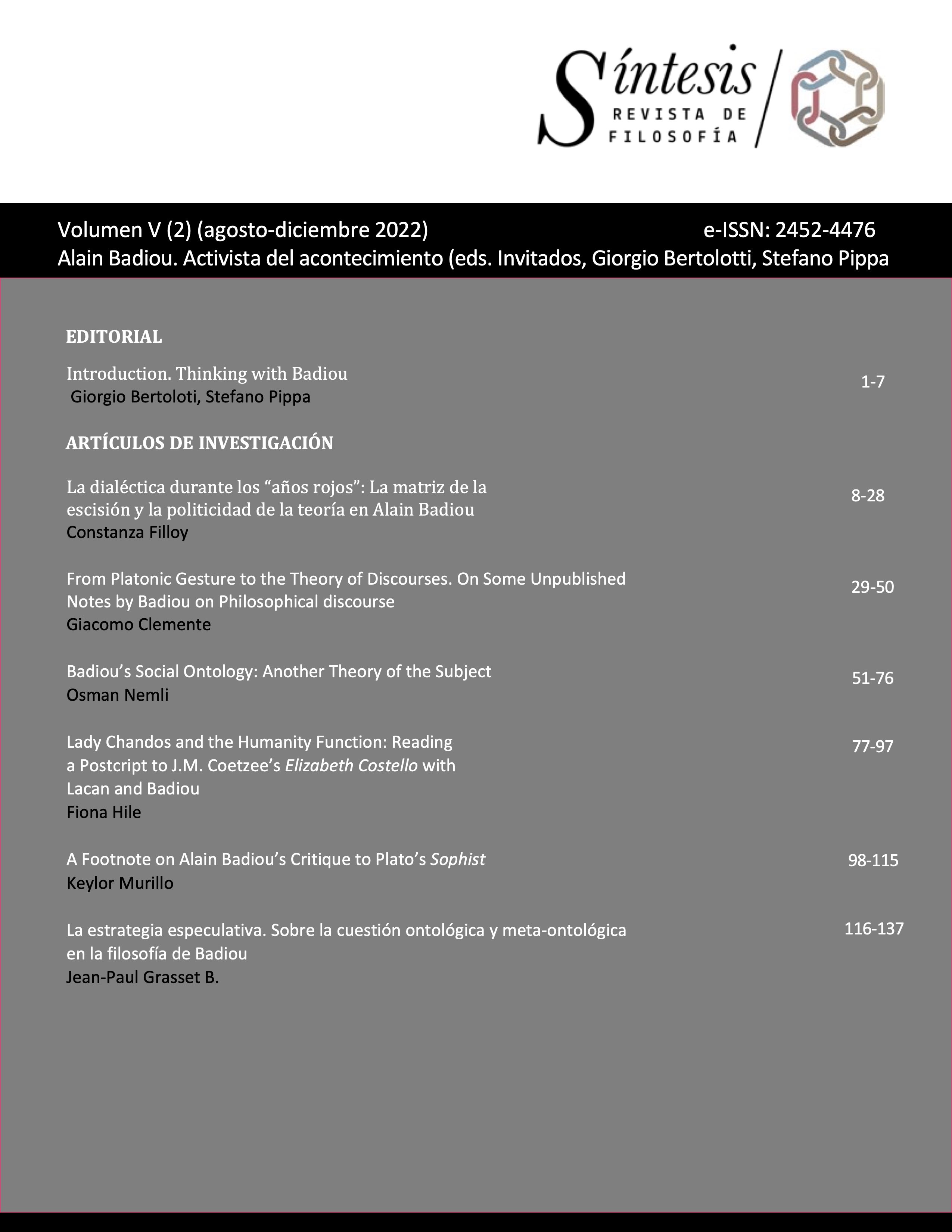
From Platonic Gesture to the Theory of Discourses. On Some Unpublished Notes by Badiou on Philosophical Discourse.
DOI:
https://doi.org/10.15691/0718-5448Vol5Iss2a387Palabras clave:
Epistemological Break, Philosophical Discourse, Ideology, Plato, Dialectical/Historical materialismResumen
This article will examine some theses that Badiou developed in the first period of his philosophy, when he was close to the theoretical horizon of Althusserianism. The article traces a route back from the Manifesto for Philosophy to some yet unpublished notes, dating from the late Sixties, on an aborted collective project on materialist philosophy. While, according to the later Badiou – who is also the most well-known – contemporary philosophical discourse should recover the Platonic gesture after Heidegger, it will be shown that the early Badiou, by debating the nature of the Platonic gesture with Macherey, seems to conceptualise philosophical discourse and its function under the inseparable link of dialectical materialism and historical materialism. The article ends with some open questions for a possible theory of discourse that would build on Badiou’s theoretical insights.
Referencias
Althusser, Louis. 1967. Conception du monde et philosophie; Philosophie et con-ception du monde. Althusser collection (IMEC). [ALT2. A10-03.06].
Althusser, Louis. 1990. Philosophy and the Spontaneous Philosophy of the Sci-entists and Other Essays. Edited by G. Elliott, translated by B. Brewster, J. H. Kavanagh, T. E. Lewis, G. Locke and W. Montag. London: Verso.
Althusser, Louis. 2017. Philosophy for Non-Philosophers. Translated by G. M. Goshgarian, with an introduction by W. Montag. London-New York: Bloomsbury Academic.
Badiou, Alain. 1967a. À propos du concept d’application créatrice. Althusser collection (IMEC). [ALT2. A10-03.08].
Badiou, Alain. 1967b. Sur le texte de Macherey et la note d’Althusser du 15 novembre. Althusser collection (IMEC). [ALT2. A10-04.04].
Badiou, Alain. 1967c. Pratique, philosophie. Althusser collection (IMEC). [ALT2. A10-04.07].
Badiou, Alain. 1967d. Diderot: la visibilité du généalogique. Althusser collection (IMEC). [ALT2. A52-02.06].
Badiou, Alain. 1999. Manifesto for Philosophy Followed by Two Essays. Trans-lated, edited, and with and introduction by N. Madarasz. Albany: State University of New York Press.
Badiou, Alain. 2008. Manifesto per la filosofia. Translated by F. Elefante. Napoli: Edizioni Cronopio.
Badiou, Alain. 2012. “The (Re)commencement of Dialectical Materialism.” In The adventure of French Philosophy, 133-170. Introduction and translation by B. Boostels. London-New York: Verso.
Badiou, Alain. 2013. “The Autonomy of the Aesthetic Process.” Introduction and translation by B. Boostels. Radical Philosophy 178, Mar/Apr: 30-39.
Badiou, Alain. 2013. Theory of the Subject. Translated by B. Boostels. London-New York: Bloomsbury Academic.
Plato. 2007. Republic. Translated by D. Lee, with an introduction by M. Lane. London-New York: Penguin Books.
Macherey, Pierre. 1967. Sur la nature de la philosophie. Althusser collection (IMEC). [ALT2. A10-03.14].
Regnault, François. 1968. Qu’est-ce qu’une coupure épistémologique?. Althus-ser collection (IMEC). [ALT2. A12-03.05].
Tort, Michel. 1967. L’idéologisation philosophique. Althusser collection (IMEC). [ALT2. A10-03.07].
Descargas
Publicado
Número
Sección
Licencia
Aquellos autores/as que tengan publicaciones con esta revista, aceptan los términos siguientes:
1. Los/as autores/as conservarán sus derechos de autor y concederán a Síntesis. Revista de Filosofía el derecho de primera publicación de su obra. La obra se publicará simultáneamente bajo una Licencia Creative Commons Atribución-CompartirIgual 4.0 Internacional (CC BY-SA 4.0), que permite compartir y adaptar el material para cualquier propósito, siempre que se reconozca adecuadamente la autoría y, en caso de realizarse modificaciones o desarrollos a partir de la obra, estos se distribuyan bajo la misma licencia.
2. Los/as autores/as podrán establecer acuerdos adicionales para la distribución no exclusiva de la versión publicada de su obra (por ejemplo, depositarla en un repositorio institucional o publicarla posteriormente en un volumen monográfico), siempre que se reconozca su publicación inicial en Síntesis. Revista de Filosofía.
3. Se permite y recomienda a los/as autores/as difundir su obra a través de Internet - por ejemplo, mediante repositorios institucionales o páginas web académicas - antes y durante el proceso de envío, siempre que ello sea compatible con las exigencias de anonimato propias de la evaluación por pares cuando corresponda.