
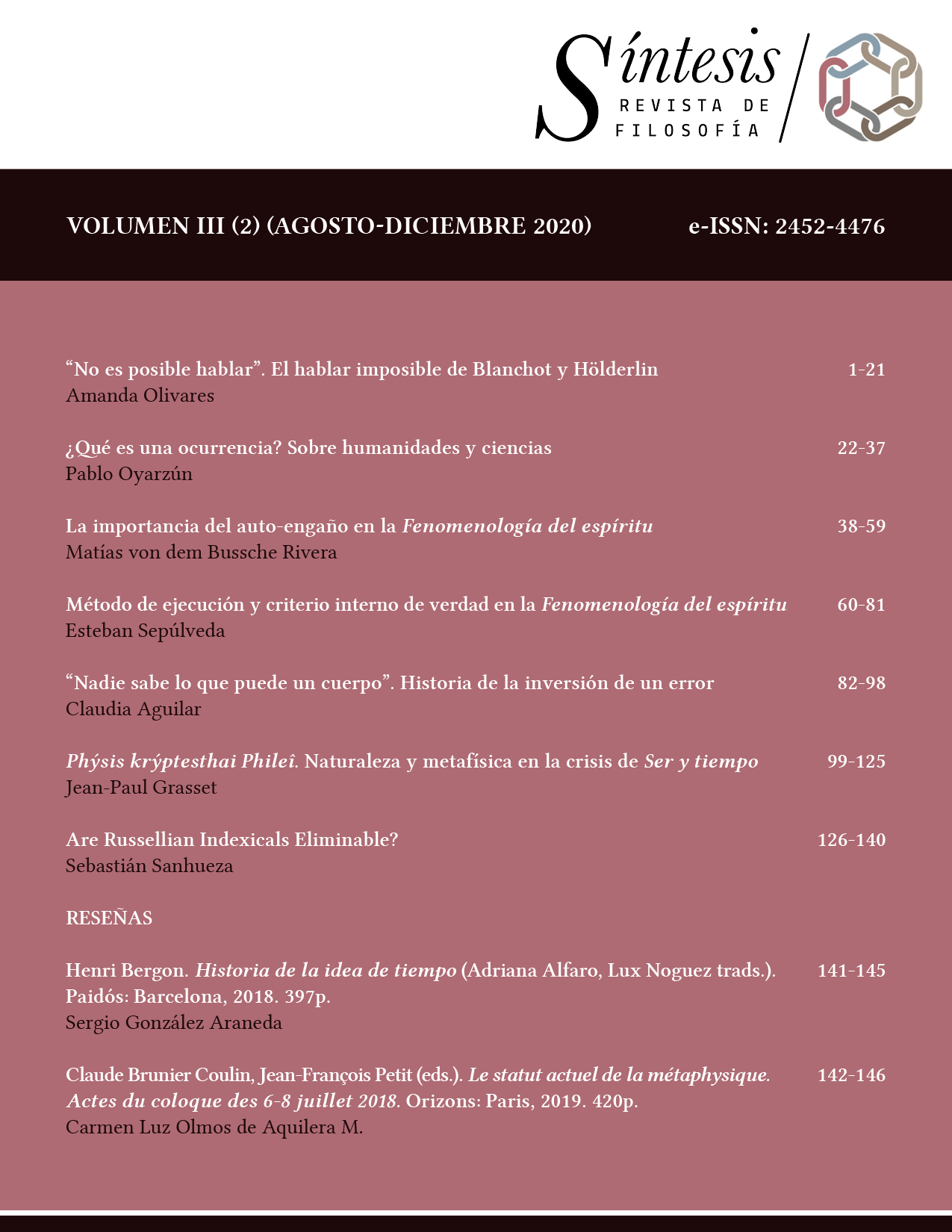
Are Russellian Indexicals Eliminable?
DOI:
https://doi.org/10.15691/0718-5448Vol3Iss2a333Palabras clave:
Indexicals, Bertrand Russell, Acquaint-ance, Causal Chains, NamesResumen
It is widely thought that, in his later work An Inquiry into Meaning and Truth, Bertrand Russell argued that our natural languages could in principle do away with indexicals. This brief piece, by contrast, aims to show that, instead of suggesting the potential eliminability of such expressions, Russell outlined a semantic account of indexicals according to which such expressions fundamentally depend on the perspectival way in which they refer to worldly items. If correct, this proposal would not only show that, in Russell’s later work, the meaning of expressions like indexicals is not exhaustively determined by the items they refer to: it would also show that Russell did not mean to eliminate indexicals from our natural languages at all.
Referencias
Ayer, Alfred. 1945. “The Terminology of Sense-Data.” Mind 54: 289-312.
——. 1973. The Central Questions of Philosophy. London: Weidenfeld and Nicolson.
Barrett, Martyn. 1995. “Early Lexical Development.” In Paul Fletcher and Brian MacWhinney (eds.), The Handbook of Child Language. Oxford: Blackwell: 362-392.
Beer, Randall. 1997. “The Dynamics of Adaptive Behavior: A Research Program.” Robotics and Autonomous Systems 20: 257-289. https://doi.org/10.1016/S0921-8890(96)00063-2.
——. 2003. “The Dynamics of Active Categorical Perception in an Evolved Model Agent.” Adaptive Behaviour 11: 209-243.
https://doi.org/10.1016/j.neunet.2009.03.002.
Bostock, David. 2012. Russell’s Logical Atomism. Oxford: Oxford University Press.
https://doi.org/10.1093/acprof:oso/9780199651443.001.0001.
Di Paolo, Ezequiel, Buhrmann, Thomas & Barandarian, Xabier. 2017. Sensorimotor Life: An Enactive Proposal. Oxford: Oxford University Press. https://doi.org/10.1093/acprof:oso/9780198786849.001.0001.
Eilan, Naomi. 1997. “Objectivity and the Perspective of Consciousness.” European Journal of Philosophy 5: 235-250. https://doi.org/10.1111/1468-0378.00038.
Kaplan, David. 1989. “Demonstratives.” In Joseph Almog, John Perry, and Howard Wettstein (eds.), Themes from Kaplan. New York: Oxford University Press: 481-614.
Martin, M. G. F. 2015. “Old Acquaintance: Russell, Memory and Problems with Acquaintance.” Analytic Philosophy 56 (1): 1–44. https://doi.org/10.1111/phib.12059.
Milne, A.A. 2001. “Winnie-the-Pooh.” In Winnie-the-Pooh: The Complete Collection of Stories and Poems. London: Egmont: 36-41.
Perry, John. 1979. “The Problem of the Essential Indexical.” Noûs 3–21. https://doi.org/10.2307/2214792.
Roberts, Lawrence. 1984. “Russell on the Semantics and Pragmatics of In-dexicals.” Philosophia 14: 111-127. https://doi.org/10.1007/BF02378963.
Russell, Bertrand. 1918. “Knowledge by Acquaintance and Knowledge by Description.” In Mysticism and Logic, 209–32. New York: Longmans, Green & Co.
———. 1956a. “On the Nature of Acquaintance.” In Logic and Knowledge, 127–74. London: George Allen & Unwin.
———. 1956b. “The Philosophy of Logical Atomism.” In Logic and Knowledge, 175–281. London: George Allen & Unwin.
———. 1962. An Inquiry into Meaning and Truth. Harmondsworth: Pelican Books.
Sainsbury, Mark. 1979. Russell. London: Routledge & Kegan Paul.
Soles, Deborah. 1981. “Russell’s Causal Theory of Meaning.” Russell 1: 27-37. https://doi.org/10.15173/russell.v1i1.1522.
Descargas
Publicado
Número
Sección
Licencia
Aquellos autores/as que tengan publicaciones con esta revista, aceptan los términos siguientes:
1. Los/as autores/as conservarán sus derechos de autor y concederán a Síntesis. Revista de Filosofía el derecho de primera publicación de su obra. La obra se publicará simultáneamente bajo una Licencia Creative Commons Atribución-CompartirIgual 4.0 Internacional (CC BY-SA 4.0), que permite compartir y adaptar el material para cualquier propósito, siempre que se reconozca adecuadamente la autoría y, en caso de realizarse modificaciones o desarrollos a partir de la obra, estos se distribuyan bajo la misma licencia.
2. Los/as autores/as podrán establecer acuerdos adicionales para la distribución no exclusiva de la versión publicada de su obra (por ejemplo, depositarla en un repositorio institucional o publicarla posteriormente en un volumen monográfico), siempre que se reconozca su publicación inicial en Síntesis. Revista de Filosofía.
3. Se permite y recomienda a los/as autores/as difundir su obra a través de Internet - por ejemplo, mediante repositorios institucionales o páginas web académicas - antes y durante el proceso de envío, siempre que ello sea compatible con las exigencias de anonimato propias de la evaluación por pares cuando corresponda.