The Objective Value of the Natural World in the Rationalist Cosmologies of Descartes, Spinoza and Leibniz
DOI:
https://doi.org/10.15691/0718-5448Vol8Iss2a498Keywords:
Descartes, Spinoza, Leibniz, Value, Nature, EnvironmentAbstract
The paper presents and analyses three possible ways of thinking about the value of nature objectively, corresponding to three interpretations of the principal figures of early modern rationalism: Descartes, Spinoza, and Leibniz. While all three propose a notion of nature’s value that is not subjectively mediated, their metaphysical and cosmological theories differ radically, resulting in very different conceptions of objective value. The advantages and disadvantages of these interpretations are assessed, focusing on their consistency and suitability as candidates for a robust conception of nature's objective value. It is shown that the Cartesian model, which is based on voluntarist theology, conceives a notion of value that is independent of human valuers. However, it fails to provide a means for humans to judge objective value for themselves. Spinoza rejects the idea that traditional properties such as goodness or beauty have any real basis in nature. Instead, he seeks an objective value intrinsic to nature itself, namely, the power to exist. Thus, Spinoza offers a non-anthropocentric solution that is accessible, yet restricted, for humans to evaluate nature. Finally, Leibniz’s theory permits human access to nature’s values as traditionally understood. Nonetheless, this advantage comes with the potential drawback of an arguably anthropocentric conception of value.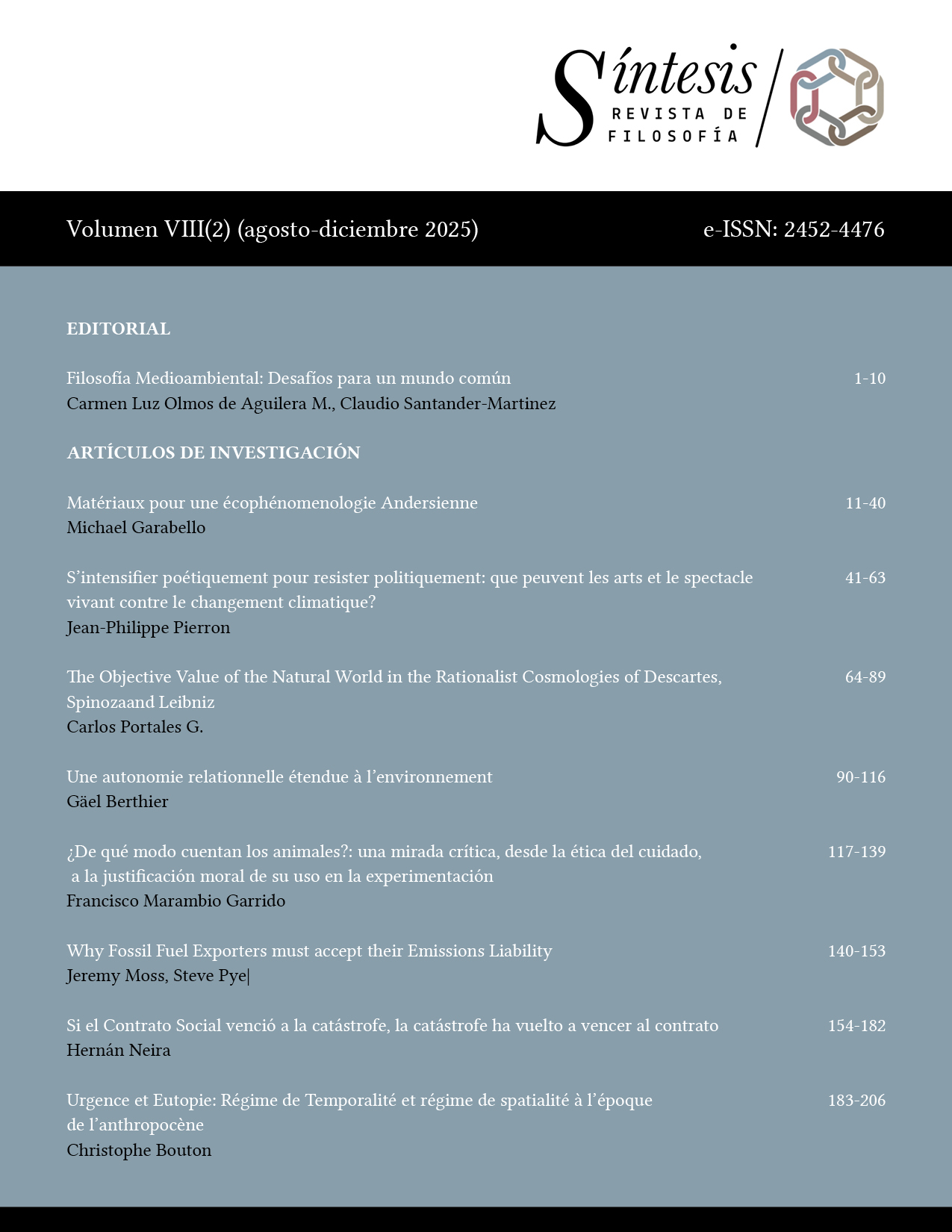
Downloads
Published
2025-12-26
Issue
Section
Research Articles
License
Authors who publish with this journal agree to the following terms:- Authors retain copyright and grant the journal right of first publication with the work simultaneously licensed under a Creative Commons Attribution License that allows the use, transformation, and distribution for any purpose, as long as the author is recognized, and in the event of changes or developements are made from it, the derivate work be shared under the same license.
- Authors are able to enter into separate, additional contractual arrangements for the non-exclusive distribution of the journal's published version of the work (e.g., post it to an institutional repository or publish it in a book).
- Authors are permitted and encouraged to post their work online (e.g., in institutional repositories or on their website) prior to and during the submission process, as it can lead to productive exchanges, as well as earlier and greater citation of published work (See The Effect of Open Access).
How to Cite
Portales G., Carlos. 2025. “The Objective Value of the Natural World in the Rationalist Cosmologies of Descartes, Spinoza and Leibniz”. Síntesis. Philosophy Journal 8 (2): 64-89. https://doi.org/10.15691/0718-5448Vol8Iss2a498.