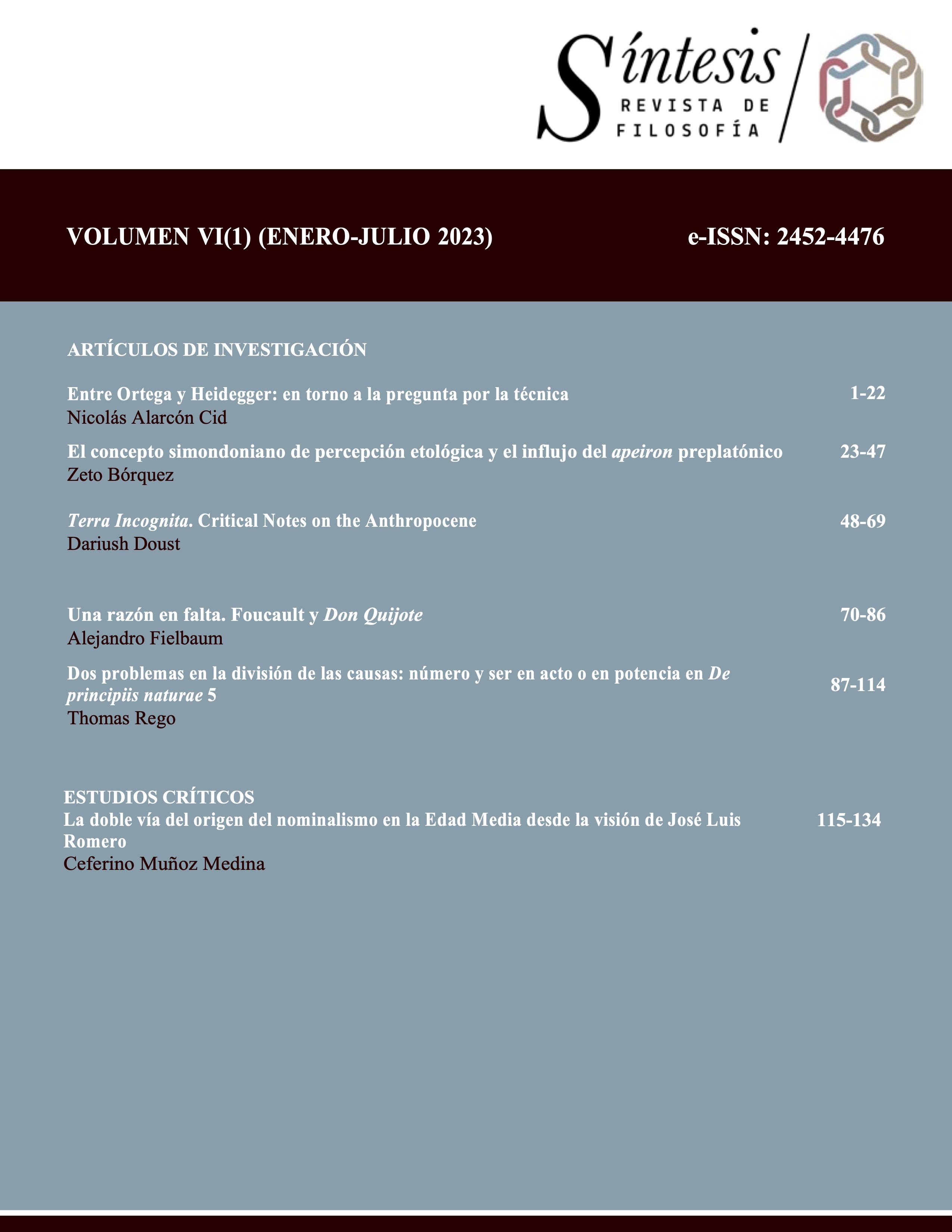
Terra Incognita. Critical Notes on the Anthropocene
DOI:
https://doi.org/10.15691/0718-5448Vol6Iss1a415Palabras clave:
Anthropocene, Arts, Cruelty, Love, Marx.Resumen
The concept of the Anthropocene, originally proposed by Paul Crutzen and Eugene Stoermer in 2000, denotes the human-dominated geological epoch that follows the earlier Holocene. This article critically investigates productive potentials, ambiguities, and implications of this concept. It starts with the recent past postmodernist notions as a contrasting background and relates the idea of a pending disaster to the scalar differences between earth systems and human literary and artistic practices. Poiesis is the key concept discussed and explained throughout the article. This proposed concept is based on Marx’s idea of the deployment of productive powers (natural or human) as an end in itself. The discussions encompass arts and literature as well as ontological and ethical issues. The main conclusion, presented in the last section, connects the critique of the concept of Anthropocene to the urgency of a collective project based on what I call the principle of sharing.
Referencias
Adams, Robert, and William Jenkins. 1975. New Topographics: Photographs of a Man-Altered Landscape. Rochester, N.Y.: International Museum of Photography at George Eastman House.
Adorno, Theodor W. 1997. Aesthetic Theory. London, New York: Continuum.
Benjamin, Walter. 1996. Selected writings Volume 1. Cambridge, Massachusetts: Harvard University Press.
Bennett, Jane. 2010. Vibrant Matter: A Political Ecology of Things. Durham, NC: Duke University Press.
Bonneuil, Christophe, Jean-Baptiste Fressoz. 2016. The Shock of the Anthropocene: The Earth, The History and Us. London: Verso.
Chakrabarty, Dipesh. 2012. “Postcolonial Studies in the Era of Climate Change.” New Literary History 43, no. 1: 1–18.
Crutzen, Paul. 2002. “Geology of Mankind”. Nature 415: 23.
Deleuze, Gilles.1991. Coldness and Cruelty. New York: Zone Books.
Deleuze, Gilles and Félix Guattari. 1987. A Thousand Plateaus: Capitalism and Schizophrenia. Minneapolis: The University of Minnesota Press.
Emerson, Ralph Waldo. 2008. Nature. London: Penguin Books.
Grusin, Richard. 2015. The Nonhuman Turn. Minneapolis: University of Minnesota Press.
Haraway, Donna. 2016. Staying with the Trouble: Making Kin in the Chthulucene. Durham, NC: Duke University Press.
Hassan, Ihab. 1971. The Dismemberment of Orpheus; Toward a Postmodern Literature. New York: Oxford University Press.
Hofmann, Klaus. 2005. “Poetry after Auschwitz – Adorno's Dictum”. German Life and Letters. London: John Wiley and Sons.
Johnson, Taylor R et al. 2018. “The Cutaneous Microbiome and Wounds: New Molecular Targets to Promote Wound Healing.” International journal of molecular sciences 19, no. 9: 2699.
Kirby, Vicki. 2011. Quantum Anthropologies. Durham: Duke University Press.
Lacan, Jacques. 1975. Le Séminaire. Livre XX 1972-1973. Paris: Seuil.
Latour, Bruno. 2017. Facing Gaia: Eight Lectures on the New Climatic Regime. London: Polity Press.
— 2014. “Agency at the Time of the Anthropocene.” New Literary History 45 (1): 1–18.
Lyotard, Jean-François. 1979. La Condition Postmoderne. Paris: Les Éditions de Minuit.
Marx, Karl, and Friedrich Engels. 1996. Collected Works, Volume 35. London: Lawrence & Wishart.
Marx, Karl. 1998. Collected Works, Karl Marx and Friedrich Engels Volume 37. London: Lawrence & Wishart.
Montaigne. 1965. “De la Cruauté” in Montaigne’s Essais, volume 2. Paris: Gallimard.
Nersessian, Anahid. 2013. "Two Gardens: An Experiment in Calamity Form". Modern Language Quarterly. 74, no. 3: 307-329.
Ruddiman, William F. 2003. “The Anthropogenic Greenhouse Era Began Thousands of Years Ago”, Climatic Change. 61, no. 3: 261–93.
Sloterdijk, Peter. 1988. Critique of cynical reason. Minneapolis: Minnesota University Press.
Spinoza, Baruch.2018. Ethics. Cambridge: Cambridge University Press.
Thoreau, Henry David. 2004. Walden. New Haven & London: Yale University Press.
Valdes, Marcella. “His Stupid Heart”. VQR, National Journal of Literature and Discussion. Winter 2008, Online: https://www.vqronline.org/essay/his-stupid-heart.
Venturi, Robert, Denise Scott Brown, and Steven Izenour. 1998. Learning from Las Vegas: the Forgotten Symbolism of Architectural Form. Cambridge, Mass: MIT Press.
Descargas
Publicado
Número
Sección
Licencia
Aquellos autores/as que tengan publicaciones con esta revista, aceptan los términos siguientes:
1. Los/as autores/as conservarán sus derechos de autor y concederán a Síntesis. Revista de Filosofía el derecho de primera publicación de su obra. La obra se publicará simultáneamente bajo una Licencia Creative Commons Atribución-CompartirIgual 4.0 Internacional (CC BY-SA 4.0), que permite compartir y adaptar el material para cualquier propósito, siempre que se reconozca adecuadamente la autoría y, en caso de realizarse modificaciones o desarrollos a partir de la obra, estos se distribuyan bajo la misma licencia.
2. Los/as autores/as podrán establecer acuerdos adicionales para la distribución no exclusiva de la versión publicada de su obra (por ejemplo, depositarla en un repositorio institucional o publicarla posteriormente en un volumen monográfico), siempre que se reconozca su publicación inicial en Síntesis. Revista de Filosofía.
3. Se permite y recomienda a los/as autores/as difundir su obra a través de Internet - por ejemplo, mediante repositorios institucionales o páginas web académicas - antes y durante el proceso de envío, siempre que ello sea compatible con las exigencias de anonimato propias de la evaluación por pares cuando corresponda.