
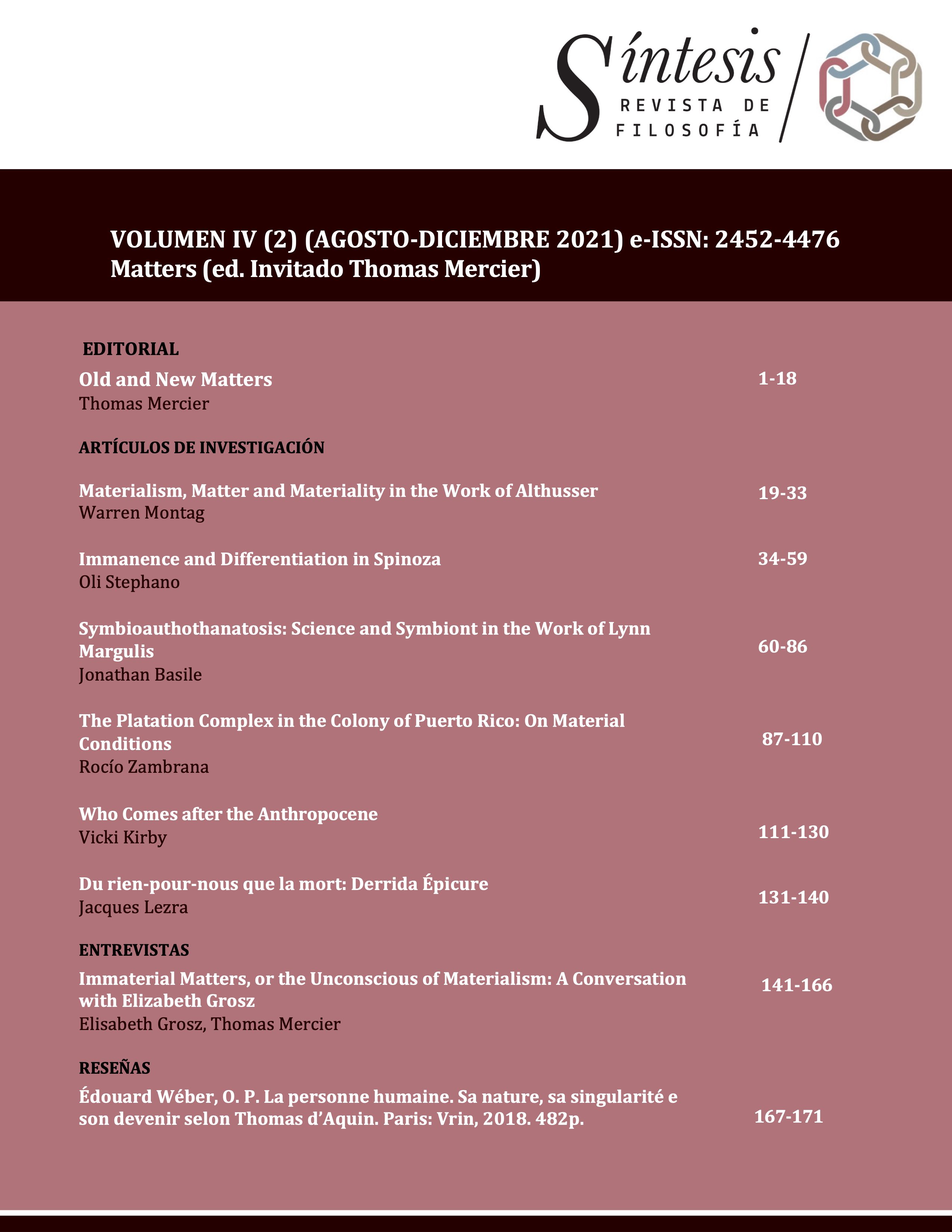
Immaterial Matters, or the Unconscious of Materialism: A Conversation with Elizabeth Grosz
DOI:
https://doi.org/10.15691/0718-5448Vol4Iss2a363Palabras clave:
New Materialism, Covid-19, Feminist Thought, Psychoanalysis, Nietzsche, Deleuze.Resumen
In this conversation, which took place across several months in the year 2021, Elizabeth Grosz describes her position with respect to “new materialism” and “the material turn”: while she emphasizes the necessity of materialist thought in the current situation marked by a global pandemic, she also stresses the equal importance of what she calls “the incorporeal”: an excess in and of matter, materiality’s heterogeneous virtuality, differentiality and becoming-other. Grosz describes the incorporeal as mutually implicated with materiality in a way that eschews both monism and dualism. The conversation roughly follows five topics: 1. How does one conceive of ontology without fixity? 2. How does matter “make sense”? 3. Can we think sexual differences beyond cisgender binarism and oppositional dualism? 4. What are the ethico-political implications of a materialist thought predicated on becoming and immanence? 5. Is psychoanalysis compatible with materialism, and is there a materiality of the unconscious? In the course of this exceptional interview, Grosz discusses the works of Jacques Derrida, Donna Haraway, Sigmund Freud, Luce Irigaray, Karen Barad, Friedrich Nietzsche, and of course Gilles Deleuze, among many others...
Referencias
Barad, Karen. 2007. Meeting the Universe Halfway: Quantum Physics and the Entanglement of Matter and Meaning. Durham and London: Duke University Press.
Deleuze, Gilles. 1994. Difference and Repetition. Translated by Paul Patton. New York: Columbia University Press.
Derrida, Jacques. 1982. Margins of Philosophy. Translated by Alan Bass. Chicago: University of Chicago Press.
Foucault, Michel. 1989. The Order of Things: An archaeology of the human sciences. London and New York: Routledge.
Grosz, Elizabeth. 1989. Sexual Subversions: Three French Feminists. Sydney: Allen and Unwin.
Grosz, Elizabeth. 1990. Jacques Lacan: A Feminist Introduction. London and New York: Routledge.
Grosz, Elizabeth. 1994. Volatile Bodies: Toward a Corporeal Feminism. Bloomington and Indianapolis: Indiana University Press.
Grosz, Elizabeth. 1995. Space, Time, and Perversion: Essays on the Politics of Bodies. New York and London: Routledge.
Grosz, Elizabeth. 2004. The Nick of Time: Politics, Evolution, and the Un-timely. Durham and London: Duke University Press.
Grosz, Elizabeth. 2005. Time Travels: Feminism, Nature, Power. Durham and London: Duke University Press.
Grosz, Elizabeth. 2008. Chaos, Territory, Art: Deleuze and the Framing of the Earth. New York: Columbia University Press.
Grosz, Elizabeth. 2011. Becoming Undone: Darwinian Reflections of Life, Politics, and Art. Durham and London: Duke University Press.
Grosz, Elizabeth. 2017. The Incorporeal: Ontology, Ethics, and the Limits of Materialism. New York: Columbia University Press.
Grosz, Elizabeth, and Simone Stirner. 2016. “All Too Human: A Conversa-tion with Elizabeth Grosz”. Qui Parle: Critical Humanities and Social Sciences 25 (1–2): 17–33.
Haraway, Donna. 2008. When Species Meet. Minneapolis: University of Minnesota Press.
Irigaray, Luce. 1993. An Ethics of Sexual Difference. Translated by Carolyn Burke and Gillian C. Gill. Ithaca: Cornell University Press.
Jackson, Zakiyyah Iman. 2020. Becoming Human: Matter and Meaning in an Antiblack World. New York: New York University Press.
Latour, Bruno. 2013. An Inquiry into Modes of Existence: An Anthropology of the Moderns. Translated by Catherine Porter. Cambridge and London: Harvard University Press.
Nancy, Jean-Luc. 2002. “L’Intrus”. Translated by Susan Hanson. CR: The New Centennial Review 2 (3): 1–14.
Nietzsche, Friedrich. 1968. The Will to Power. Translated by Walter Kaufmann and R. J. Hollingdale. New York: Vintage Books.
Salamon, Gayle. 2010. Assuming a Body: Transgender and Rhetorics of Ma-teriality. New York: Columbia University Press.
Stephano, Oli. 2019. “Irreducibility and (Trans) Sexual Difference”. Hypatia 34 (1): 141–154.
Descargas
Publicado
Número
Sección
Licencia
Aquellos autores/as que tengan publicaciones con esta revista, aceptan los términos siguientes:
1. Los/as autores/as conservarán sus derechos de autor y concederán a Síntesis. Revista de Filosofía el derecho de primera publicación de su obra. La obra se publicará simultáneamente bajo una Licencia Creative Commons Atribución-CompartirIgual 4.0 Internacional (CC BY-SA 4.0), que permite compartir y adaptar el material para cualquier propósito, siempre que se reconozca adecuadamente la autoría y, en caso de realizarse modificaciones o desarrollos a partir de la obra, estos se distribuyan bajo la misma licencia.
2. Los/as autores/as podrán establecer acuerdos adicionales para la distribución no exclusiva de la versión publicada de su obra (por ejemplo, depositarla en un repositorio institucional o publicarla posteriormente en un volumen monográfico), siempre que se reconozca su publicación inicial en Síntesis. Revista de Filosofía.
3. Se permite y recomienda a los/as autores/as difundir su obra a través de Internet - por ejemplo, mediante repositorios institucionales o páginas web académicas - antes y durante el proceso de envío, siempre que ello sea compatible con las exigencias de anonimato propias de la evaluación por pares cuando corresponda.