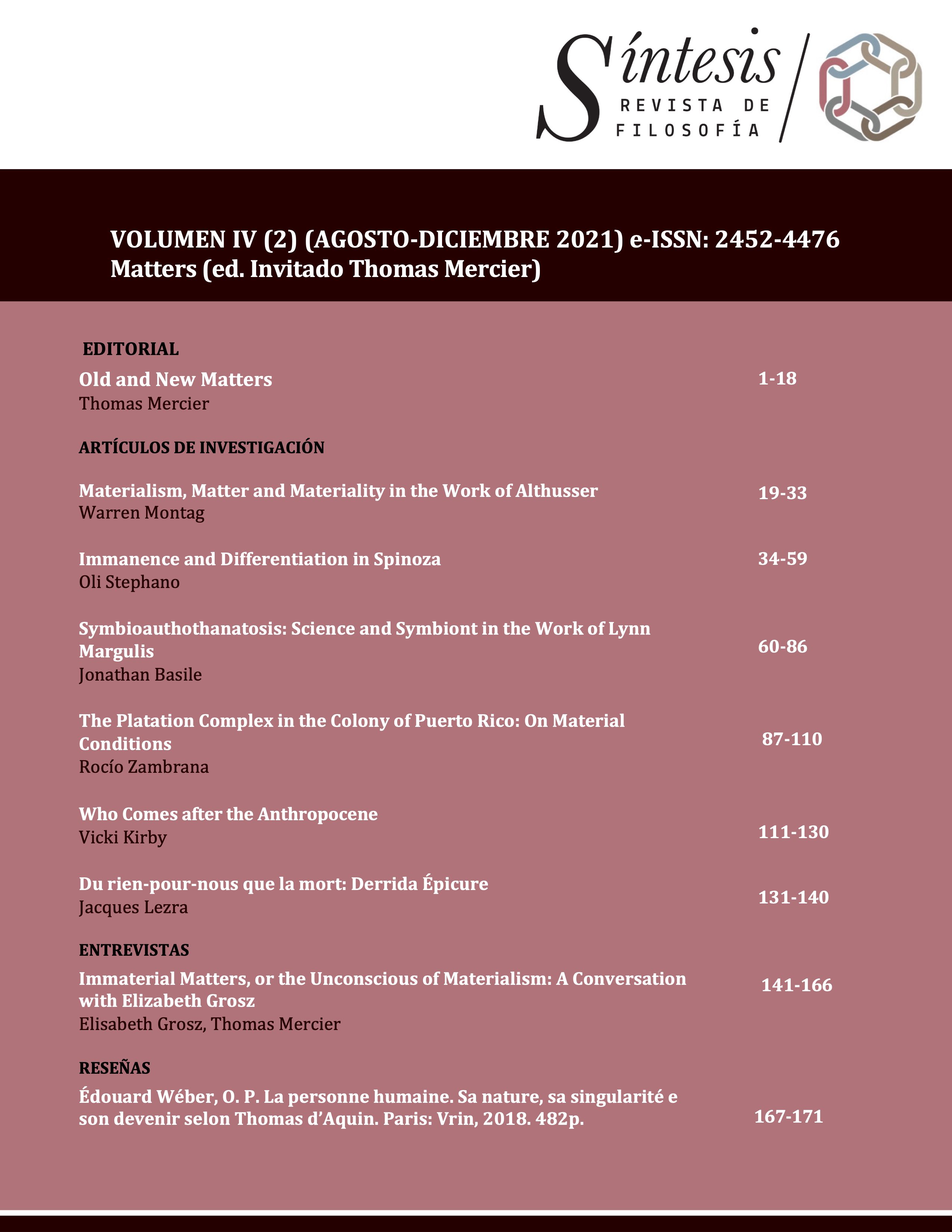
Who Comes after the Anthropocene?
DOI:
https://doi.org/10.15691/0718-5448Vol4Iss2a361Palabras clave:
Postcritique, Originary Humanicity, New Materialism, Deconstruction, NatureResumen
I remember my immediate fascination with an edited collection, now twenty years old, Who Comes After the Subject? The title seemed to entirely displace the identity of the subject, the “of-courseness” of its uniquely human definition. Indeed, its provocation did more than destabilise the what and where of the subject, as if we might extend this complexity, albeit in attenuated form, to non-human entities. The more radical implication was a destabilisation of human identity itself—its circumscribed location—together with the progress narrative that made the arrival of language, technology and agential smarts synonymous with human achievement. As contemporary concern about planetary health is galvanized around the unique power of human agency to either ruin or redeem an impassive and defenceless Nature, a “before” that lacks what being a subject affords, this article will linger over the logic that continues to sustain this story. By reworking Derrida’s “originary writing” as “originary humanicity,” a different sense of ecological involvement might be possible.
Referencias
Alaimo, Stacey and Susan Hekman, eds. 2008. Material Feminisms. Bloom-ington and Indianapolis: Indiana University Press.
Anker, Elizabeth. S. and Rita Felski. 2017. Critique and Postcritique. Durham N.C.: Duke University Press.
Barad, Karen. 2007. Meeting the Universe Halfway: Quantum Physics and the Entanglement of Matter and Meaning. Durham N.C.: Duke University Press.
Barad, Karen. 2012. “Matter feels, converses, suffers, desires, yearns and remembers” in New Materialism: Interviews and Cartographies, edit-ed by Rick Dolphijn and Iris van der Tuin, 48–70. Ann Arbor: Open Humanities Press.
Breen, Margaret Soenser et al. 2001. “‘There is a Person Here’: An Interview with Judith Butler,” International Journal of Sexuality and Gender Studies 6, no. 1–2: 7–23.
Cadava, Eduardo, Peter Connor and Jean-Luc Nancy, eds. 1991. Who Comes After the Subject? New York and London: Routledge.
Coole, Diana. and Samantha Frost, eds. 2010. New Materialisms: Ontology, Agency, and Politics. Durham, NC.: Duke University Press.
De Lange, Catherine. December 11, 2019. “Who do you think you are? Why your sense of self is an illusion.” New Scientist.
Deleniv, Sophia. September 5, 2018. “The ‘me’ illusion: How your brain conjures up your sense of self.” New Scientist.
Derrida, Jacques. 2020. Life Death. Edited by Pascale-Anne Brault and Peggy Kamuf. Translated by Pascale-Anne Brault and Michael Naas. Chicago: University of Chicago.
Derrida, Jacques. 1997. Of Grammatology. Corrected Edition. Translated by Gayatri Chakravorty Spivak. Baltimore: The Johns Hopkins University Press.
Dolphijn, Rick and Iris van der Tuin, eds. 2012. New Materialism: Interviews and Cartographies. Ann Arbor: Open Humanities Press.
Galiano, Monica. 2012. “In a green frame of mind: perspectives on the behavioural ecology and cognitive nature of plants.” The Annals of Botany—Plants 7: 1–8.
Hekman, Susan. 2008. “Constructing the Ballast: An Ontology for Feminism.” In Material Feminisms, edited by Stacey Alaimo and Susan Hekman, 85–119. Bloomington and Indianapolis: Indiana University Press.
Jacob, François. 1993. The Logic of Life: A History of Heredity. Translated by Betty. E. Spillman. Princeton, NJ.: Princeton University Press.
Kirby, Vicki. 2006. Judith Butler: Live Theory. New York and London: Continuum.
Kirby, Vicki. 2010. “Original Science: Nature Deconstructing Itself.” Derrida Today 3, no. 2: 201–220.
Kirby, Vicki. 2011. Quantum Anthropologies: Life at Large. Durham N.C.: Duke University Press.
Kirby, Vicki. 2015. “Transgression: Normativity’s Self-Inversion.” differences: a journal of feminist cultural studies 26, no. 1: 96–116.
Kirby, Vicki, ed. 2017. What if Culture was Nature All Along? Edinburgh: Edinburgh University Press.
Kirby, Vicki. 2018. “Originary Humanicity: Locating Anthropos.” philoSOPHIA: A Journal of Continental Feminism 8, no. 1: 43–60.
Kirby, Vicki, Astrid Shrader and Eszter Timár. 2018. “How Do We Do Bio-deconstruction?” Postmodern Culture 28, no. 3.
Marshall, Michael. June 17, 2019. “What is a Species?” New Scientist.
Lu, Donna, Alison George, Daniel Cossins and Layal Liverpool. January 29, 2020. “What you experience may not exist. Inside the strange truth of reality,” New Scientist.
Saussure, Ferdinand de. 1974. Course in General Linguistics. Edited by Charles Bally and Albert Sechehaye with Albert Riedlinger. Translated by Wade Baskin. Suffolk: Fontana Collins.
Sonnenberg, Justin and Erica Sonnnenberg. May 1, 2015. “Gut Feelings—the ‘Second Brain’ in Our Gastrointestinal Systems.” Scientific American.
Toro, Rafael A. 1945. “Psychology in Plants.” Bios 16, no. 4: 257–261.
Trewavas, Anthony. 2003. “Aspects of Plant Intelligence.” Annals of Bota-ny 92: 1–20.
Wilson, Elizabeth A. 2015. Gut Feminism. Durham. NC.: Duke University Press.
Wohlleben, Peter. 2016. The Hidden Life of Trees: What They Feel, How They Communicate. Carlton, Vic.: Black Inc.
Descargas
Publicado
Número
Sección
Licencia
Aquellos autores/as que tengan publicaciones con esta revista, aceptan los términos siguientes:
1. Los/as autores/as conservarán sus derechos de autor y concederán a Síntesis. Revista de Filosofía el derecho de primera publicación de su obra. La obra se publicará simultáneamente bajo una Licencia Creative Commons Atribución-CompartirIgual 4.0 Internacional (CC BY-SA 4.0), que permite compartir y adaptar el material para cualquier propósito, siempre que se reconozca adecuadamente la autoría y, en caso de realizarse modificaciones o desarrollos a partir de la obra, estos se distribuyan bajo la misma licencia.
2. Los/as autores/as podrán establecer acuerdos adicionales para la distribución no exclusiva de la versión publicada de su obra (por ejemplo, depositarla en un repositorio institucional o publicarla posteriormente en un volumen monográfico), siempre que se reconozca su publicación inicial en Síntesis. Revista de Filosofía.
3. Se permite y recomienda a los/as autores/as difundir su obra a través de Internet - por ejemplo, mediante repositorios institucionales o páginas web académicas - antes y durante el proceso de envío, siempre que ello sea compatible con las exigencias de anonimato propias de la evaluación por pares cuando corresponda.