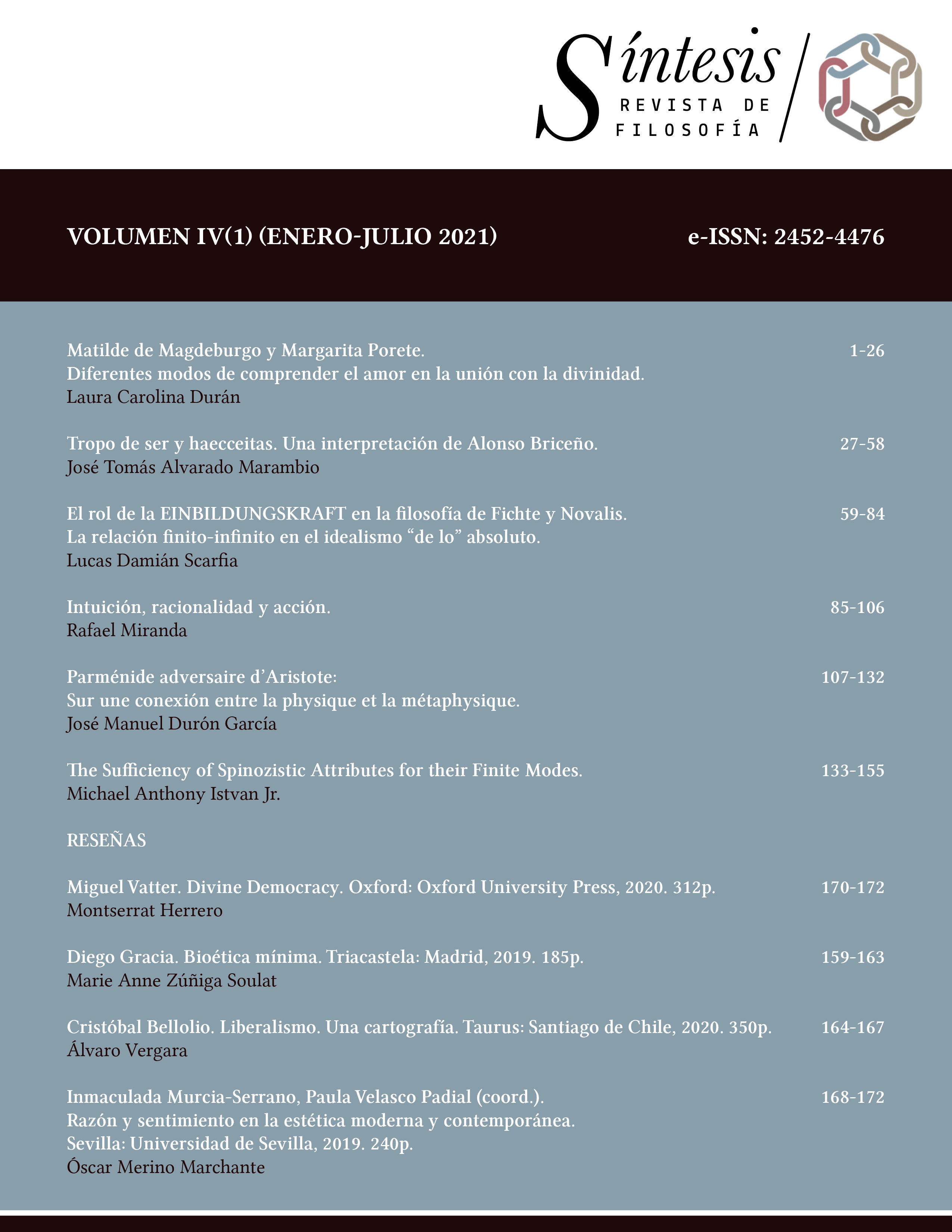
The Sufficiency of Spinozistic Attributes for their Finite Modes
DOI:
https://doi.org/10.15691/0718-5448Vol4Iss1a350Palabras clave:
Spinoza, Attribute, Mode, Necessitarianism, Explanatory RationalismResumen
Some passages throughout Spinoza’s body of works suggest that an attribute in its absolute nature provides a sufficient condition for all of its modes, including the finite ones. Other passages suggest that an attribute in its absolute nature fails to provide a sufficient condition for its finite modes. My aim is to dispel this apparent tension. I argue that all finite modes are ultimately entailed by the absolute nature of their attribute. Furthermore, I explain how the Spinozistic positions that appear incompatible with this view are in fact compatible. As I see it, we should read those passages where Spinoza says that no finite mode ultimately follows from the absolute nature of its attribute as saying merely that no finite mode ultimately follows in one-by-one fashion, independent of an infinite series of other modes, from the absolute nature of its attribute.Referencias
Bennett, J. 1984. A Study of Spinoza’s Ethics. Indianapolis: Hackett.
Bussotii, P. and C. Tapp. 2009. “The Influence of Spinoza’s Concept of In-finite in Cantor’s Set Theory.” Studies in History of Philosophy and Sci-ence 40.1. 25-35.
Carriero, J. P. 1991. “Spinoza’s Views on Necessity in Historical Perspec-tive.” Philosophical Topics 19.1. 47-96.
Curley, E. 1969. Spinoza’s Metaphysics: An Essay in Interpretation. Cambridge, Harvard University Press.
Curley, E. M. 1988. Behind the Geometrical Method: A Reading of Spinoza’s Ethics. Princeton: Princeton University Press.
Curley, E. M. and G. Walski, 1999. “Spinoza’s Necessitarianism Reconsidered.” New Essays on the Rationalists. Ed. R. J. Gennero and C. Huenemann. New York: Oxford University Press.
Dea, S. 2008. “Firstness, Evolution and the Absolute in Peirce’s Spinoza.” Transactions of the Charles S. Peirce Society 44.4. 603-628.
Delahunty, R. J. 1985. Spinoza. Boston: Routledge & Kegan Paul.
Deleuze, G. 1988. Spinoza: Practical Philosophy. Trans. R. Hurley. San Fran-cisco: City Lights Books. 93-94.
Della Rocca, M. 1996. Representation and the Mind-Body Problem in Spinoza. New York: Oxford University Press.
Della Rocca, M. 2008. Spinoza. New York: Routledge.
Donagan, A. 1973. “Spinoza’s Proof of Immortality.” Spinoza: A Collection of Critical Essays. Ed. M. Grene. Garden City: Anchor Books. 241-258.
Friedman, J. I. 1986. “How the Finite Follows from the Infinite in Spinoza’s Metaphysical System.” Synthese 69. 371-401.
Fullerton, G. S. 1894. The Philosophy of Spinoza as Contained in the First, Second, and Fifth Parts of the “Ethics” and in Extracts from the Third and Fourth. New York: H. Holt.
Garrett, D. 1999. “Spinoza’s Necessitarianism.” The Rationalists: Critical Essays on Descartes, Spinoza, and Leibniz. Ed. D. Pereboom. New York: Rowman and Littlefield. 103-130.
Griffin, M. V. 2008. “Necessitarianism in Spinoza and Leibniz.” Interpreting Spinoza: Critical Essays. Ed. C. Huenemann. Cambridge: Cambridge University Press. 71-93.
Hampshire, S. 1970. Spinoza. Baltimore: Penguin Books.
Hart, A. 1983. Spinoza’s Ethics Part I and II: A Platonic Commentary. Lei-den: Brill.
Huenemann, C. 1999. “The Necessity of Finite Modes and Geometrical Containment in Spinoza’s Metaphysics.” New Essays on the Rationalists. Ed. R. J. Gennero and Huenemann. New York: Oxford University Press. 224-240.
Jarrett, C. 1978. “The Logical Structure of Spinoza’s Ethics, Part 1.” Synthese 37. 55-56.
Koistinen, O. 1998. “On the Consistency of Spinoza’s Modal Theory.” The Southern Journal of Philosophy 36.1. 66.
Koistinen, O. 2003. “Spinoza’s Proof of Necessitarianism,” Philosophy and Phenomenological Research 67.2. 283-310.
Leibniz, G. W. 1969. Philosophical Papers and Letters. Ed. L. Loemker. Dor-drecht: The Netherlands.
Leibniz, G. W. 1994. La réforme de la dynamique: De corporum concursu (1678) et autres textes inédits. Ed. M. Fichant. Paris: Vrin.
Lovejoy, A. 1964. The Great Chain of Being: The Study of the History of an Idea. Cambridge: Harvard University Press.
Matson, W. 1979. “Steps Towards Spinozism,” Revue Internationale de Philosophie 31. 76-83.
Miller, J. A. 2001. “Spinoza’s Possibilities.” The Review of Metaphysics 54. 779-814.
Nadler, S. M. 2006. Spinoza’s Ethics: An Introduction. Cambridge University Press.
Newlands, S. 2007. “Spinoza’s Modal Metaphysics.” Stanford Encyclopedia of Philosophy Ed. E. N. Zalta. <http://plato.stanford.edu/entries/spinoza-modal/>.
Newlands, S. 2010. “The Harmony of Spinoza and Leibniz.” Philosophy and Phenomenological Research 81.1. 64-104.
Phemister, P. 2006. The Rationalists: Descartes, Spinoza, and Leibniz. Malden: Polity Press.
Schmaltz, T. M. 1997. “Spinoza’s Mediate Infinite Mode.” Journal of the History of Philosophy 35.2. 199-235.
Steinberg, D. 1981. “Spinoza’s Theory of the Eternity of the Mind,” Canadian Journal of Philosophy 11. 35-68.
Viljanen, V. 2008. “Spinoza’s Essentialist Model of Causation,” Inquiry 51.4. 412-437.
Willis, R. 1870. Benedict de Spinoza: His Life, Correspondence, and Ethics. London: Trübner.
Yovel, Y. 1991. “The Infinite Mode and Natural Laws in Spinoza.” God and Nature: Spinoza’s Metaphysics. Ed. Yovel. Leiden: E. J. Brill. 79-96.
Descargas
Publicado
Número
Sección
Licencia
Aquellos autores/as que tengan publicaciones con esta revista, aceptan los términos siguientes:
1. Los/as autores/as conservarán sus derechos de autor y concederán a Síntesis. Revista de Filosofía el derecho de primera publicación de su obra. La obra se publicará simultáneamente bajo una Licencia Creative Commons Atribución-CompartirIgual 4.0 Internacional (CC BY-SA 4.0), que permite compartir y adaptar el material para cualquier propósito, siempre que se reconozca adecuadamente la autoría y, en caso de realizarse modificaciones o desarrollos a partir de la obra, estos se distribuyan bajo la misma licencia.
2. Los/as autores/as podrán establecer acuerdos adicionales para la distribución no exclusiva de la versión publicada de su obra (por ejemplo, depositarla en un repositorio institucional o publicarla posteriormente en un volumen monográfico), siempre que se reconozca su publicación inicial en Síntesis. Revista de Filosofía.
3. Se permite y recomienda a los/as autores/as difundir su obra a través de Internet - por ejemplo, mediante repositorios institucionales o páginas web académicas - antes y durante el proceso de envío, siempre que ello sea compatible con las exigencias de anonimato propias de la evaluación por pares cuando corresponda.