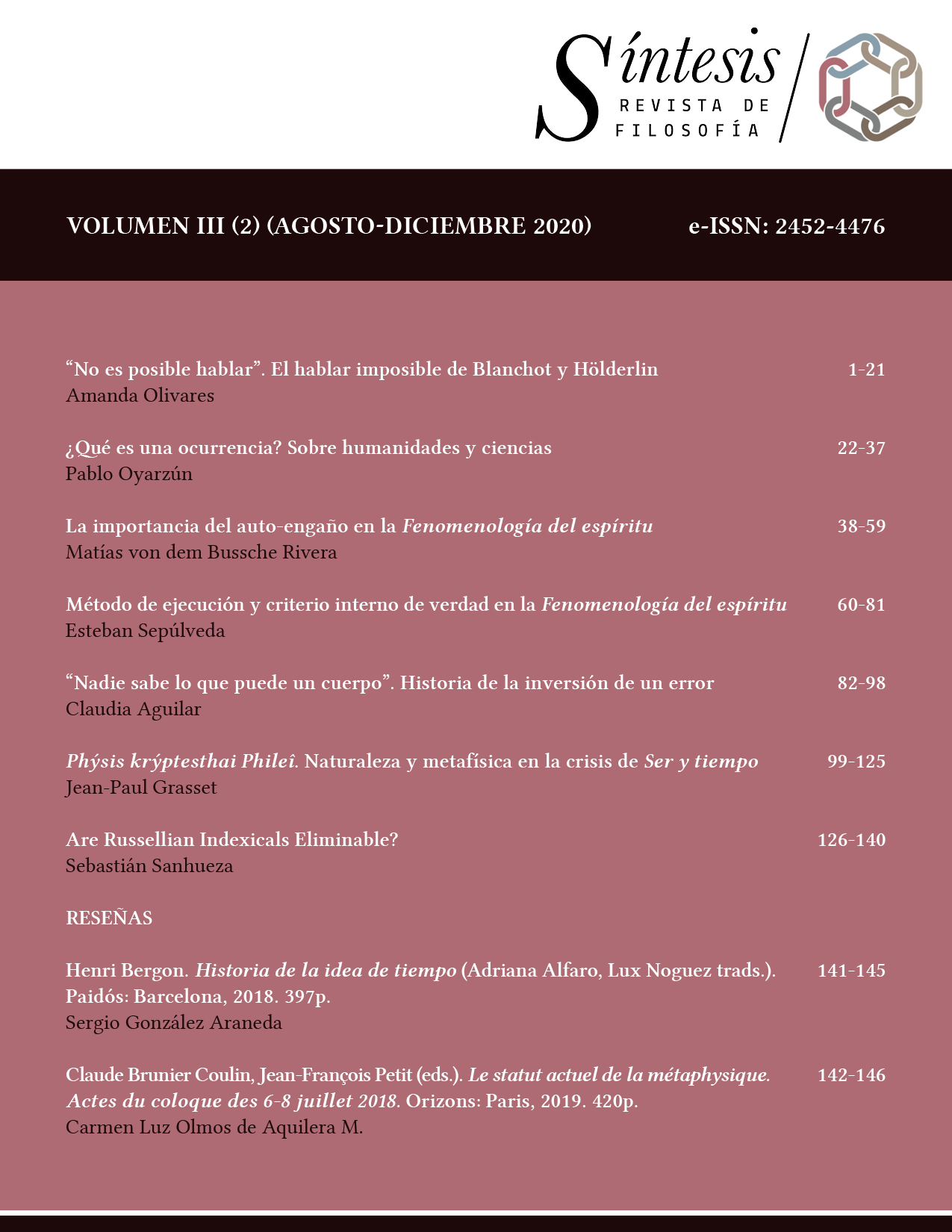
"No one knows what a body can do". History of the inversion of an error
DOI:
https://doi.org/10.15691/0718-5448Vol3Iss2a331Keywords:
Spinoza, Individual, Relationship, Conatus, BodyAbstract
"No one knows what a body can do" is one of the most invoked phrases about Spinoza; generally to talk about the indetermination of bodies or the unlimited power of them. However, that does not take into account the double attribution, one of the central points of Spinoza's philosophy; so mind and body are one and the same thing seen from different attributes of the unique substance. To explain this phrase, which never appears like that in Spinoza's works, I consider the notion of individual is crucial. My hypothesis is that this statement is inadequate if we consider the double attribution and the characterizations of the individual. I have two goals: (1) to develop the characterizations of the individual as a complex body and conatus; in order to to address how these characterizations answer the question about what a body can do; and (2) to analyze the scholium that gave rise to the phrase in the title, phrase that erroneously reverses an old error.
References
Aguilar, Claudia. 2019. Resignificación, resistencia y alianzas. Una propuesta desde la teoría de la individualidad spinoziana. Buenos Aires: RAGIF ediciones
Deleuze, Gilles. 1999. Spinoza y el problema de la expresión. Barcelona: Muchnik.
_______. 2003. En medio de Spinoza. Buenos Aires: Cactus.
Gueroult, Martial. 1974. Spinoza. L’âme (Éthique, 2). Paris: Aubier-Montagne.
Jabase, Leila. 2020. “Individuación y conatus: puntos de intersección entre Spinoza y Leibniz”. In Felipe Jardim (ed.), Spinoza Filosofía & Liberdade . Río de Janeiro: Editora PUC Rio. En prensa.
Leibniz, Gottfried Wilhelm, Sämtliche Schriften und Briefe, Darmstadt-Leipzig-Berlin: Akademie Verlag, 1923-sig.
Lin, Martin. 2005. “Memory and personal Identity in Spinoza”. Canadian Journal of Philosophy 35-2: 243-268.
Macherey, Pierre. 2014. Hegel o Spinoza. Buenos Aires: Tinta Limón.
Peterman, Alison. 2007. “The ‘Physical’ Interlude”. In Yitzhak Melamed (ed.): Spinoza's Ethics. A Critical Guide. Cambridge: Cambridge University Press: 102-120.
Rovere, Maxime. 2017. Le Clan Spinoza. Paris: Flammarion.
Solé, María Jimena. 2019. “El conocimiento como acción. Exploración del concepto de filosofía en Spinoza”. Síntesis. Revista de filosofía 2-1: 23-44.
Spinoza, Baruch. 2019. Ética demostrada según el orden geométrico (Atilano Domínguez trad.). Madrid: Guillermo Escolar.
Steinberg, Justin. 2019. “Bodies Politic and Civic Agreement”. In Aurelia Armstrong, Keith Green & Andrea Sangiacomo (eds.), Spinoza and Relational Autonomy. Being with Others. Edinburgo: Edinburgh Uni-versity Press: 132-148.
Williams, Caroline. 2019. “Revisiting Spinoza’s Concept of Conatus: Degrees of Autonomy”. In Aurelia Armstrong, Keith Green y Andrea Sangiacomo (eds.), Spinoza and Relational Autonomy. Being with Others. Edinburgo: Edinburgh University Press: 115-131.
Downloads
Published
Issue
Section
License
Authors who publish with this journal agree to the following terms:- Authors retain copyright and grant the journal right of first publication with the work simultaneously licensed under a Creative Commons Attribution License that allows the use, transformation, and distribution for any purpose, as long as the author is recognized, and in the event of changes or developements are made from it, the derivate work be shared under the same license.
- Authors are able to enter into separate, additional contractual arrangements for the non-exclusive distribution of the journal's published version of the work (e.g., post it to an institutional repository or publish it in a book).
- Authors are permitted and encouraged to post their work online (e.g., in institutional repositories or on their website) prior to and during the submission process, as it can lead to productive exchanges, as well as earlier and greater citation of published work (See The Effect of Open Access).