
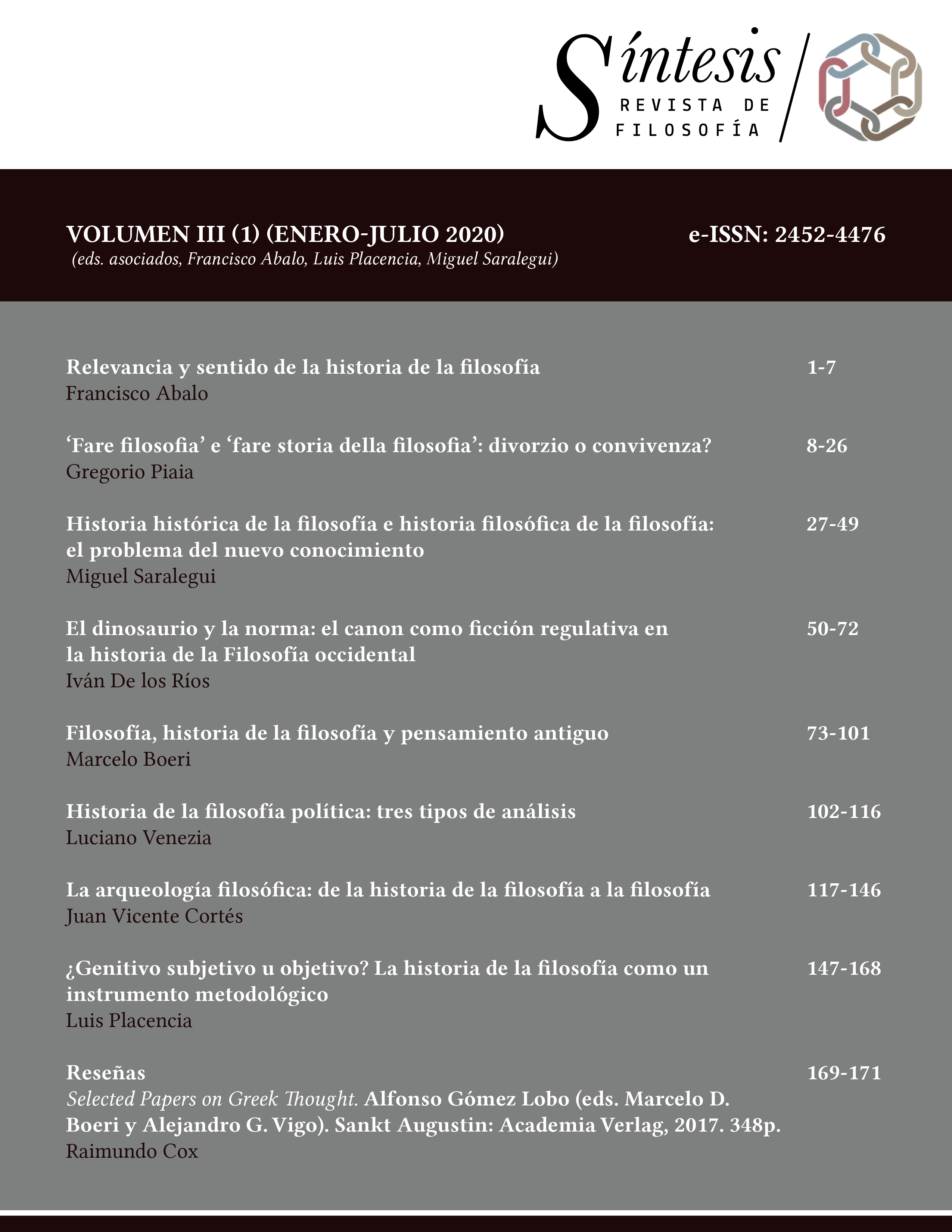
Historical History of Philosophy and Philosophical History of Philosophy: The Problem of New Knowledge
DOI:
https://doi.org/10.15691/0718-5448Vol3Iss1a310Keywords:
history of philosophy, history, philosophy, intensive research, extensive research.Abstract
This article focuses on the relation of two varieties of history of philosophy and the concept of research. In this paper are distinguished two different prototypes of research in the frame of history of philosophy, the intensive and the extensive. In the first part is claimed that the hybrid character of the concept of history of philosophy, on the one hand, and the relation with the canon, on the other hand, determine these forms research. Then, the main features of the intensive and the extensive researches are explained and it is showed that all practices of research in the field of history of philosophy depend on this two prototypes. Finally some conclusions are provided in order to consider a much balanced relation between historical research and philosophical activity.References
Collins, Jeffrey. “Quentin Skinner’s Hobbes and the Neo-Republican Project.” Modern Intellectual History vol.6, N°3 (2009): 343-367.
Hankins, James. “The significance of Renaissance philosophy”. En The Cambridge Companion to Renaissance Philosophy, de James Hankins. Cambridge: Cambridge University Press, 2007: 338-345.
Hegel, G.W.F. Lecciones sobre historia de la filosofía. México: FCE, 1996.
Koselleck, R. “Sobre la necesidad teórica de la ciencia histórica” in Prismas. Revista de historia intelectual, XIV, 2010, pp. 137-148.
Koselleck, R. Sentido y repetición en la historia. Buenos Aires: Hydra, 2013.
Llano, A.. Olor a yerba seca. Madrid: Encuentro, 2008.
Manzo, S. “Piezas de un modelo para armar, desarmar y rearmas. Autores, textos y temas en la construcción de cánones filosóficos.” En La modernidad ayer y hoy, de Susana Maidana y María Risco. Tucumán: Universidad Nacional de Tucumán, 2017: 117-146.
Mondolfo, Rodolfo. Problemas y métodos de investigación en la historia de la filosofía. Buenos Aires: Eudeba, 1960.
Morgan, Michael. “The goals and methods of the history of philosophy.” The Review of Metaphysics vol.40, N°4 (1987): pp. 717-732.
Narbonne, Jean-Marc. “De la dualité structurelle de l’histoire de la philosophie: les enjeux d’un controverse.” En Comment écrire l’histoire de la philosophie, de Yves Zarka. París: PUF, 2009: pp. 59-78.
Ortega y Gasset, José “Prólogo a Historia de la filosofía de Émile Brehier.” En Obras completas vol. VI, en José Ortega y Gasset. Madrid: Taurus, 2006: pp. 135-171.
Pitkin, Hanah. Fortune is a Woman. Gender and Politics in the Thought of Niccolò Machiavelli. Chicago: The University of Chicago Press, 1984.
Rabossi, Eduardo. En el comienzo Dios creó el canon. Biblia berolinensis. Buenas Aires: Gedisa, 2008
Schopenhauer, Arthur. “Sobre la historia.” En El mundo como voluntad y representación. Complementos, de Arthur Schopenhauer, 490-498. Madrid: Trotta, 2003.
Sorell, Tom. “Pertinence et limite de la caricature en histoire de la philosophie: le cas de Descartes.” En Comment écrire l’histoire de la philosophie, de Yves Zarka. París: PUF, 2001: pp. 113-129.
Zarka, Yves. “Que nous importe l’histoire de la philosophie?” En Comment écrire l’histoire de la philosophie, de Yves Zarka.París: PUF, 2001: pp. 19-32.
Downloads
Published
Issue
Section
License
Authors who publish with this journal agree to the following terms:- Authors retain copyright and grant the journal right of first publication with the work simultaneously licensed under a Creative Commons Attribution License that allows the use, transformation, and distribution for any purpose, as long as the author is recognized, and in the event of changes or developements are made from it, the derivate work be shared under the same license.
- Authors are able to enter into separate, additional contractual arrangements for the non-exclusive distribution of the journal's published version of the work (e.g., post it to an institutional repository or publish it in a book).
- Authors are permitted and encouraged to post their work online (e.g., in institutional repositories or on their website) prior to and during the submission process, as it can lead to productive exchanges, as well as earlier and greater citation of published work (See The Effect of Open Access).