
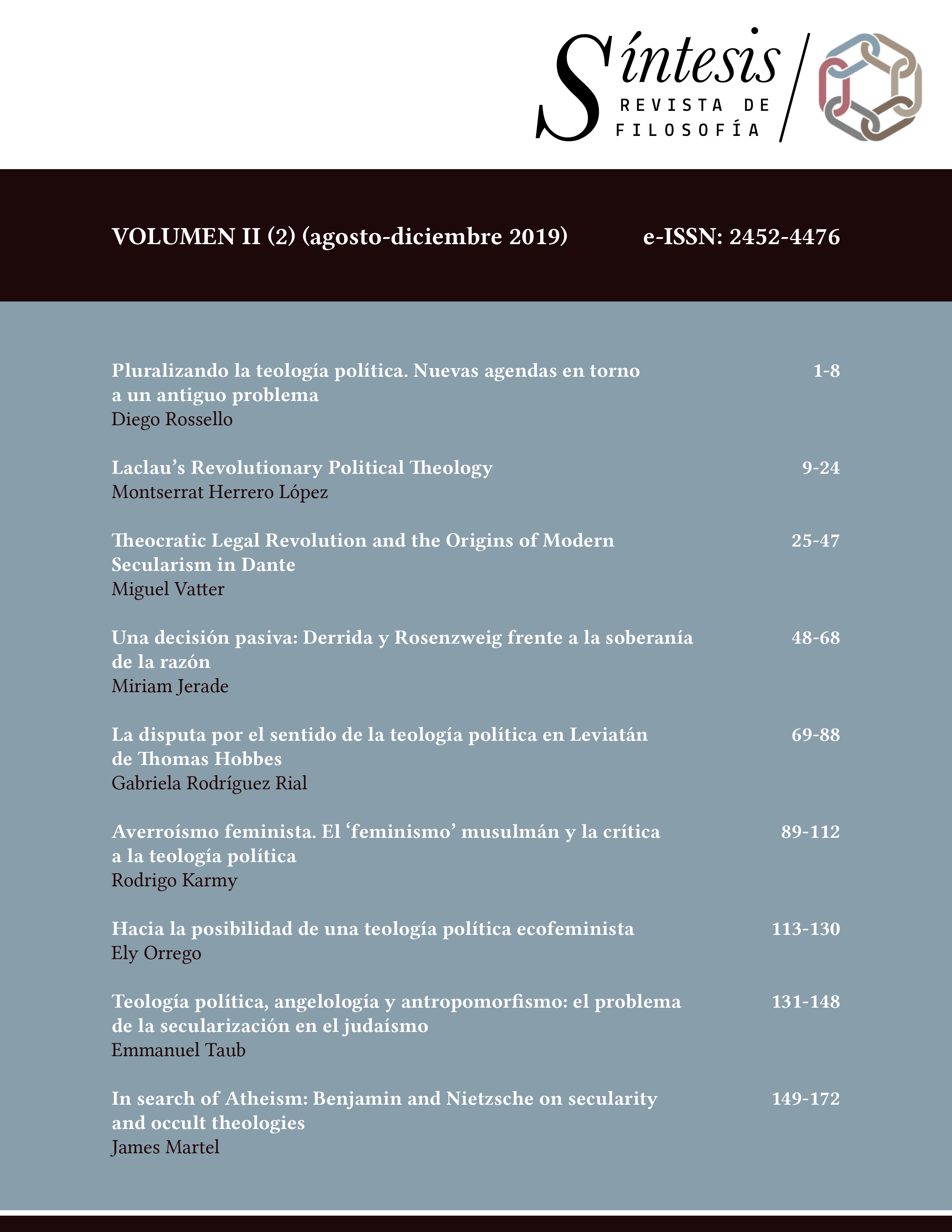
Laclau’s Revolutionary Political Theology
DOI:
https://doi.org/10.15691/0718-5448Vol2Iss2a287Palabras clave:
Political Theology, Anti-fundationalism, Revolutionary Politics, Violence, LaclauResumen
One of the ways of thinking God in contemporary philosophy is reflecting on violence. In fact, reflecting on violence implies always at the same time to refer to the difficulty of thinking about the co-implication of law and violence, a typical prerogative of divine action. From this perspec-tive, political theology is concerned with the status and the possibilities or impossibilities of rep-resenting violence in a given political order. Three are the classical texts in the backdrop of this reflection on the hiatus between law and violence: Walter Benjamin Critique of Violence of 1921, Carl Schmitt’s Political Theology of 1922 and Derrida’s Force of Law of 1989. The article exam-ines another paradigm, that of Ernesto Laclau. The article concludes that only a non-presentable idea of God as a negative fundament allows for a non-authoritarian political idea. But this non-presentable character is only made possible by revolutionary politics.Referencias
Agamben, Giorgio. 2011. The Kingdom and the Glory: for a Theological Genealogy of Economy and Government (translated by Lorenzo Chiesa with Matteo Mandarini). Stanford: Stanford University Press.
Arato, Andrew. 2013. “Political Theology and Populism”. Social Research 80: 143-172.
Benjamin, Walter. 1986. “Critique of violence”, in Reflections. New York: Schocken Books.
Biset, Emmanuel. 2013. “Dar el nombre. Derrida lector de Benjamin”. Papel Máquina 8: 107-130.
Derrida, Jacques. 1997. Of Grammatology. Baltimore: Johns Hopkins.
Drew, Julie. 1999. "The Politics of Persuading: Ernesto Laclau and the Question of Discursive Force". JAC 19, no. 2: 292-97.
Eagleton, Terry. 1981. Walter Benjamin. Towards a Revolutionary Criticism. London: Verso.
Franke, William. 2014. A Philosophy of the Unsayable. Indiana: Notre dame University Press.
Gold, Tomás. 2014. “Democracia, hegemonía y populismo. Ernesto Laclau lector de Claude Lefort”. Las Torres de Lucca 5: 57-76.
Greer, Robert G. 2003. Mapping Postmodernism: a Survey of Christian Options. Madison: InterVarsity Press.
Herrero, Montserrat. 2015. The Political Discourse of Carl Schmitt. A Mystic of Order. Lanham: Rowman & Littlefield.
Herrero, Montserrat. 2017. “Carl Schmitt's Political Theology: The Magic of a Phrase”. In Political Theology in Medieval and Early Modern Europe: Discourses, Rites and Representations, edited by Herrero, M., Aurell, J., Miceli, A. Turnhout: Brepols: 23-43.
Jakobson, Roman. 1958. “Two Aspects of Language and Two Types of Aphasic Disturbance,” in R. Jakobson y Morris Halle Fundamentals of Language. La Haya: Mouton.
Laclau, Ernesto. 2005. On Populist Reason. London: Verso.
Laclau, Ernesto. 2014. “The impossibility of society”. In The Discourse Studies Reader: Main currents in theory and analysis, edited by Johannes Anger-muller, Dominique Maingueneau and Ruth Wodak. John Benjamins Publishing Company: 122–122.
Laclau, Ernesto. 2014. The Rhetorical Foundation of Society. London/New York: Verso.
Lefort, Claude. 2006. “The permanence of the Theological-Political?”. In Public Religions in a Post-secular World, edited by Hent de Vries and Lawrence E. Sullivan. Fordham: Fordham University Press.
Marchart, Olivier. 2007. Post-foundational Political Thought: Political Differ-ence in Nancy, Lefort, Badiou and Laclau. Edinburgh: Edinburgh University Press.
Martel, James. 2012. Divine Violence. Walter Benjamin and the Eschatology of Sovereignty. New York: Routledge.
Schmitt, Carl. 2005. Political Theology. Four Chapters on the Concept of Sovereignty. Chicago: University of Chicago Press.
Vatter, Miguel. 2017. “The Political Theology of Carl Schmitt”. In The Oxford Handbook of Carl Schmitt, edited by Jens Meierhenrich and Oliver Simons. Oxford: Oxford University Press: 245-269.
Vatter, Miguel. 2019. “Only a God Can Resist a God. Political Theology be-tween Polytheism and Gnosticism”. Political Theology: DOI: 10.1080/1462317X.2019.1618597.
Descargas
Publicado
Número
Sección
Licencia
Aquellos autores/as que tengan publicaciones con esta revista, aceptan los términos siguientes:
1. Los/as autores/as conservarán sus derechos de autor y concederán a Síntesis. Revista de Filosofía el derecho de primera publicación de su obra. La obra se publicará simultáneamente bajo una Licencia Creative Commons Atribución-CompartirIgual 4.0 Internacional (CC BY-SA 4.0), que permite compartir y adaptar el material para cualquier propósito, siempre que se reconozca adecuadamente la autoría y, en caso de realizarse modificaciones o desarrollos a partir de la obra, estos se distribuyan bajo la misma licencia.
2. Los/as autores/as podrán establecer acuerdos adicionales para la distribución no exclusiva de la versión publicada de su obra (por ejemplo, depositarla en un repositorio institucional o publicarla posteriormente en un volumen monográfico), siempre que se reconozca su publicación inicial en Síntesis. Revista de Filosofía.
3. Se permite y recomienda a los/as autores/as difundir su obra a través de Internet - por ejemplo, mediante repositorios institucionales o páginas web académicas - antes y durante el proceso de envío, siempre que ello sea compatible con las exigencias de anonimato propias de la evaluación por pares cuando corresponda.